
Only two defining forces have ever offered to die for you, Jesus Christ and the American G.I.
Jesus died for your soul, the G.I. for your freedom.
Thank them both today.

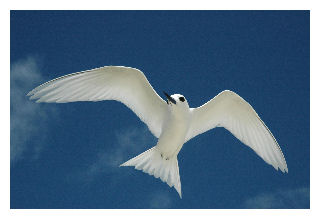
On some tropical islands, the fairy tern is known as the Holy Ghost bird
The fairy tern is a celestial vision: Its silky plumage pure white, its slender wings translucent, its large, black-rimmed eyes the deepest midnight blue. When one hovers above you, all innocent curiosity, you can easily understand why on some tropical islands it is called the Holy Ghost bird.
Fairy terns are small, robin-sized birds with long wings. They have no natural enemies, and generally they are gentle, tame and trusting. They live on remote tropical islands in the Pacific, Indian and South Atlantic Oceans, out-of-the-way spots some people equate with paradise. With their ethereal beauty, the dainty birds fit right in.
I watched them on Bird Island, northernmost of the Seychelle Islands in the Indian Ocean. This 62-acre coral-and-sand outpost set in a turquoise sea is aptly named: Upon it nest in serried ranks nearly a million sooty terns, as well as brown and lesser noddies and about a hundred pairs of fairy terns.
Eccentric breeders, fairy terns are also called love terns. Unlike sooty terns that lay their eggs with synchronous precision during two weeks in early June, they breed at any time of year, at least in the Seychelles. One pair near my cabin was gently amorous in May: The mates sat close together on a branch and alternately preened the fine feathers on each other's faces, the preenee uttering soft, buzzing chirps of pleasure.

It seems to me that the devil has been hitting Catholic homeschool families hard lately. I know of several families currently struggling with pending divorce. Of course, satan is always going to hit those doing the Lord's work the hardest. And we Catholic homeschoolers are doing no less than the Lord's work.NOVENA TO THE HOLY FAMILY
With that in mind, I hope that you all will join me in praying a novena for our Catholic homeschooling community, particularly our marriages.
Husbands, Love Your Wives! - 5 Actions That Say I Love You
"Husbands, love your wives, just as Christ loved the church and gave Himself up for her" (Ephesians 5:25).
How Do I Love You?
1. By Praying. Prayer is the most important thing a husband can do for his wife.
2. By Talking. Communication is very important between a husband and a wife. However, the timing of the talk is also important.
3. By Meeting Needs. Help your wife's needs. The important needs are as follows:
a. Time for God;
b. Time with other women;
c. Time out or in other words, a break
4. By Encouraging. Say something sincere to will make her feel good about herself.
5. By Going Out Together. The occasional date is very important to a happy marriage.
How to Really Love Your Husband?
Making it Real. Consider your husbands likes and preferences in little things as well as big.
Questions for Reflection:
1. Do I pray for my husband?
2. Do I show him respect?
3. Do I cook for my husband or for myself?
4. Do I do the things my husband asks me to do?
5. Does our time out together ever reflect my husband's interests?
6. Do I serve my husband cheerfully when he is sick?
7. Do I impose my standards of 'proper' behavior on my husband?
8. Do I resent my husband's time with his friends?
9. Is your home a place that both of you find physically pleasing?
As yourself each day? How is the lord calling me to show my love to my husband today?
"Outdo one another in showing honor and mutual affection' (Romans 12:10).
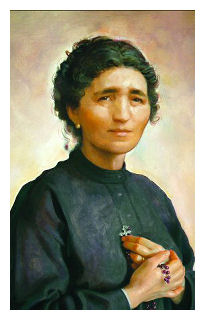
"The virtues of 'Mamma Rosa,' who died in 1932, were honored during the
beatification ceremony in Vicenza. 'She knew how to transform her
very large family into a school of holiness,' Vatican Radio said on the eve of
the ceremony.
"Priority loving in the family means loving your spouse first, your children second. The love of husband and wife is the wellspring of love for the entire family. Though our children's needs seem greater and more immediate, we must be careful not to allow their needs to consume the time and energy needed for our spouse. Besides, the greatest need of our children is to experience the love of their parents for each other. Often when my husband and I embrace, our young children try to wedge between us--not to break us apart but to feel the squeeze of love."
The Paradoxical Commandments were written by Kent M. Keith when he was 19, a sophomore at Harvard College. He wrote them as part of a book for student leaders entitled The Silent Revolution: Dynamic Leadership in the Student Council, published by Harvard Student Agencies in 1968. The Paradoxical Commandments subsequently spread all over the world, and have been used by millions of people.
Mother Teresa, or one of her co-workers, put the Paradoxical Commandments up on the wall of Mother Teresa's children's home in Calcutta. That fact was reported in a book compiled by Lucinda Vardey, Mother Teresa: A Simple Path, which was published in 1995. As a result, some people have attributed the Paradoxical Commandments to Mother Teresa.
As Kent explains in his book, Do It Anyway: The Handbook for Finding Personal Meaning and Deep Happiness in a Crazy World:
"I found out about it in September 1997 at my Rotary Club meeting. We usually begin each meeting with a prayer or a thought for the day, and a fellow Rotarian of mine got up and noted that Mother Teresa had died, and said that, in her memory, he wanted to read a poem she had written that was titled "Anyway." I bowed my head in contemplation, and was astonished to recognize what he read–it was eight of the original ten Paradoxical Commandments."
"I went up after the meeting and asked him where he got the poem. He said it was in a book about Mother Teresa, but he couldn't remember the title. So the next night I went to a bookstore and started looking through the shelf of books about the life and works of Mother Teresa. I found it, on the last page before the appendices in Mother Teresa: A Simple Path. The Paradoxical Commandments had been reformatted to look like a poem, and they had been retitled "Anyway." There was no author listed, but at the bottom of the page, it said: "From a sign on the wall of Shishu Bhavan, the children's home in Calcutta."
"Mother Teresa, or one of her coworkers, thought that the Paradoxical Commandments were important enough to put up on the wall at their children's home, to look at, day after day, as they ministered to the children. That really hit me. I wanted to laugh, and cry, and shout–and I was getting chills up and down my spine. Perhaps it hit me hard because I had a lot of respect for Mother Teresa, and perhaps because I knew something about children's homes. Whatever the reason, it had a huge impact on me. That was when I decided to speak and write about the Paradoxical Commandments again, thirty years after I first wrote them."

