
Note: in the 2007 Issue of Soul Magazine, Issue 3, I found the following with regard to the above painting:
"In the 1960's, the co-founders (Msgr. Colgan and John Haffert) were instrumental in viting Padre Pio to become the spiritual father of the Apostolate. They also commissioned Salvador Dali to paint the "Vision of Hell" which expresses his vision of Sister Lucia's description of what she saw at the 3rd. apparition by Our Lady..."The first time I realized that artist Salvador Dali was a devout Catholic was when my family and I visited the
World Apostolate of Fatima (formerly known as the Blue Army Shrine) in Washington, NJ. The above painting of Hell hangs at the Shrine.
...his old style, surrealism,dominates these[sic] portrayal of hell (the left side of the painting), while his newer style of "Religious Mysticism" is used on the right side of the painting in the portrayal of Our Lady of Fatima. A close look at Our Lady of Fatima shows that an experimental technique was used around the upper body of Our Lady. The paint has texture. It is interesting to note that Dali does not use his wife Gala as the subject for his portrayal of Mary, as he had in previous portrayals of Our Lady (The Madonna of Port Lligat (1949,1950)); however, in vision of hell Our Lady of Fatima does hold her hands open in a similar way as the Madonna of Port Lligat.
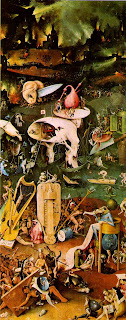 ...Dali, as well as other surrealist painters, were greatly influenced by the Dutch painter, Hieronymous Bosch (1450-1516). Vision of Hell actually copies a part of Hieronymous Bosch's Hell, portrayed in the right hand panel of the Garden of Earthly Delights (triptych). The burning buildings shown in the top left if Dali's painting closely resemble Bosch's burning building in hell, and, interestingly, Dali also picks up from Bosch's inferno the image of the tattered flag, as well as a rectangular structure from which emanate four rays of light...
...Salvador Dali often hides images and faces within his paintings, and many of his works are self-portraits. There are three places in this painting where it seems Dali is portraying himself. First, in the polymorphic body. Second, in a whimsical face which appears in a puff of smoke in the lower left center part of the painting. However, there is another face, hidden face, composed of an eye and a nose, that dominates the painting...
Source
hereCan you find the third self-portrait?

If you are interested in Dali's subject of hell, you may like to few his works depicting Dante's Inferno. You can find it
here
 Picture Source


