Feast Day August 9th
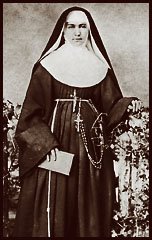
 Picture courtesy of The Vatican
Source: Second Exodus
The Early Years
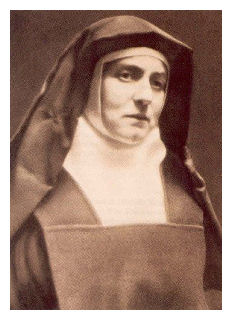
Edith Stein was born on October 12, 1891, Yom Kippur, of Orthodox Jewish parents. A brilliant Jewish girl, but at age 14 she suddenly stopped praying and dropped out of school, angry because an anti-Semitic teacher consistently refused to put her at the head of the class even though the entire class thought she had earned it. However, eager for education, she received private tutoring and was admitted to the University of Breslau, one of the very first women admitted to full matriculation at a major university, where she majored in psychology.
The Philosophy Years
In the summer of 1913, when she was nearly 22 years old, Edith was an atheist on the surface but a Jew deep in her heart. This is fairly common among young Jews when their faith is presented to them simply as ethical idealism. They see it as a philosophy rather than a faith, and find it appropriate to probe its defects. Edith took a neutral position on God and refused all religious practice. Instead, she began to look for intellectual principles more deeply rooted in truth than those of Judaism.
Edith Stein did not find these higher principles in psychology, so she switched to the University of Göttingen to study philosophy under Edmund Husserl. His “phenomenology” sought to make philosophy a hard science by resolving the conflict between empiricism (observation) and rationalism (reason and theory). Phenomenology highlights the origin of all philosophical and scientific systems and theoretical constructs in the experiential life. Soon Edith became Husserl’s most gifted student; and when she had brilliantly completed her studies with a doctorate summa cum laude, he took her on as his assistant and collaborator.
The Old Damascus Road
Christ calls to us in ways that fill our needs. Phenomenology led Edith Stein into a state of Voraussetzungslosigkeit, total impartiality, without which she would have been incapable of opening herself to thinking of God in terms of objective analysis. She set out to understand what should be her relationship with God. She began to weigh the three alternatives within her environment: Jewish, Protestant, and Catholic.
She tried to return to the Judaism of her parents, especially by reading the Old Testament prophets. After deep exploration, Edith decided that Judaism did not fill the need in her heart. But she never tried to refute it, as some Jews who have become complete in Christ do. She was always respectful. Her exploration of Protestant religion fit in with her preference for Bach’s Christian music. More important, the Christian response to grief for the atrocities of World War I and the strength of Christian hope born of the Cross of Christ deeply impressed her.
Edith had tried to reach Christ on a rational level, but He reached her heart. She had become close to Adolf and Anna Reinach, both Jewish converts to the Evangelical Church. Adolf enlisted early in World War I and was killed in 1917. Edith went to his home to help Anna arrange his scholarly papers. She had also come to console Anna. Anna, however, was serene; her deep Christian faith led her to see the Cross in Adolf’s death. Anna’s deep faith made a deep impression on Edith, and prepared her for what was to come. Relating this experience many years later to Father Hirschaum,a Jesuit, Edith told him, “This was my first meeting with the Cross, with the divine strength it brings to those who bear it. I saw for the first time within my reach the Church, born of the Redeemer’s sufferings in his victory over the sting of death. It was at that moment that my incredulity was shattered and the light of Christ shone forth, Christ in the mystery of the Cross.” However, this was preparation. Many Jews who find Christ, myself included, experience something like what Saul of Tarsus experienced on the road to Damascus, which breaks our attachment to our old way of thinking and prepares us for the conversion itself.
During the next three or four years Edith, again like many Jews attracted to Christ, entered a period of intense reflection. She read numerous books on Catholic spirituality. One day she bought a book on the Spiritual Exercises of St Ignatius. She began by getting involved in the Exercises at a purely psychological level, but after a few pages she found this impossible. She ended up doing the Spiritual Exercises as an atheist thirsting for God. The Exercises were Christ’s preparation for what was to follow. That came in June 1921. she went to Bergzabern, to the home of a friend, Hedwig Konrad Martius, a regular meeting place of Husserl former students. Edith discovered in the library The Book of the Life, the autobiography of the great Spanish mystic, St Teresa of Avila, who originated the Carmelite Reform that restored and emphasized the austerity and contemplative character of primitive Carmelite life. Edith, astonishlingly, finished the entire book in a single night. Closing it, she exclaimed, “This is the truth! Her Damascus transformation was complete; all became light for her.
The Path to Carmel
Edith was baptised on January 1st 1922 and at once began to consider becoming a Carmelite nun. She had always sought the most complete path; Carmel seemed the only way to satisfy her desire for totality. Thirty years old, full of energy and enthusiasm, her faith became an integral part of her life.
Mt. Carmel is in some mysterious way associated with Jews who become Catholic. The prophet Elijah had spent most of his life on Mt. Carmel. Elijah, the rabbis taught, would return to herald the arrival of the Messiah. Jesus told us Mt 11:14 “[John the Baptist] is Elijah who is to come.” Rev. Elias Friedman, a Jew who became a Catholic priest and founded the Association of Hebrew Catholics, was a Carmelite friar. Edith Stein, when she was baptized, received a vocation to Carmel.
Twelve years passed, however, before she entered the Carmel of Cologne. During that time she taught at the Institute for Scientific Pedagogy in Munster, gave lecture tours, studied, and above all matured interiorly. Here again, Christ’s ways are above ours. Edith may well have continued her brilliant academic career for the rest of her life, but the rising tide of anti-Semitic measures made it impossible for her to continue teaching. Edith became a Carmelite nun, taking the name of Sister Teresa Benedicta of the Cross. Her name, “of the Cross,” probably taken in honor of St. John of the Cross, was prophetic. The Germans discovered her Jewish origins. She was no longer safe behind monastery walls in Germany, so in the wee hours of New Year’s Day 1939 she was taken to Holland, to the Carmel of Echt. It seemed tranquil, but Edith sensed that she would not escape the destiny of her people.
The Final Journey
On Sunday July 26, 1942, a protest by the Catholic Bishops of Holland against the Nazi deportation of Dutch Jews was read at every Mass in all churches. It said, “In this we are following the path indicated by our Holy Father, the Pope.” Gestapo General-Commissar Schmidt announced, “We are compelled to regard the Catholic Jews as our worst enemies and consequently see to their deportation to the East with all possible speed.” One week later, the Gestapo arrested, deported, and sent to Auschwitz all Dutch Catholics of Jewish origin. At the Carmel of Echt, while she was writing her book on the doctrine of St John of the Cross, titled The Science of the Cross, two officials of the German occupation forces came to the monastery. She had to go with them, together with her sister Rose, also a convert, who had joined her in Echt. Edith and Rose Stein were deported to Auschwitz. On August 9th, 1942, St. Teresa Benedicta of the Cross, in a white house filled with Zyklon-B gas, went to heaven.
Pope John Paul II beatified Sr. Teresa Benedicta of the Cross on May 1, 1987 and canonized her on Oct. 11, 1998.
St. Teresa Benedicta, pray for us!
Copyright © 1999-2006 Martin K Barrack. All rights reserved.
by Cure' of Ars, St. John Mary Vianney and complied by Abbe' H. Convert
From the NAS (Nocturnal Adoration Society) Letter August 2006
We can tell when a soul has received the Sacrament of the Eucharist worthily. It is so flooded with love, so pervaded and changed, that we recognize it no longer in its words and actions. It is humble, gentle, mortified, charitable, and modest, and at peace with everyone. It is a soul capable of the greatest sacrifices; in fact, it is unrecognizable.
St. Magdalen of Pazzi tells us that it needs only one Communion, made with tender love and a very pure heart, to raise us to the highest perfection.
People who practise devotion, who confess and communicate often, and who neglect works of faith and charity, are like trees in blossom; you think there will be much fruit as flower - but there is a great difference.
The blessed Cure' contended with our Lord in generosity. Every morning he received the Body and Blood Christ, and in return sacrificed his whole self in union with the divine Savior. For the conversion of his parish he multiplied prayers, vigils, and scourgings, and led a life more and more austere. Insensible to so many mortifications, however, the people confided to his care indulged in dancing and frivolous pleasures with the same ardour, profaned the holy day of Sunday with the same obstinacy, and still frequented the public houses.
The holy Cure' thought he was thus unsuccessful because he had not offered enough penances to our Lord, and he exclaimed, distressed but resolute, "I will go on till I can do no more." It was then that he was found trying to live on the grass in his garden and during certain periods of the year taking a meal only once every two days. And what a meal! It consisted of a piece of dry bread and a single boiled potato which was often moldy.
The servant of God was no less lavish towards souls with his time and toil than with his fasts and penances. In contact with the God of the Eucharist who delivered himself up for our redemption, and who daily renews his sacrifice, St. John Vianney's zeal was kindled to such a point that he could say one day; "If the good God should give me my choice of going to heaven this very minute or staying on earth till the end of the world to work for the conversion of sinners, I would stay, and I would continue to get up at midnight."
Thank you Sue.
The First Saturday Devotion to the Immaculate Heart of Mary
The observance of the first Saturday in honor of the Immaculate Heart of Mary is intended to make reparation to it for the sins of mankind. This devotion was revealed by the Blessed Virgin to three children, Francisco, Jacinta and Lucia to whom she appeared at Fatima, Portugal, in 1917. On June 13, 1917, Our Lady specifically stated in speaking to Lucia: "Jesus wants to make use of you to make me known and loved. He wants to establish in the world devotion to my Immaculate Heart.
Our Lady repeated this in the July 13th apparition when, after the vision of Hell that was granted to the three children, she said: "You have seen Hell, where the souls of poor sinners go. To save them, God wishes to establish in the world devotion to my Immaculate Heart. If what I say to you is done, many souls will be saved and there will be peace." Our Lady asks for reparation. "There are so many souls whom the Justice of God condemns for sins committed against me, that I have come to ask reparation."
"O my Jesus, I offer this for love of Thee, for the conversion of sinners, and in reparation for the sins committed against the Immaculate Heart of Mary. (Sacrifice Prayer)
The following First Saturday devotions are efficacious in honoring the Immaculate Heart of Mary:
1. The Holy Sacrifice of the Mass
2. Adoration of the Blessed Sacrament
3. Act of Consecration to the Immaculate Heart of Mary
4. Act of Reparation
5. The Litany of the Blessed Virgin Mary
6. The Sacrament of Reconciliation
"I promise to help at the hour of death, with the graces needed for salvation, whoever on the First Saturday of five consecutive months shall:
1. Confess and Receive Holy Communion.
2. Recite five decades of the Holy Rosary.
3. Keep me company for fifteen minutes while meditating on the fifteen mysteries of the Rosary, with the intention of making reparation to me."
 Picture Courtesy of The Catholic Sun
While visiting a sick friend, I found a little pamphlet near the Chapel that contained the following beatitudes courtesy of Blessed Marianne Cope Sisters of St. Francis email: yesGodislove@juno.com
Picture Courtesy of The Catholic Sun
While visiting a sick friend, I found a little pamphlet near the Chapel that contained the following beatitudes courtesy of Blessed Marianne Cope Sisters of St. Francis email: yesGodislove@juno.com
CLICK HERE FOR WEBSITE
Blessed are the children of parents who...
1. Witness love for their spouse, their children, their neighbor, and the world.
2. Talk freely about the presence of God in the joys and sorrows of their lives.
3. Remind their children that they are loved by God and have been given gifts to serve others.
4. Lead their family in prayer.
5. Speak positively about priests, sisters, brothers, and deacons.
6. Participate in the lay ministries and activities of their parish and community.
7. Invite a deacon, brother, sister or priest to their home.
8. Encourage their children to consider priesthood and religious life, as well as marriage.
I visited a new blog today, Bonfires of the Vanities, and found these very interested questions posed by Fr. Martin Fox
"It would be appropriate, in my judgment, for the media to ask a lot tougher questions of these ladies and their movement:
* Is this only about women's ordination? Does that mean you aren't seeking any change in Church teaching on, say, divorce-and-remarriage, contraception, homosexual behavior, or other areas that are controversial?"
Click Fr. Fox's name above to read the rest.
Living in Hawaii and walking to church used to mean me attending daily Mass in shorts. When I knelt in front of the Blessed Sacrament and asked myself if Jesus would approve, I kind of figured the answer to that would be NO. As my dear mom would remind us, if we were going to see the President of the United States, we would make sure we were dressed in the very best of our clothing.
Bishop Yanta's Pastoral Letter on Modesty.
Feast Day: August 2nd
When I was in my teens, we belonged to a parish run by Franciscan Capuchin Friars. It was a tradition to celebrate this feast day by attending Mass at our parish church. We would also gain plenary indulgences for that day, for attending Mass at a Franciscan church, when accompanied by the other requirements such as praying for the intentions of our Holy Father and going to confession as soon as possible.
New Advent
"A town and parish situated about three-quarters of a mile from Assisi. The town, numbering about 2000 inhabitants and officially known as Santa Maria degli Angeli, has grown up around the church (basilica) of Our Lady of the Angels and the adjoining Franciscan monastery. It was here that on 24 Feb., 1208, St. Francis of Assisi recognized his vocation..."
To learn more about this feast day and the indulgences requirement, click above.
Hat tip to Sts. Peter and Paul Church for this one.
A man with a nagging secret couldn't keep it any longer. In the confessional he admitted that for years he had been stealing building supplies from the lumberyard where he worked.
"What did you take?" his priest asked.
"Enough to build my own house and enough for my son's house. And houses for our two daughters and our cottage at the lake."
"This is serious," the priest said. "I shall have to think of a far reaching penance. Have you ever done a retreat?"
"No, Father, I haven't," the man replied. "But if you can get the plans, I can get the lumber."
 Source: 2 Hearts Network
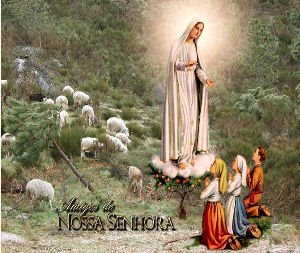
Picture: Unknown source: Portugese
1. THE DAILY ROSARY FOR PEACE:
“Pray the Rosary every day in honor of Our Lady of the Rosary to obtain peace in the world . . . for she alone can save it.” (Our Lady—July 13, 1917)
“God has placed peace in her hands, and it is from the Immaculate Heart that men must ask it." (Jacinta—shortly before her death)
“When you pray the Rosary, say after each mystery: ‘O Jesus, forgive us our sins, save us from the fires of hell, lead all souls to Heaven, especially those who have most need of your mercy.' " (June 13, 1917)
(Every Rosary increases Mary’s power to crush the head of the Serpent and to destroy his evil power in the world.)
2. DEVOTION TO THE IMMACULATE HEART OF MARY:
"Jesus wishes to establish devotion to my Immaculate Heart in the world. I promise salvation to those who embrace it." (June 13, 1917)
3. FIRST SATURDAY DEVOTIONS, which include:
reception of Holy Communion, and Confession (within 8 days before or after) pray five decades of the Rosary spend 15 minutes in meditation on the mysteries of the Rosary.
(All the above to be offered up in reparation for sins and ingratitude against the Immaculate Heart of Our Lady.)
4. OFFERING IN REPARATION THE SACRIFICES, TRIALS AND CROSSES OF LIFE
especially those sacrifices involved in keeping God’s Commandments, and in fulfilling the duties of one’s state in life — offering them through the Immaculate Heart of Mary in reparation to the Divine Majesty so offended by sin, and for the conversion of sinners.
“Sacrifice yourselves for sinners and say often whenever you make a sacrifice: ‘O Jesus, it is for love of You, for the conversion of sinners, and in reparation for the offenses committed against the Immaculate Heart of Mary.' " (Our Lady—July 13, 1917)
“Pray much and make sacrifices for sinners, for many souls go to hell because there is no one to make sacrifices for them." (Our Lady—August 19, 1917)
5. CONSECRATION TO THE IMMACULATE HEART OF MARY. Any formula may be used which expresses a sincere confiding of oneself without reserve.
Are We Actually Doing What She Requests?
1. Are you offering up your daily tasks as a sacrifice in reparation?
2. Are you praying the Rosary daily?
3. Are you wearing the Brown Scapular as a sign of personal consecration--and making acts of consecration to the Immaculate Heart of Mary?
4. Are you fulfilling Our Lady's First Saturday's Communion request?
5. Are you making frequent visits to church--adoring Our Lord in the Blessed Sacrament? Mass--Communion?
6. Are you making a Holy Hour at least once a week in reparation for the sins of the world and for the conversion of sinners?
 Today our family got up for early Mass again. No big enthusiasm on our part. We won't admit it but we were all probably looking forward to going back to sleep when we got home.
What we didn't expect was to hear the homily given by a visiting priest today. Father looks like a kindly priest, whose age is hard to gauge. Although I don't recall the beginning of his homily, I do remember listening a little closer when he started talking about how we don't appreciate the Eucharist or the celebration of Mass like we should. He started talking about some people who went to Saturday evening Mass just to get it over with. He also mentioned those of us who come to Mass late or leave early just to beat the parking crowd.
The Saturday evening mass reference made me squirm in my seat. There have been many times when we did just that.
He went on about how we just don't make time for Christ. That some of us will attend Mass if it fits into our schedule.
Listening to Father really made me ashamed of myself. Oh no, we are never late for mass nor do we leave early but do we...rather, do I really appreciate what the Mass is? Probably not. If I did, I would look forward to it with all my heart and soul. Instead I find myself yawning or thinking about what to make for dinner.
Thankfully, I do realize the sacredness of the Consecration so I do pay full attention then.
Anyway, Father finished the homily by telling us a little story of a Maryknoll priest who had to travel two days by mule with a companion, in order to get to a little town in Mexico. When they arrived they found a little house with swept floors and nothing else. The floors had been swept clean by the villagers in preparation of their arrival.
They were greeted enthusiastically by all the people of the village. And one of them told the priest that their prayers had been answered with his arrival. The priest asked him how many months they had prayed for a priest to be send to their village. "Months Father?" responded one of them. "We have been praying for thirty years!".
Father went on to tell us how reverently these humble people attended Mass with such love and awe.
One day the priest found a list of women's names on a paper on the church door. One of the women explained to him that all the women had signed up for turns to keep our Lord company in adoration. They would never let Him be alone. They would do this in so that they would not ever lose the gift of having a priest there.
That is faith!
 Picture courtesy of The Vatican