Showing posts with label Edith Stein. Show all posts

Friday, August 09, 2013

Edith on the Way of Perfection

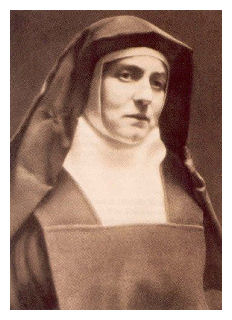
St. Teresa Benedicta of the Cross

Picture source, click here for more photos

I wanted to share with you the following notes from the translator of Edith Stein's autobiography.

Edith Stein, Sister Teresa Benedicta of the Cross, has a singularly interesting qualification for joining the four best known Discalced Carmelites:  Teresa of Jesus, John of the Cross, Therese of the Child Jesus, and Elizabeth of the Trinity.  Each of the five, as a child, lost one parent; in each of the five families, the surviving parent was both loving and influential.

Teresa de Ahumada was thirteen-years old and Therese Martin was four when they lost the loving care of a mother; for both of them, the experience of a father's solicitous care, and a surrogate mothering by an older sister offset the suffering that usually attends a mother's early death.

Juan de Yepes was an infant when his father died; Captain Catez, father of Elizabeth, died when she was about seven; Edith, a toddler not quite two years old, called her father back for an affectionate farewell embrace the day he succumbed to a heat stroke.

...did their childhood experience make these five more attentive to a call from God?...Was there a quality to the relationship with the living parent that predisposed these women, and the young man, for Carmel?
Interesting questions.

Source:  Edith Stein: Life in a Jewish Family 1891-1916, An Autobiography, Translation by Josephine Koeppel, O.C.D.

Tuesday, August 21, 2012

Thursday, August 09, 2012

Saint Teresa Benedicta of the Cross

Postulant Edith Stein
It was the custom for a postulant to wear a wedding gown.  Later the white silk was reworked into a vestment.

Perpetual profession document in Edith Stein's own handwriting
It was the custom in Carmel to place this document in the coffins of the deceased nuns.  However, Edith Stein's document was preserved.

"I am confident that the Lord has accepted my life for everyone.  I am reminded repeatedly of Queen Esther who was taken from her people precisely to stand before the king for the people.  I am a very poor and powerless Esther, but the King who has chosen me is eternally great and compassionate." - Sister Teresa Benedicta of the Cross

Source Edith Stein: Her Life in Photos and Documents by Maria Amata Neyer, O.C.D.

Tuesday, August 09, 2011

The Death of Two Saints


Picture source

Today is the feast of Saint Teresa Benedicta of the Cross, formerly Edith Stein, a Jewish convert. This Sunday  is the feast of another martyr who died at the hands of the Nazis, St. Maximilian Kolbe, formerly Raymond Kolbe.

Picture source

One saint's search for the truth led her from the life of a secular Jew, to atheist to Catholic nun and finally to being canonized a saint.

The other saint knew the truth from a very early age. In fact in a vision, when the Immaculata presented him with the choice of either virgin or martyr, chose both.

Picture source

These two saints loved God and His most holy mother with their whole hearts, especially St. Maximilian Kolbe. His love for the Immaculata is still evident today with the many members of the Militia Immaculata.


Picture source

Edith Stein was an intellectual. She was a philosopher who could call many famous intellectuals in Germany, friends. It was her love of philosophy that ultimately lead her home to the true Church.


It is very tragic that this nun and priest had to have their lives taken so cruelly and maliciously and so prematurely by evil men.


The following document is from the Netherlands Red Cross.

BUREAU OF INFORMATION OF THE NETHERLANDS RED CROSS
9 Jan Everts Street, 's-Gravenhage, 2 June 1958
Settlement Bureaur for Jewish Affairs
Dossier Nol 108796
Your Letter of May 16, 1958

Certification

The undersigned, Chief of the Settlement Bureau for Jewish Affairs of the Netherlands Red Cross Bureau of Information confirms hereby that according to the papers kept in our archives

Edith Teresa Hedwig Stein

Born on: October 12, 1891 in: Breslau
Last Residence: Monastery of the Carmelite Nuns,
Bovenstrestraat 48, Echt (Holland)
For Reasons of Race, and specifically because of Jewish Descent
on 2 August, 1942, arrested in Echt, via K.L. (Concentration Camp)
Amersfoort (Holland)
On 5 August, 1942, handed over in KI.L. Westerbork and
on 7 August, 1942 deported from K.L. Westerbork to K.L. Auschwitz,
The, above named person is to be considered as having died on 9 August, 1942* in Auschwitz.

Notice to this effect is given on 15 February, 1950 in Echt
...(conditions are given regarding legal procedures)...
(Signed, official seal applied by Chief of the Bureau)

*For official purposes this date of death was established as deduced from various available facts. Individual statements regarding the exact time of death are not available.

Source: Edith Stein: Life in a Jewish Family 1891-1916, An Autobiography

"Thus two weeks passed..." (fellow Pole Bruno Borgowiec's personal testimony.)..."Meanwhile, the prisoners died one after the other, so much so that at the end of the third week only four remained, among whom was Father Kolbe. To the authorities it seemed that they lived on too long. The cell was needed for other victims.

For this reason, on August 14, the criminal Bloch, a German and the director of the hall of the sick, was brought in. He gave everyone an injection of poisonous acid in the left arm. With a prayer on his lips, Father Kolbe held out his arm to the killer. Being unable to stand what my eyes beheld, under the pretext of having to work in the office, I went away.

After the guard and the executioner left, I returned to the cell, where I found Father Maximilian Kolbe sitting down, leaning against the wall, with eyes opened and his head bent to the left side. (It was his usual position.) His serene face was beautifully radiant.

Together with the barber of the block, Mr. Chelbik from Karwina, I took the body of the hero to the bath. Here it was placed in a box and taken to the mortuary cell of the prison.

Thus died the priest, the hero of the camp of Auschwitz, offering himself voluntarily for the father of a family, quiet and tranquil, praying until the last moment.

Source: Saint Maximilian Kolbe: Apostle of Our Difficutl Age, Antonio Ricciardi, OFM Conv.

Father Kolbe died on the vigil of the Feast of the Assumption of Mary into Heaven. How appropriate!

Wednesday, August 11, 2010

Monday, August 09, 2010

St. Theresa Benedicta of the Cross - Photos of the Life of Edith Stein

The following information is from Edith Stein: Her Life in Photos and Documents by Maria Amata Neyer, O.C.D., Translated by Waltruat Stein, Ph.D.


This photo of little Edith Stein is a detail of the following family portrait.

The family portrait was taken around 1894. However, this photo was taken after the death of Mr. Stein, Edith's father. "After the sudden death of the father, the family members were sorry that they had no family portrait, and so they had a passport photo of the deceased father inserted into the picture."

"Frau Auguste Stein used to divide her family into three groups: the boys, the girls and the 'children'. The last were the 'afterthoughts'Erna and Edith. The two sisters were bound in a special friendship throughout life.

Edith's most difficult time was during the winter semester of 1913-1914. She wanted to dedicate herself to working on her doctoral dissertation with the theme On the Problem of Empathy. But it was not meant to be. "I gradually worked myself into real despair...I could no longer cross the street without wishing that a car would run over me...and I would not come out alive..."

"In the Cadet Academy of Monavian Weisskirchen, which was converted to a typhoid military hospital, there lay thousands of very ill soldiers. Auguste Stein [Edith's mother] tried to forbid Edith to go there. 'You will not go with my consent!' 'Then I must do so without your consent,' retorted Edith. The nursing staff in Moravian Weisskirchen occasionally put on a party. It was harmless, but Edith Stein 'Nurse Edith' was uncomfortable. 'I thought about my patients,' she writes, and adds that she was also not used to cigarettes and strong coffee."


While a student teacher at St. Magdalene in Speyer.


"At a lecture on St. Elizabeth of Thuringia on May 30, 1931, in St. Elizabeth's jubilee year, Edith Stein spoke elven times at celebrations of the Saint's seven hundredth anniversary. It was important to her to instill great examples of the Christian life into the hearts of her audience.


Edith Stein at 40 years of age in 1931.


"After the violence of the government's Kristallnacht, Edith Stein decided to emigrate to a foreign Carmel.  Her plan of going to a monastery in the Holy Land fell through.  So she chose Echt in Holland.  Edith Stein needed a photo for her passport. This picture was taken on the threshold of the open door of the enclosure.  On the whitewashed wall of the convent passage, one can very faintly recognize the cross handing there that can be seen over the head of St. Benedicta of the Cross."
Chronology of Events and Dates in the Life of Edith Stein

1891 October 12: Born as a Jew in Breslau

1911 High school diploma with honors

1911-1913 Studies in Breslau: German, history, psychology and philosophy

1913-1915 Studies in Göttingen: philosophy (Husserl), German, history.

1915 Staatsexamen (course exam) in Göttingen with honors.

1916 Assistant instructor in Breslau

1916-1918 Research assistant to Edmund Husserl in Freiburg.

1919-1923 Private scholarly work; fruitless attempts to qualify as a university lecturer.

1921 Reading of the Life of St. Teresa of Avila in the Conrad-Martius house in Bergzabern/Pfalz; conversion decision.

1922 January 1: Baptism and first Holy Communion in the parish church of St. Martin in Bergzabern.
February 2: Confirmation in the private chapel of the bishop of Speyer.

1923-1931 Teacher at St. Magdalene's, the Dominican girls' school and education school in Speyer.

1932-1933 Instructor at the German Institute for Scientific Pedagogy in Münster.

1933 October 14: Entrance into the Carmel in Cologne.

1934 April 15: Clothing as Sister Teresia Benedicta a Cruce.

1935 April 21: Taking of First Vows. Profession for three years.

1938 April 21: Perpetual vows.
May 1: So-called veiling celebration.
December 31: Emigration to Echt, Holland

1934-1942 Production of her most important works, Finite and Eternal Being and Science of the Cross, and also many shorter works.

1942 August 2: Arrest and transport to Amersfoort.
August 4: Continuation from Amersfoort to Camp Westerbork.
August 9: Arrival in Auschwitz, murder in Birkenau.

1962 January 4: Initiation of the ecclesiastical process for the beatification of Edith Stein by the Archbishop of Cologne, Cardinal Josef Frings.
July 25: Initiation of the examination of the writings of Edith Stein.

1971 July 7: Celebration of the conclusion of the examination of writings in Cologne.
March 7: Initiation of the third part of the process: "De-non-cultu."

1972 August 9: Conclusion of the entire diocesan process by Cardinal Höffner in a celebration at the Cologne Carmel of the thirtieth anniversary of Edith Stein's death; in conjunction with this, the transfer of all the documents to Rome.

1987 May 1: Beatification of Edith Stein by Pope John Paul II in Cologne.

1988 October 11: Canonization by Pope John Paul II at St. Peter's in Rome.
Tuesday, August 08, 2006

Wednesday Feast Day of St. Teresa Benedicta of the Cross

Feast Day August 9th
Picture courtesy of The Vatican

Source:
Second Exodus

The Early Years


Edith Stein was born on October 12, 1891, Yom Kippur, of Orthodox Jewish parents. A brilliant Jewish girl, but at age 14 she suddenly stopped praying and dropped out of school, angry because an anti-Semitic teacher consistently refused to put her at the head of the class even though the entire class thought she had earned it. However, eager for education, she received private tutoring and was admitted to the University of Breslau, one of the very first women admitted to full matriculation at a major university, where she majored in psychology.

The Philosophy Years

In the summer of 1913, when she was nearly 22 years old, Edith was an atheist on the surface but a Jew deep in her heart. This is fairly common among young Jews when their faith is presented to them simply as ethical idealism. They see it as a philosophy rather than a faith, and find it appropriate to probe its defects. Edith took a neutral position on God and refused all religious practice. Instead, she began to look for intellectual principles more deeply rooted in truth than those of Judaism.

Edith Stein did not find these higher principles in psychology, so she switched to the University of Göttingen to study philosophy under Edmund Husserl. His “phenomenology” sought to make philosophy a hard science by resolving the conflict between empiricism (observation) and rationalism (reason and theory). Phenomenology highlights the origin of all philosophical and scientific systems and theoretical constructs in the experiential life. Soon Edith became Husserl’s most gifted student; and when she had brilliantly completed her studies with a doctorate summa cum laude, he took her on as his assistant and collaborator.

The Old Damascus Road

Christ calls to us in ways that fill our needs. Phenomenology led Edith Stein into a state of Voraussetzungslosigkeit, total impartiality, without which she would have been incapable of opening herself to thinking of God in terms of objective analysis. She set out to understand what should be her relationship with God. She began to weigh the three alternatives within her environment: Jewish, Protestant, and Catholic.

She tried to return to the Judaism of her parents, especially by reading the Old Testament prophets. After deep exploration, Edith decided that Judaism did not fill the need in her heart. But she never tried to refute it, as some Jews who have become complete in Christ do. She was always respectful. Her exploration of Protestant religion fit in with her preference for Bach’s Christian music. More important, the Christian response to grief for the atrocities of World War I and the strength of Christian hope born of the Cross of Christ deeply impressed her.

Edith had tried to reach Christ on a rational level, but He reached her heart. She had become close to Adolf and Anna Reinach, both Jewish converts to the Evangelical Church. Adolf enlisted early in World War I and was killed in 1917. Edith went to his home to help Anna arrange his scholarly papers. She had also come to console Anna. Anna, however, was serene; her deep Christian faith led her to see the Cross in Adolf’s death. Anna’s deep faith made a deep impression on Edith, and prepared her for what was to come. Relating this experience many years later to Father Hirschaum,a Jesuit, Edith told him, “This was my first meeting with the Cross, with the divine strength it brings to those who bear it. I saw for the first time within my reach the Church, born of the Redeemer’s sufferings in his victory over the sting of death. It was at that moment that my incredulity was shattered and the light of Christ shone forth, Christ in the mystery of the Cross.” However, this was preparation. Many Jews who find Christ, myself included, experience something like what Saul of Tarsus experienced on the road to Damascus, which breaks our attachment to our old way of thinking and prepares us for the conversion itself.

During the next three or four years Edith, again like many Jews attracted to Christ, entered a period of intense reflection. She read numerous books on Catholic spirituality. One day she bought a book on the Spiritual Exercises of St Ignatius. She began by getting involved in the Exercises at a purely psychological level, but after a few pages she found this impossible. She ended up doing the Spiritual Exercises as an atheist thirsting for God. The Exercises were Christ’s preparation for what was to follow. That came in June 1921. she went to Bergzabern, to the home of a friend, Hedwig Konrad Martius, a regular meeting place of Husserl former students. Edith discovered in the library The Book of the Life, the autobiography of the great Spanish mystic, St Teresa of Avila, who originated the Carmelite Reform that restored and emphasized the austerity and contemplative character of primitive Carmelite life. Edith, astonishlingly, finished the entire book in a single night. Closing it, she exclaimed, “This is the truth! Her Damascus transformation was complete; all became light for her.

The Path to Carmel
Edith was baptised on January 1st 1922 and at once began to consider becoming a Carmelite nun. She had always sought the most complete path; Carmel seemed the only way to satisfy her desire for totality. Thirty years old, full of energy and enthusiasm, her faith became an integral part of her life.

Mt. Carmel is in some mysterious way associated with Jews who become Catholic. The prophet Elijah had spent most of his life on Mt. Carmel. Elijah, the rabbis taught, would return to herald the arrival of the Messiah. Jesus told us Mt 11:14 “[John the Baptist] is Elijah who is to come.” Rev. Elias Friedman, a Jew who became a Catholic priest and founded the Association of Hebrew Catholics, was a Carmelite friar. Edith Stein, when she was baptized, received a vocation to Carmel.

Twelve years passed, however, before she entered the Carmel of Cologne. During that time she taught at the Institute for Scientific Pedagogy in Munster, gave lecture tours, studied, and above all matured interiorly. Here again, Christ’s ways are above ours. Edith may well have continued her brilliant academic career for the rest of her life, but the rising tide of anti-Semitic measures made it impossible for her to continue teaching. Edith became a Carmelite nun, taking the name of Sister Teresa Benedicta of the Cross. Her name, “of the Cross,” probably taken in honor of St. John of the Cross, was prophetic. The Germans discovered her Jewish origins. She was no longer safe behind monastery walls in Germany, so in the wee hours of New Year’s Day 1939 she was taken to Holland, to the Carmel of Echt. It seemed tranquil, but Edith sensed that she would not escape the destiny of her people.

The Final Journey

On Sunday July 26, 1942, a protest by the Catholic Bishops of Holland against the Nazi deportation of Dutch Jews was read at every Mass in all churches. It said, “In this we are following the path indicated by our Holy Father, the Pope.” Gestapo General-Commissar Schmidt announced, “We are compelled to regard the Catholic Jews as our worst enemies and consequently see to their deportation to the East with all possible speed.” One week later, the Gestapo arrested, deported, and sent to Auschwitz all Dutch Catholics of Jewish origin. At the Carmel of Echt, while she was writing her book on the doctrine of St John of the Cross, titled The Science of the Cross, two officials of the German occupation forces came to the monastery. She had to go with them, together with her sister Rose, also a convert, who had joined her in Echt. Edith and Rose Stein were deported to Auschwitz. On August 9th, 1942, St. Teresa Benedicta of the Cross, in a white house filled with Zyklon-B gas, went to heaven.

Pope John Paul II beatified Sr. Teresa Benedicta of the Cross on May 1, 1987 and canonized her on Oct. 11, 1998.

St. Teresa Benedicta, pray for us!

Copyright © 1999-2006 Martin K Barrack. All rights reserved.