Joey and I attended the first day of the conference today.
Boy, were we glad we went! It was just the first day but what an opening! First of all, it's being held at the Hawaii Convention Center in the Waikiki area. Lucky for us, it's within walking distance and walk we did.
We had never been to the convention center before. My dh has often referred to it as the Big White Elephant but it is a beautiful building inside.
We took a very long escalator to the top and we had the feeling of going up to Heaven. This was probably because we knew that Jesus was up there!
We had lots of time to kill so we started exploring the bookstore. I saw some friends and spend time with them while doing a little shopping. All of a sudden I see a familiar face, a young priest. I pulled Joey to the other side of the room and I introduced ourselves to Fr. Donald Calloway. For those of you not familiar with him. He is a priest with quite a story to tell of his youth filled with sex, drugs and rock and roll before Divine Mercy intervened. He is now a priest with the Marians of the Immaculate Conception. We chatted a few minutes and I took a picture of Joey and Father Calloway. We are really looking forward to his talk tomorrow.
So the conference began with the Angelus, the recitation of the Holy Rosary in honor of our Blessed Mother's birthday, and the Divine Mercy Chaplet. A local recording artist sang On this Day O Beautiful Mother and Ave Maria while the Knights of Columbus led the procession of the banners of the different Catholic groups and pilgrims.
Then we had the privilege of hearing Dr. Bryan Thatcher, the head of EADM give a very moving speech on God's Divine Mercy.
I will try to post more tomorrow, and maybe some pictures, after the conference
Friday, September 08, 2006


HAPPY BIRTHDAY DEAR BLESSED MOTHER
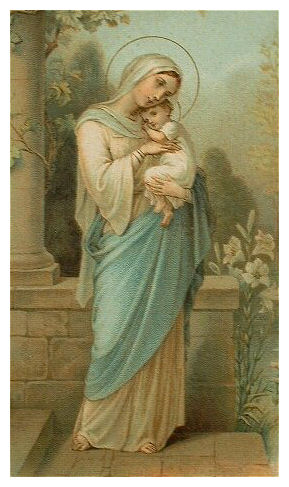
Photo Source: Internet
The Spiritual Tradition Regarding Mary's Birth
Sacred Scripture does not record Mary's birth. The earliest known writing regarding Mary's birth is found in the Protoevangelium of James (5:2), which is an apocryphal writing from the late 2nd century. What matters is not the historicity of the account, but the significance of Mary's and of every person's birth. In Mary's case, the early Church grew more and more interested in the circumstances surrounding the origin of Christ. Discussion about Mary throws light on the discussion about the identity of Jesus Christ.
The Church usually celebrates the passing of a person, that is, the person's entry into eternal life. Besides the birth of Christ, the Christian liturgy celebrates only two other birthdays: that of St. John the Baptizer and of Mary, the Mother of Jesus. It is not the individual greatness of these saints that the Church celebrates, but their role in salvation history, a role directly connected to the Redeemer's own coming into the world.
Mary's birth lies at the confluence of the two Testaments--bringing to an end the stage of expectation and the promises and inaugurating the new times of grace and salvation in Jesus Christ. Mary, the Daughter of Zion and ideal personification of Israel, is the last and most worthy representative of the People of the Old Covenant but at the same time she is "the hope and the dawn of the whole world." With her, the elevated Daughter of Zion, after a long expectation of the promises, the times are fulfilled and a new economy is established. (Lumen Gentium 55)
The birth of Mary is ordained in particular toward her mission as Mother of the Savior. Her existence is indissolubly connected with that of Christ: it partakes of a unique plan of predestination and grace. God's mysterious plan regarding the Incarnation of the Word embraces also the Virgin who is His Mother. In this way, the Birth of Mary is inserted at the very heart of the History of Salvation. (M. Valentini, Dictionary of Mary, pp. 36-7.)
Refrain:
On this day, O Beautiful Mother!
On this day we give thee our love;
Near thee, Madonna, fondly we hover,
trusting thy gentle care to prove.
On this day we ask to share, dearest Mother,
thy sweet care;
Aid us e'er, our feet astray, wandering from
thy guiding way.
Queen of Angels, deign to hear, thy dear
children's humble pray'r;
Young hearts gain, O Virgin pure, sweetly
to thyself allure.

Thursday, September 07, 2006
Back to School Prayer
Mahalo to my friend Easter for sharing this with us.
Back to School
Praise you, Lord, for the blessing of learning.
—Catholic Prayers for Every Day and All Day
Christ’s love and our faith in that love should pervade everything we do—work, study, play.
-St. John Bosco
PRAYER
We pray for all students
That they may learn and study
With Christ’s wisdom and understanding
And use all knowlege to make this world
A better place to live.
We pray for all parents and teachers
That they may bring to the children
The love of God first
Then love for God next.
With Christ as the anchor of learning
We shall prevail
And achieve that which Christ
Has planned for each child He brings
To this world.
We pray with Mary,
In her Son’s name, Jesus,
Amen!
-Easter A.
Back to School
Praise you, Lord, for the blessing of learning.
—Catholic Prayers for Every Day and All Day
Christ’s love and our faith in that love should pervade everything we do—work, study, play.
-St. John Bosco
PRAYER
We pray for all students
That they may learn and study
With Christ’s wisdom and understanding
And use all knowlege to make this world
A better place to live.
We pray for all parents and teachers
That they may bring to the children
The love of God first
Then love for God next.
With Christ as the anchor of learning
We shall prevail
And achieve that which Christ
Has planned for each child He brings
To this world.
We pray with Mary,
In her Son’s name, Jesus,
Amen!
-Easter A.
Monday, September 04, 2006
A Gift for our Blessed Mother on Her Birthday - September 8th
Mahalo Sue for this one too!
Friday 8th September is the feast of the Birthday of the Blessed Virgin Mary.
As a Gift for Our Lady on this special day, please join with people from all over the world in a day of prayer and fasting for an end to abortion.
Fasting does not necessarily have to be just bread and water. It can be a day of abstinence from sweets, meat, TV, gossip or anything that you have to make an effort or sacrifice in order to do without.
As regards prayer, this can be as simple as 3 Hail Mary's on the day but of course the rosary and Eucharistic Adoration have a special place in Our Lady's heart not to mention the greatest prayer of all, the mass. And yet a moment of personal prayer joined to the prayers of so many will help to change hearts and make this a special day for Our Lady and will most certainly help in the battle against abortion.
Nothing needs to be done except to inform others to take part in this special birthday gift for our Mother who is incessantly praying for us.
May God Bless all your efforts and all your work for the protection of life. Please forward this far and wide.
Stuart McGovern
stumcgov@hotmail.com
Dublin
Sunday, September 03, 2006
Eucharistic Quote by St. Augustine

Holy card courtesy of Aci Prensa
"Christ held Himself in His hands when He gave His Body to His disciples saying: 'This is My Body.' No one partakes of this Flesh before he has adored it."
- St. Augustine
Saturday, September 02, 2006
Picasso in the Vatican?
By Elizabeth Lev
ROME, AUG. 31, 2006 (Zenit.org).- This summer, Francesco Buranelli, director of the Vatican Museums, was interviewed by the Italian newspaper La Stampa, revealing his ambition to add a Picasso to the Vatican collection.
This struck me as somewhat strange. While Picasso was undeniably a great artist, why would the Vatican Museums want to display the work of a man who undermined the Christian message for seventy years?
Of course from a purely technical angle, Buranelli's aspiration makes good sense. What museum director, after all, wouldn't want a work by the most celebrated name in 20th century art?
But perhaps I am missing something. After all, there are so many styles and periods in Picasso's work, maybe one would indeed complement the art collection of the Catholic Church?
So I did a little research and compiled a short list of possible contenders for a place alongside Michelangelo, Raphael and other great Christian artists represented in the Vatican Museums.
"The Crucifixion"
This would be perhaps the most obvious choice, as this is the only religiously themed work by Picasso from 1897, until his death in 1973.
Pablo Picasso was born in 1881 into a Spanish Catholic family. He rejected his Catholic upbringing in his early 20s, mostly because he saw religious morals as an obstacle to the burgeoning sexual freedom of his age.
More prodigious than prodigal, Picasso never publicly returned to the church, although a priest was present at the artist's funeral.
Picasso sidelined Christ in the painting the way he had sidelined him in his own life. Picasso's "Crucifixion" features a small Christ at the top center. The crucified Jesus seems overwhelmed by what appears to be weeping women superimposed on him.
It is difficult to tell friend from foe in the work, and the clearest image of all is the soldier playing dice in the lower left.
Done in crayon colors, the painting seems more like a self-pitying tribute to Picasso's personal troubles (his wife and mistress were not getting along) than any real exploration of the meaning of Christ's suffering.
"Man with Sheep"
This bronze sculpture, representing a man holding a sheep, was created in 1944 at the end of World War II. This piece could be displayed next to "The Good Shepherd" statue in the Pio Christian Museum.
Viewers could contrast the youthful gentle face of the good shepherd, one of the earliest Christian symbols for Jesus, next to Picasso's stark, distorted man with the bulging eyes and fierce expression.
In the Christian version of the subject, a tranquil lamb curls gently around the shepherd's shoulders, but in the modern vision, although the shepherd clasps the sheep in one arm like an infant, the animal twists its head away, open-mouthed and protesting. Unlike the good shepherd, the savior who has found a lost sheep, Picasso's figure seems like a butcher bringing a lamb to the slaughter.
Picasso sculpted this work at the same time he joined the Communist party, so the distortion of one of the oldest symbols of man's salvation makes an apt metaphor for the artist's new ideology.
"The Demoiselles of Avignon"
This work, painted in 1904, of course refers to Avignon, home of the Papacy for over 70 years in the 14th century, so it bears a nice papal point of reference.
The painting has all the hallmarks of a masterpiece; employing the techniques of the old masters, Picasso made 106 preparatory sketches for it, which resulted in an innovative, gripping effect.
Unlike Michelangelo's Mary in the Pieta, who renders the sublime beauty of God's grace and her exemplary obedience to divine will, Picasso's five female figures are imbued with a very different kind of "feminine genius." The demoiselles pose, strut and squat in a brothel.
Like Renaissance artists, Picasso explored the sacred in this work, except his "holy" inspiration was drawn from the tribal African masks. Speaking of the "Demoiselles," the Spanish painter said that the African masks "were intercessors … against everything," adding that the painting was his "first canvas of exorcism!"
True, this work is a watershed in the history of art and most curators would allow themselves to be contorted into one of Picasso's misshapen figures to own it, furthermore, they would be completely justified given the nature and function of their secular museums.
The Vatican Museums, however, were not intended to be just another general exhibition in the history of art.
Michelangelo and Bernini and Fra Angelico created works that incite devotion, glorify God and stir viewers to transcend themselves. Secular museums do not have to reckon with two thousand years of propagating the Christian message.
My real question became: What do these works have to offer to the Christian audience looking for signs of God's sublime presence in our troubled modern times?
One of Picasso's early works might offer a solution to the selection dilemma.
"Science and Charity" was painted in 1897 by a 17-year-old Picasso.
This academic painting shows a woman on her deathbed, a doctor on her right and a nun on her left. The doctor looks away from the patient as he takes her pulse and goes about his science. The religious sister holds the woman's soon-to-be-orphaned child, proffering a glass toward the woman offering comfort.
Both the nun and the doctor wear the same colors of black and white, and appear as two sides of a scale. But the balance is tipped slightly toward the sister as the light shines on her while the doctor is cast in shadow. At the moment of death his science is useless, but the charitable care of the sister can offer solace.
Given that Picasso was to reject religion and embrace science as his guide -- from optics in cubism to psychology in his surrealist phase -- if nothing else, this painting would serve as a reminder of how God's gifts of talent, vision and genius can be used for both good and ill.
Is there a place in the history of art for Pablo Picasso? Most assuredly. I doubt very much, however, that it is in the Vatican Museums.
Elizabeth Lev teaches Christian art and architecture at Duquesne University's Italian campus. She can be reached at lizlev@zenit.org.
ZE06083129


Friday, September 01, 2006
First Saturday Reminder
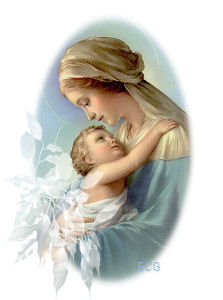
The First Saturday Devotion to the
Immaculate Heart of Mary
The observance of the first Saturday in honor of the Immaculate Heart of Mary is intended to make reparation to it for the sins of mankind. This devotion was revealed by the Blessed Virgin to three children, Francisco, Jacinta and Lucia to whom she appeared at Fatima, Portugal, in 1917. On June 13, 1917, Our Lady specifically stated in speaking to Lucia: "Jesus wants to make use of you to make me known and loved. He wants to establish in the world devotion to my Immaculate Heart.
Our Lady repeated this in the July 13th apparition when, after the vision of Hell that was granted to the three children, she said: "You have seen Hell, where the souls of poor sinners go.
To save them, God wishes to establish in the world devotion to my Immaculate Heart. If what I say to you is done, many souls will be saved and there will be peace." Our Lady asks for reparation. "There are so many souls whom the Justice of God condemns for sins committed against me, that I have come to ask reparation."
"O my Jesus, I offer this for love of Thee, for the conversion of sinners, and in reparation for the sins committed against the Immaculate Heart of Mary. (Sacrifice Prayer)
The following First Saturday devotions are efficacious in honoring the Immaculate Heart of Mary:
1. The Holy Sacrifice of the Mass
2. Adoration of the Blessed Sacrament
3. Act of Consecration to the Immaculate Heart of Mary
4. Act of Reparation
5. The Litany of the Blessed Virgin Mary
6. The Sacrament of Reconciliation
"I promise to help at the hour of death, with the graces needed for salvation, whoever on the First Saturday of five consecutive months shall:
1. Confess and Receive Holy Communion.
2. Recite five decades of the Holy Rosary.
3. Keep me company for fifteen minutes while meditating on the fifteen mysteries of the Rosary, with the intention of making reparation to me."
5 Non-Negotiable Issues for Catholic Voters
Hat tip to SUNNY for providing me with this list.
These five current issues concern actions that are intrinsically evil and must never be promoted by the law. Intrinsically evil actions are those which fundamentally conflict with the moral law and can never be deliberately performed under any circumstances. It is a serious sin to deliberately endorse or promote any of these actions, and no candidate who really wants to advance the common good will support any action contrary to the non-negotiable principles involved in these issues.
1. Abortion
The Church teaches that, regarding a law permitting abortions, it is "never licit to obey it, or to take part in a propaganda campaign in favor of such a law, or to vote for it" (EV 73). Abortion is the intentional and direct killing of an innocent human being, and therefore it is a form of homicide.
The unborn child is always an innocent party, and no law may permit the taking of his life. Even when a child is conceived through rape or incest, the fault is not the child's, who should not suffer death for others' sins.
2. Euthanasia
Often disguised by the name "mercy killing," euthanasia also is a form of homicide. No person has a right to take his own life, and no one has the right to take the life of any innocent person.
In euthanasia, the ill or elderly are killed, by action or omission, out of a misplaced sense of compassion, but true compassion cannot include intentionally doing something intrinsically evil to another person (cf. EV 73).
3. Embryonic Stem Cell Research
Human embryos are human beings. "Respect for the dignity of the human being excludes all experimental manipulation or exploitation of the human embryo" (CRF 4b).
Recent scientific advances show that often medical treatments that researchers hope to develop from experimentation on embryonic stem cells can be developed by using adult stem cells instead. Adult stem cells can be obtained without doing harm to the adults from whom they come. Thus there is no valid medical argument in favor of using embryonic stem cells. And even if there were benefits to be had from such experiments, they would not justify destroying innocent embryonic humans.
4. Human Cloning
"Attempts . . . for obtaining a human being without any connection with sexuality through 'twin fission,' cloning, or parthenogenesis are to be considered contrary to the moral law, since they are in opposition to the dignity both of human procreation and of the conjugal union" (RHL I:6).
Human cloning also involves abortion because the "rejected" or "unsuccessful" embryonic clones are destroyed, yet each clone is a human being.
5. Homosexual "Marriage"
True marriage is the union of one man and one woman. Legal recognition of any other union as "marriage" undermines true marriage, and legal recognition of homosexual unions actually does homosexual persons a disfavor by encouraging them to persist in what is an objectively immoral arrangement.
"When legislation in favor of the recognition of homosexual unions is proposed for the first time in a legislative assembly, the Catholic lawmaker has a moral duty to express his opposition clearly and publicly and to vote against it. To vote in favor of a law so harmful to the common good is gravely immoral" (UHP 10).
THE FIVE NON-NEGOTIABLE ISSUES
These five current issues concern actions that are intrinsically evil and must never be promoted by the law. Intrinsically evil actions are those which fundamentally conflict with the moral law and can never be deliberately performed under any circumstances. It is a serious sin to deliberately endorse or promote any of these actions, and no candidate who really wants to advance the common good will support any action contrary to the non-negotiable principles involved in these issues.
1. Abortion
The Church teaches that, regarding a law permitting abortions, it is "never licit to obey it, or to take part in a propaganda campaign in favor of such a law, or to vote for it" (EV 73). Abortion is the intentional and direct killing of an innocent human being, and therefore it is a form of homicide.
The unborn child is always an innocent party, and no law may permit the taking of his life. Even when a child is conceived through rape or incest, the fault is not the child's, who should not suffer death for others' sins.
2. Euthanasia
Often disguised by the name "mercy killing," euthanasia also is a form of homicide. No person has a right to take his own life, and no one has the right to take the life of any innocent person.
In euthanasia, the ill or elderly are killed, by action or omission, out of a misplaced sense of compassion, but true compassion cannot include intentionally doing something intrinsically evil to another person (cf. EV 73).
3. Embryonic Stem Cell Research
Human embryos are human beings. "Respect for the dignity of the human being excludes all experimental manipulation or exploitation of the human embryo" (CRF 4b).
Recent scientific advances show that often medical treatments that researchers hope to develop from experimentation on embryonic stem cells can be developed by using adult stem cells instead. Adult stem cells can be obtained without doing harm to the adults from whom they come. Thus there is no valid medical argument in favor of using embryonic stem cells. And even if there were benefits to be had from such experiments, they would not justify destroying innocent embryonic humans.
4. Human Cloning
"Attempts . . . for obtaining a human being without any connection with sexuality through 'twin fission,' cloning, or parthenogenesis are to be considered contrary to the moral law, since they are in opposition to the dignity both of human procreation and of the conjugal union" (RHL I:6).
Human cloning also involves abortion because the "rejected" or "unsuccessful" embryonic clones are destroyed, yet each clone is a human being.
5. Homosexual "Marriage"
True marriage is the union of one man and one woman. Legal recognition of any other union as "marriage" undermines true marriage, and legal recognition of homosexual unions actually does homosexual persons a disfavor by encouraging them to persist in what is an objectively immoral arrangement.
"When legislation in favor of the recognition of homosexual unions is proposed for the first time in a legislative assembly, the Catholic lawmaker has a moral duty to express his opposition clearly and publicly and to vote against it. To vote in favor of a law so harmful to the common good is gravely immoral" (UHP 10).
Eucharistic Quote - St. Francis
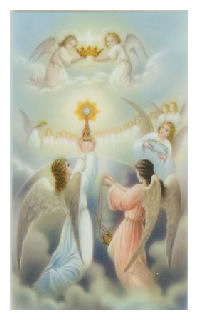
Picture Courtesy of The Brothers and Sisters of Penance
"I believe that You, O Jesus, are in the most holy Sacrament. I love You and desire You. Come into my heart. I embrace You. Oh, never leave me. May the burning and most sweet power of Your love, O Lord Jesus Christ, I beseech You, absorb my mind that I may die through love of Your love, Who were graciously pleased to die through love of my love."
- St. Francis
Thursday, August 31, 2006
Reminder - FIRST FRIDAY - September 1st

Picture Courtesy of Women for Faith and Family
Source: Theotokos Catholic Books
It was just as Jansenism was causing a "coldness" to enter into Catholic life in France, that the revelations to St Margaret Mary Alacoque, concerning devotion to the Sacred Heart of Jesus, were made.
This was a devotion in which the heart symbolised Jesus' perfect love for mankind; it began to grow in importance in the eleventh and twelfth centuries and was later promoted by St Gertrude and St Bonaventure amongst others.
St Gertrude (died 1302) is said to have had a vision of St John the Evangelist on his feast day, where he told her that devotion to the Sacred Heart of Jesus was reserved for subsequent ages, when the world would need to be reminded of his infinite love.
This devotion was very much a private affair until about the sixteenth century when it came more into the mainstream of Christian practice, particularly under the influence of writers such as St Francis de Sales and prominent Jesuits such as St Francis Borgia and St Peter Canisius.
It was still essentially a private devotion, though, until St John Eudes worked to establish a feast day, which was first celebrated in 1670. This feast of the Sacred Heart gradually spread to other dioceses in France and eventually coalesced with the devotion that began as a result of the apparitions of Jesus to St Margaret Mary, in the small town of Paray-le-Monial in central France.
Earlier in the seventeenth century France had been consecrated to Mary by Louis XIII, an example followed by a number of other nations including Portugal.
The first apparition took place on 27 December, the feast of Saint John the Evangelist, probably in 1673, while Margaret Mary was a nun in the Visitation convent at Paray-le-Monial. There is some uncertainty as to the precise dates of the apparitions, but not their content).
She related what happened to Fr. Claude de la Colombiere, who was in charge of the Jesuit house in the town, describing how she had a vision of Jesus during which she was given some idea of the greatness of his love for mankind. Jesus told her that he wanted her to tell the people of this love, and a similar theme was expressed during the second apparition, early in 1674, when Margaret Mary saw Jesus' Sacred Heart on a throne of flames, transparent as crystal, surrounded by a crown of thorns signifying the sins of mankind, with a cross above it.
Again Jesus told her of his infinite love for mankind and his desire that he should be honoured through the display of this image of his heart, with the promise that all who did so would be specially blessed.
The third apparition probably took place on 2 July 1674, while Margaret Mary was praying before the Blessed Sacrament exposed, that is the host consecrated during Mass which had become the Body of Christ. She saw a vision of Jesus in glory, with his five wounds shining like suns, and he then showed her his heart on fire with love for mankind, a love that unfortunately was often ignored or treated with contempt.
He asked her to make up for this coldness and ingratitude by receiving Holy Communion as often as she was allowed, and particularly on the first Friday of each month. This idea of making reparation for the sins of others is also prominent in the messages given by Mary to the children at Fatima in 1917.
The fourth apparition, which probably took place on 16 June 1675, was the most important. Again it happened as Margaret Mary was praying before the Blessed Sacrament, when he again showed her a representation of his heart, further complaining of the ingratitude and coldness of mankind towards him, and particularly when this was the case with those specially consecrated to him.
To make up for this he asked that the first Friday after the feast of Corpus Christi (Latin for the "Body of Christ"), should be dedicated as a feast in honour of his Sacred Heart, when people should receive Holy Communion in reparation.
The "Great promise" associated with this devotion applied to those who went to Communion on nine consecutive First Fridays: "I promise you, in the excess of the mercy of My Heart, that Its all-powerful love will grant to all those who shall receive Communion on the first Friday of nine consecutive months the grace of final repentance; they shall not die under My displeasure nor without receiving the Sacraments, My Divine Heart becoming their assured refuge at that last hour."
These promises have been endorsed by successive Popes, and were explicitly mentioned in the bull of St Margaret Mary's canonisation authorised by Benedict XV. Obviously this last promise in particular is dependent on people adopting an interior attitude of love towards Jesus, and not abusing his goodness.
This promise is really one of the grace of final repentance, that is of dying in a state of grace, and so there is some similarity here to the promise attached to the brown scapular. If somebody dies in this state then although they may have to spend time in purgatory they will eventually get to heaven.
To qualify for this tremendous grace it is necessary to receive Holy Communion validly and worthily, that is not being in a state of mortal sin, on the nine consecutive first Fridays as stated. In addition the communicant must have the intention, at least implicitly, of making reparation to the Sacred Heart of Jesus for all the sinfulness and ingratitude of mankind.
This promise is paralleled by the one made to Lucia, that of the Five First Saturdays following the apparitions at Fatima.
This series of apparitions has been approved by the Church, which has vouched for their authenticity as far as is possible. The writings of Margaret Mary, which included these revelations and her letters, were examined during the process of her beatification, and she would not have been canonised, that is declared a saint, if they were not reliable.
Likewise, the popes have expressed their approval of these apparitions, with their essential content being included in the bull of canonisation by Pope Benedict XV in 1920, while the feast of the Sacred Heart has been established in the Church calendar as requested.
Sources: L. Verheylezoon, Devotion to the Sacred Heart, (TAN Books and Publishers, Rockford, 1978); The Catholic Encyclopedia, Vol. VII, s.v. "Heart of Jesus;" Fr. Arthur B. Calkins, Totus Tuus: John Paul II's Program of Marian Consecration and Entrustment, (Academy of the Immaculate, New Bedford, 1992).
Subscribe to:
Posts (Atom)