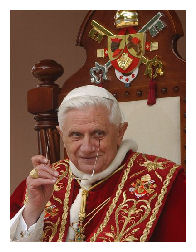
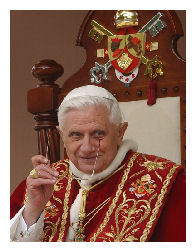
 VATICAN CITY, NOV. 19, 2006 (Zenit.org).- Sacred art and music help man to open his heart to God, says Benedict XVI.
This was the message the Pope gave to the organizers and musicians of the fifth international festival Pro Musica e Arte Sacra, which ended today in St. Peter's Basilica with Mozart's Coronation Mass, K. 317.
The Mass was presided over by Cardinal Christoph Schönborn, and the Vienna Philharmonic Orchestra resounded the Austrian composer's notes, under the direction of Leopold Hager.
Later, at the midday Angelus in St. Peter's Square, the Pope greeted the musicians to applaud the event and said: "The beauty and grandeur of the faith resound in spiritual music and sacred art."
He added: "Music and art touch our senses and help us to open our spirit and heart to God and his Word."
ZE06111908
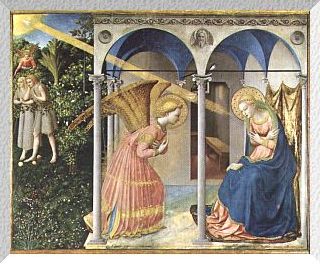
H/T to Kaylan 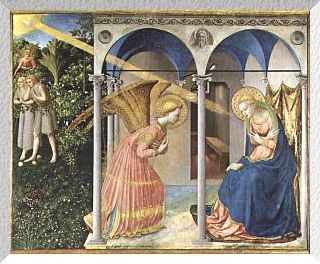 The Annunciation by Fra Angelico
It isn't even Thanksgiving yet but the stores are bombarding us with secular Christmas music, decorations and of course SALES! SALES! SALES!! I am happy to note that other people, specifically bloggers, are speaking out against the commercialization of Christmas. Chris over at Domestic Vocations being one of the first that I noted.
My family was supposed to write a Wish List for the gifts we wanted. Yesterday I decided that I would not be making such a list. I told them that I don't care what they bought me or made me, as long as it came from the heart, and given with love. I refuse to get us caught up in the "Holiday" frenzy where we fight to buy things and forget that Jesus is the reason for the season.
The following article will also be helpful as we get ready to observe the season of Advent.
CATHOLIC TRADITIONS FOR ADVENT AND CHRISTMAS
Some activities to do as a family are:
The following activities are provided so that you and your family can live Advent and Christmas to the fullest.
Advent wreath: The Advent wreath, which has German origins, is probably the most recognized Advent custom. It is a wreath made of evergreens that is bound to a circle of wire. It symbolizes the many years from Adam to Christ in which the world awaited its Redeemer; it also represents the years that we have awaited His second and final coming. The wreath holds four equally spaced candles, the three purple ones lit on the “penitential” Sundays and a pink one for Gaudete, the joyful third Sunday in Advent. There are many available prayers and hymns found in the reading list that can accompany your personal Advent wreath ceremony.
The empty manger: Each child may have his own individual manger, or there may be one manger for the whole family. The idea is that when acts of service, sacrifice, or kindness are done in honor of Baby Jesus as a birthday present, the child receives a piece of straw to put into the manger. Then, on Christmas morning, “Baby Jesus” is placed in the manger. Encourage your children to make Jesus’ bed as “comfortable” as possible through their good deeds. In the process, explain Christ’s incomparable self-gift at Christmas and Easter that enables us to be part of God’s family.
The Jesse tree: The Jesse tree tells about Christ’s ancestry through symbols and relates Scripture to salvation history, progressing from creation to the birth of Christ. The tree can be made on a poster board with the symbols glued on, or on an actual tree. For further information read, Advent and Christmas in a Catholic Home.
St. Nicholas Day: The feast of St. Nicholas is on Dec. 6th. It is a highlight of the Advent season. Each child puts out a shoe the night before St. Nicholas Day in the hope that the kind bishop — with his miter, staff, and bag of gifts — will pay a visit. The current “Santa Claus” is modeled after St. Nicholas, but commercialism has tarnished the true story. Many families give gifts on both Dec. 6 and Christmas. Read about St. Nicholas in your favorite saints book.
The Christ candle: Any large white candle can be used for the Christ candle. The idea is to decorate it with symbols for Christ. Use old Christmas cards, sequins, holly, etc. The candle can be lit on Christmas Eve to show that the Light of the World has arrived. Then continue to light the Christ candle throughout the year at Sunday dinner to remind your family of our waiting for Christ, as well as celebrating His birth and Resurrection.
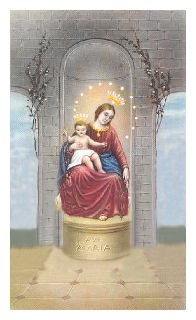
The Mary candle: Some families have the custom of decorating the Christ candle with a blue veil on December 8th, the Solemnity of the Immaculate Conception. On this great feast, others place a candle with a blue ribbon before a statue or picture of the Blessed Virgin, whose “yes” to God enabled our Lord’s coming at Christmas. The candle is lit during meal times to serve as a delightful reminder of Mary’s eager expectation of the “Light of the World.” It can also serve as a reminder to each family member to keep their own light of grace burning as a preparation for Christ’s coming.
St. Lucy cakes: The feast of St. Lucy, virgin and martyr, is on December 13th. This marks the opening of the Christmas season in Sweden. Her life story can be found in most saints books, as can the recipe for the traditional cakes. The symbolism is rich and her life story worthwhile reading.
The Nativity scene: This is the event in which the entire family shares — setting up the Christmas manger. Mary and Joseph should be far off traveling and their approach to Bethlehem can be adjusted daily. Older children can make life-size Nativity models, carve them, cut them out from cardboard, or set up pre-made figurines. The creative ideas are without limit. Make sure to place the Nativity scene where many can admire the children’s efforts to give God glory.
Christmas baking: There are many recipe books available to find great traditional Christmas baking ideas. (See recommended reading below.) The baking usually starts around December 20th. As Christmas approaches, the house will smell of baking and fresh wreaths. The glory of Christmas is at hand! Move the manger to a focal point, add lights to the Nativity to be lighted on Christmas Eve, and anticipate together.
Blessing of the tree: More and more frequently families are blessing their Christmas trees. It is good to remind children that “the tree” relates to many aspects of our faith. For example, we are reminded that our first parents were not allowed to eat from one tree, and that Christ paid the great price for our redemption by hanging on a tree (cf. Acts 5:29-32).
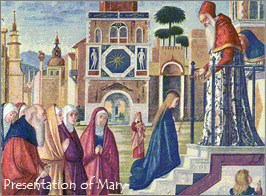 Source: St. Michael Center for the Blessed Virgin Mary
On November twenty-first the Church celebrates the Feast of the Presentation of the Blessed Virgin Mary. This feast finds its origins as early as the second century according to apocryphal source, the Protoevangelium or the book of James. This feast was already commemorated in the East by the sixth century. Pope Gregory XI heard of this feast being kept in Greece in 1372 and introduced it at Avigon. In 1585 Pope Sixtus extended to the universal Church.
This feast refers to Our Lady's presentation at the temple in Jerusalem as a small child. When she was only three years old, the Blessed Virgin Mary was taken to the Temple in Jerusalem by her parents, St. Joachim and St. Anne. There she was taught, lived with other little girls and was cared for by pious women. The Blessed Virgin was happy to begin serving God in the Temple. Even as a little Child Mary's life was centered on God. She studied the Sacred Scriptures and awaited and hope for the coming of the Messiah. On this feast of the Presentation of the Blessed Virgin Mary let us ask Our Lady to help us to consecrate ourselves entirely to God.
For more information on the presentation of Mary, kindly click HERE for the following:
+ Short Prayer on the Presentation of Mary
+ Prayer on the Presentation of Mary
+ Hail Mary
+ Table Blessing for the Feasts of the Mother
of God
+ Ave Maria Dear
+ Salve Regina
+ A Single Branch Three Roses Bore
+ Stella Matutina
+ Virgin Blessed, Thou Star the Fairest
+ Beautiful, Glorious
+ Tis Said of Our Dear Lady
+ Mary Garden
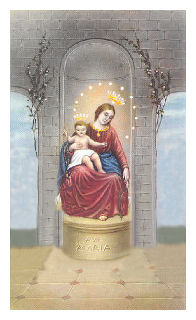 HT to Sue
The Rosary may seem like an insignificant thing in the light of the magnitude of the evils of today's world, but it is the weapon given to us by Our Lady. She merely asks our cooperation, and she will do the rest.
It is like the slingshot of David that killed the mighty enemy because the power of God was behind it. Thus, as the saying goes, he who prays the Rosary has the power of God in his hand.
H/T to Sherri
DEADLY ASSUMPTIONS
Joan, the town gossip and supervisor of the town's morals recently accused George, a local man, of having a drinking problem because she observed his pickup truck outside the town's only bar one morning. George stared at her for a moment, and said nothing. Later that evening, he parked his pickup truck in front of her house and left it there all night.
Why is it that most assumptions are wrong? Yet we too often act as if they are right!
Years ago, a young American at a banquet found himself seated next to the eminent V. K. Wellington Koo, a Chinese diplomat. Completely at a loss as to what to say to someone from such a different culture, this young man ventured, "Likee soupee?"
Mr. Koo smiled and nodded. Later when called upon to speak, Wellington Koo delivered an eloquent talk in exquisite English, sat down while the applause was still resounding, turned to the young man and smiled, "Likee speechee?
His assumption about Mr. Koo was simply not true. Which is not unlike a husband who assumes he knows his wife's opinion on a matter, only to find out she thinks differently. Or a wife who assumes that her husband's silence means he is angry or disinterested, only to learn that he is worried about something else. Or an employee who assumes he knows that his boss is upset with him because she didn't praise his performance on a project, when she was merely preoccupied with another matter.
Assumptions. We all make them. They're usually wrong and they too often get us into trouble.
I like the advice of Eniong Hilario: "Things are better said than assumed." When in doubt, check it out. You think you know what was said? Check it out. You think you know what was meant? Check it out. You may think you know, but check it out.
And when you do, be prepared to be surprised!
 Please keep Lorrie and her dear family in your prayers.
My friend Sherrie shared this with our group:
We have had several discussions with the doctor and have come to the conclusion to stop all treatments altogether. It just was not working in my body. Sadly this means I am now officially on hospice care. I am comfortable and not in much pain. My doctor said I would have one to six months; however, we agreed in reality it would be more like 1 to 2 months. Last week they didn’t think I would make it through the week-end. I have surprised them all. I still have my stubborn streak!
My children are my biggest concern. They will be signed-up for private Christian school. Because we are in a small town, our school is really intimate. The kids have expressed some interest in school, but regret that by doing so it means mommy has passed away. Wow, that is so hard to say. Please pray for a smooth transition from homeschool to private school.
I ask that the Lord cover them with His hands every day they are there.
As for me, I ask for a peaceful passing. I love you Jesus, come quickly.
{Words by Lorrie Gnos; blog updated by Karen Hayden, Lorrie’s loving sister
Lorrie's Blog
Mahalo to Sue
Virtues in General Most of you are probably familiar with what are called the three theological virtues, i.e. Faith, Hope, and Charity. They are called theological because they focus on God.
But there are also other virtues, called intellectual and moral. The moral virtues are classified as acquired and infused. So, for example, the infused moral virtues are Christian prudence, justice, fortitude, temperance, and those which accompany them, such as meekness and humility - humility being the basis of all of the virtues, even the theological virtues.
The Virtue of Patriotism
But rather than explain what you should be able to find in most good Catholic Catechisms or other sources, with the 4th of July now just a few weeks away, it seems timely to focus on the Virtue of Patriotism, especially since many people probably do not even know that Patriotism is a virtue.
Rather than re-invent the wheel, as the expression goes, here is what one source tells us about the Virtue of Patriotism: “It is not to be understood that the Church disregards the ties which bind men to their country, or undervalues the virtue of patriotism. The division of men into different nations enters into the scheme of Providence. To each nation has been assigned a special task to accomplish in the working out of God's purposes. A man owes a duty to his nation no less than to his family.”
“One who omits this duty has failed in a primary moral obligation. Moreover, each nation has its own character, and its own special gifts. It will usually be found that a man attains to high virtue, not by neglecting these gifts, but by embodying the best and noblest ideals of his own people.” (The Catholic Encyclopedia, Volume III, The Church, XI, Universality of the Church; emphasis added.)
This same source also explains that: “By civil allegiance is meant the duty of loyalty and obedience which a person owes to the State of which he is a citizen. The word allegiance is a derivative of liege, free, and historically it signifies the service which a free man owed to his liege lord. In the matter in hand its meaning is wider, it is used to signify the duty which a citizen owes to the state of which he is a subject.”
“That duty, according to the teaching of the Catholic Church, rests on nature itself and the sanctions of religion. As nature and religion prescribe to children dutiful conduct towards the parents who brought them into the world, so nature and religion impose on citizens certain obligations towards their country and its rulers.”
“These obligations may be reduced to those of patriotism and obedience. Patriotism requires that the citizen should have a reasonable esteem and love for his country. He should take an interest in his country's history, he should know how to value her institutions, and he should be prepared to sacrifice himself for her welfare. In his country's need it is not only a noble thing, but it is a sacred duty to lay down one's life for the safety of the commonwealth.” (The Catholic Encyclopedia, Volume III, Civil Allegiance; emphasis added.)
When all is said and done, all people, most especially those who call themselves “Catholics”, should be able to recognize patriotism as a virtue, regardless in which country they live. Virtue is the opposite of vice. So, then, when one recognizes the fact that the division of men into different nations enters into the scheme of Providence, one automatically recognizes that it is part of the Holy Will of God that different nations exist because to each nation has been assigned a special task to accomplish in the working out of God's purposes according to the above source.
The term nation comes from the Middle English nacioun (nation), from the Latin natio (birth, race, nation), and the French nasci (to be born). It is usually defined as: 1) a politically organized nationality; 2) a community of people composed of one or more nationalities with its own geographical territory and government; 3) the territory of a country.”
But how is the geographical territory of a particular nation/country delineated, defended, and secured and made distinct from contiguous other nations? By borders. But remember that the citizen should have a reasonable esteem and love for his country - in other words, the citizen should practice the Virtue of Patriotism.
By the same taken, one who fails to practice the Virtue of Patriotism (faithfulness), automatically practices the vice of faithlessness for his country which is sinful. This explains why such faithlessness identifies such a person as a traitor, despite all of the pagan secular humanist sophisms to the contrary!
If the citizens of any country or nation find themselves ruled by a tyrannical government, then it is within the Virtue of Patriotism for that country that its citizens exercise the true Virtue of Patriotism by trying to organize themselves in order to replace such a government, preferably by peaceful means if at all possible.
 Picture courtesy of MGR Foundation
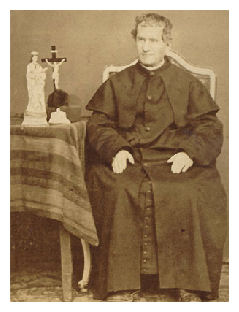
Margaret Occhiena, Co-founder of Salesian Family
VATICAN CITY, NOV. 16, 2006 (Zenit.org).- The prefect of the Congregation for Saints' Causes read a decree recognizing the heroic virtues of Margaret Occhiena, mother of St. John Bosco, as well as her reputation for holiness.
Cardinal José Saraiva Martins read the decree Wednesday in the chapel of the Salesian community in the Vatican.
On hand were the rector major of the Salesians, Father Pascual Chávez; the postulator general, Father Enrico dal Cóvolo; the prefect of the Apostolic Vatican Library, Father Raffaele Farina; the director general of the Vatican Press, Father Elio Torrigiani; and the members of the religious community.
After the reading, Vatican Secretary of State Cardinal Tarcisio Bertone came to offer his greetings and his blessing.
The Congregation for Saints' Causes, at the invitation of Benedict XVI, promulgated the decree Oct. 23.
At the end of the brief ceremony the rector major, Father Chávez, said: "This is a memorable day for the Salesian family which sees Mama Margaret take a further step toward the altars.
"It is an event the whole Salesian world has been waiting for and for which it has been preparing with many initiatives in honor of the mama of Don Bosco. We entrust ourselves to her so that she may intercede for the whole Salesian family and for the congregation as it prepares to celebrate the 26th General Chapter in 2008."
Widowed
Margaret Occhiena was born on April 10, 1788, in Caprigli, Italy. She lived at home until she married Francis Bosco. Later she moved to Becchi.
After her husband's premature death, Margaret, 29, had to raise her family alone at a time of starvation.
She took care of her husband's mother and of the latter's son Anthony, while educating her own sons, Joseph and John.
She supported her son John in his journey toward the priesthood. At age 58, she left her little house of Colle and followed her son in his mission among the poor and abandoned boys of Turin.
There, for 10 years, mother and son united their lives in the beginnings of the Salesian Work. She was Don Bosco's first and principal cooperator. She contributed her maternal presence to the Preventive System. Thus she became the "co-founder" of the Salesian family.
Margaret was illiterate but full of a wisdom that helped so many street boys. "For her, God was first, so she consumed her life in the service of God, in poverty, prayer and sacrifice," explains a biography issued by the Salesians.
She died on Nov. 25, 1856, in Turin at age 68. A throng of boys, who wept for her as for a mother, accompanied her remains to the cemetery.
ZE06111620
 Picture courtesy of Cistercians
And More on a 1570 Bull
ROME, NOV. 14, 2006 (Zenit.org).- Answered by Father Edward McNamara, professor of liturgy at the Regina Apostolorum university.
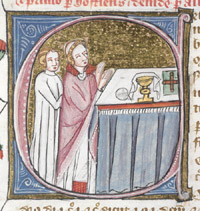
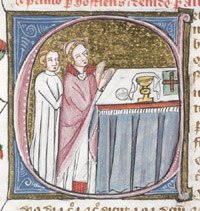
Q: I was recently speaking with some of my brother priests about the celebration of a private Mass when there is no server and no congregation, just the priest. There seemed to be no uniformity on how it is to be done, and the only thing we could find in the General Instruction of the Roman Missal (GIRM) is a few lines found in No. 254. It says, "Mass should not be celebrated without a minister or at least one of the faithful, except for a just and reasonable cause. In this case, the greetings, the introductory or explanatory remarks, and the blessing at the end of the Mass are omitted." I know this question really is of no interest to most people, but I think many priests (at least the ones I have talked to) would like some guidance on this topic. -- D.C., Sioux Falls, South Dakota
A: Our correspondent also laid out a scheme of what he believed should be omitted in this case. I will use the scheme although modifying some details.
Although this might appear to be a rather obscure point, nothing in liturgy is so obscure that liturgists cannot find points to disagree on -- and this is no exception. Therefore some of what I say is just my personal opinion based on what I believe to be an adequate interpretation of the law.
The most difficult aspect to interpret regards what is encompassed under the Latin term "Monitionis." The English translation of this term as "introductory or explanatory remarks" may give rise to a very broad interpretation.
Other languages have generally preferred to keep the technical term "monitions," which may be more restrictive. Either way, neither the original Latin rubric nor the translations are really that helpful in resolving our query. As far as I know there is no official interpretation from the Holy See.
Before entering into detail I wish to mention that some priests believe that this form of Mass with no faithful present is now forbidden. This is not the case. Indeed, present canon law, by requiring a just cause for celebrating alone, and no longer a grave cause as did the 1917 code, has actually made it easier to celebrate such a Mass even though it should always be seen as an exception and to be avoided whenever possible.
All the same, many priests have on some occasion been faced with the choice of celebrating alone, or not celebrating. Both canon law and the law of grace recommend celebrating Mass as the better thing to do.
The basic model to be followed would be the rite of Mass with only one minister present, omitting whatever would be directed toward this minister as well as the gestures of turning toward the minister for these greetings.
Therefore when a priest celebrates alone he does the following:
-- After kissing the altar he recites the entrance antiphon and makes the sign of the cross.
-- He omits the greeting at the beginning of Mass ("Dominus vobiscum") and the invitation at the beginning the penitential rite ("Fratres, agnoscamus ..."). The rest of the penitential rite is as normal.
-- He recites the invitation to the orations ("Oremus"), for these are not just invitations directed to the people but invitations in which he himself is included. The same criterion is obeyed for the introduction to the Our Father which is not omitted.
-- He includes the introduction to the readings and Gospel ("Lectio sancti …") but does omit the greeting of the people at the Gospel ("Dominus vobiscum"). He includes the conclusion to the readings and Gospel ("Verbum Domini"). These are also for his benefit and not just greetings to the people.
-- At the presentation of gifts he recites the prayers offering the bread and wine but omits the response "Blessed be God …." He also omits the "Pray Brethren" ("Orate, fratres") along with the response "May the Lord accept …."
-- Unlike the other "Dominus vobiscum," I believe that the one which forms part of the initial protocol of the preface dialogue should always be said. The norms are clear that the Eucharistic Prayer must always be said integrally and that it retains its plural form even when the priest is alone. As this dialogue is inseparable from the Eucharistic Prayer it should always be recited.
In support of this interpretation of the particular character of this "Dominus vobiscum" is the fact that even when Mass was generally celebrated toward the east, the rubrics did not ask the priest to turn toward the people at this moment as happened in almost every other case, but rather to look at the altar cross.
-- Although the Eucharistic Prayer must be said in its entirety, the memorial acclamation ("Mysterium fidei") does not form part of the prayer. Therefore both introduction and acclamation are omitted. This rubric is explicitly stated in some orders for concelebration when only priests are present at the Mass.
-- The giving of the peace ("Pax Domini sit semper ...") is omitted.
-- The moment of showing the host is easily confused. In fact we have two prayers which are placed one beside the other.
Here, the norm of No. 268 of the GIRM is followed: "If, however, the minister does not receive Communion, [or there is no minister] the priest, after genuflecting, takes the host and, facing the altar, says quietly the 'Domine, non sum dignus' (Lord, I am not worthy) and the 'Corpus Christi custodiat' (May the Body of Christ bring) and then receives the Body of Christ. Then he takes the chalice and says quietly, 'Sanguis Christi custodiat' (May the Blood of Christ bring), and then consumes the Blood of Christ."
-- After holy Communion the priest recites the Communion antiphon before purifying the sacred vessels.
-- After a period of silent thanksgiving the priest says "Let us pray" and recites the prayer after Communion.
-- Both the final blessing and the "Ite missa est" are omitted. Mass ends with the "Through Christ our Lord. Amen" of the closing prayer, followed by kissing the altar and either a bow toward the altar or a genuflection toward the tabernacle, as the case may be, before withdrawing.
These gestures are considered as sufficient forms of conclusion. There is no need to add other gestures not foreseen in the ritual such as making the sign of the cross.
Of course, this in no way excludes the recommendation that, immediately after Mass, the priest dedicates some moments to personal thanksgiving for the grace and privilege of having celebrated the Holy Sacrifice.
* * *
Follow-up: Pius V's 1570 Bull
Some readers wrote to corroborate our comments (Oct. 31) on the legal force of Pope St. Pius V's bull "Quo Primum."
A Cincinnati correspondent wrote: "The instruction printed in the Roman Missal of 1570 was for the benefit of the printers who worked the presses. This was to ensure that everything would be printed exactly as the Church intended without serious mistakes, intentional or otherwise."
This is true, above all, of the final part of the document containing some of the more severe expressions of excommunication and especially regarding printers who were outside of the Pope's civil jurisdiction. Those under his authority were subject above all to fines and loss of their printing license.
The earlier part of the bull refers to printers as well as to "every patriarch, administrator and all other persons of whatsoever ecclesiastical dignity, be they even Cardinals of the Holy Roman Church or possessed of any other rank or pre-eminence," who were henceforth obliged to follow the new missal and forbidden to change anything.
It is worth noting that the decree nowhere mentions that it has any binding force on future papal action.
Another correspondent writing from the Middle East offers the parallel case of the 1568 document "Quod a Nobis" which introduced the new Roman breviary two years before the new missal. This document contains many expressions similar to "Quo Primum" regarding, for instance, the perpetual force of law, the obligation of use in all places, and the total prohibition of adding or omitting anything.
Our reader then comments: "As you are undoubtedly aware, St. Pius X radically rearranged the ancient Roman Psalter and changed a few lessons for a few days, and provided contracted lessons, among other changes in 1913. Moreover, he forbade the use of the old Psalter. This clearly shows that he was not bound by the prescriptions issued in 'Quod a Nobis' and since these are similar to those of 'Quo Primum,' those must not be binding either.
"I have found using 'Quod a Nobis' more effective because the adherents to 'Quo Primum' argue that it is restricted to the Ordinary (either whole or from the Offertory to Last Gospel), or to the Temporale only (despite evidence in encyclicals like 'Grande Munus' to the contrary). Since the Psalter is the most fundamental part of the breviary, no such statement can be made with regard to 'Quod a Nobis.'"
* * *
Readers may send questions to liturgy@zenit.org. Please put the word "Liturgy" in the subject field. The text should include your initials, your city and your state, province or country.
ZE06111422
H/T to Legion of Mary
The Trinity is beyond what we can understand in this life. We should take time for moments of silence. Life is a mystery; mystery is understood in silence.
Silence is golden. Humility is the foundation of prayer. Humility starts with silence. We can move towards silence by spiritual reading, and by meditation.
 VATICAN CITY, NOV. 19, 2006 (Zenit.org).- Sacred art and music help man to open his heart to God, says Benedict XVI.