Just in case you were still in doubt, The Legion of Mary Blog spells it out for us.
Kneeling at the consecration is not optional for Roman Catholics. If a priest says that you need not kneel, he is sinning. If a bishop says you need not kneel, he is sinning. They have no such authority. Roman Catholics must kneel during the consecration unless prevented by lack of space, health, or another good reason. Not having kneelers is NOT a good reason, nor an excuse.
We had a visiting priest celebrate Mass today. As you know, the readings focused on the sacrament and sacredness of marriage. There is no way I can adequately present you with Father B's delivery...keeping in mind he is full of joy and very dynamic. However, he did mentioned quite clearly why these readings prove that allowing priests to marry is not the answer to the priest shortage.A higher percentage of marriages that end up in divorce are a big problem in today's world. Father asked, can you image what the church would do with half of their priests divorced? "You fix the institute of marriage and then we will talk about permitting our priests to be married!"...and he didn't see that happening any time soon. Father made it clear that marriage is a sacrament and is forever. BTW, you'll be happy to know ther lowest rate of divorce, according to Fr. B, occurs in the Catholic Church.
 Pope Warns Theologians to Not Seek Applause
In Homily, He Recommends Fidelity to Truth
VATICAN CITY, OCT. 6, 2006 (Zenit.org).- A theologian prostitutes himself when he subjects himself to the "dictatorship of common opinions," Benedict XVI told members of the International Theological Commission.
The Pope delivered that message today in a homily during a Mass he celebrated in the Redemptoris Mater Chapel of the Vatican Apostolic Palace for some 30 theologians of the commission.
"To speak to meet with applause, to speak oriented to what men want to hear, to speak obeying the dictatorship of common opinions, is considered a sort of prostitution of the word and of the soul," said the Holy Father quoting the First Letter of St. Peter.
The theologian needs a form of "chastity," which implies "not to be subjected to such standards, not to seek applause, but to seek obedience to the truth," the Pontiff said.
Benedict XVI continued: "And I believe this is the fundamental virtue of the theologian, this discipline, even hard, of obedience to the truth, which makes us collaborators of the truth, a mouth of truth, so that we will not speak in this river of words of today, but that we are really purified and chaste through obedience to the truth, so that truth may speak in us."
Recalling an experience of St. Thomas Aquinas (1221-1274), the Holy Father explained: "In theology, God is not the object of our speech. This is our normal conception. In reality, God is not the object; God is the subject of theology."
Room for God
"He who speaks in theology should be God himself," said the Pope. "And our speaking and thinking should only serve to have him heard, so that the world of God can find room in the world."
For theologians to attain this kind of purification, he recommended "silence and contemplation," which "serve, in the dispersion of daily life, to keep a permanent union with God."
The Pontiff added: "This is the objective: that union with God be always present in our soul and transform our whole being."
Silence and contemplation "serve to be able to find in the dispersion of every day this profound, continuous union with God," Benedict XVI continued.
Yet, "the beautiful vocation of the theologian is to speak," he added. "This is his mission: in the talkativeness of our time and of other times, in the inflation of words, to make the essential words present. In words make the Word present, the Word that proceeds from God, the Word that is God."
ZE06100607

Picture courtesy of Diocese of Armidale
Source for the following is EWTN
OUR LADY AND ISLAM: HEAVEN’S PEACE PLAN
Fr Ladis J. Cizik, Blue Army National Executive Director
--------------------------------------------------
Islam
Islam is an Arabic word that can be defined as "to make peace." Islam is the religion founded by Mohammed, which considers the Koran as its holy book. In addition, Islam accepts the New Testament of the Christians and the Old Testament of the Jews as Divinely inspired works. Followers of Islam are known as Muslims (also: Moors, Turks, and Moslems) and, just as Jews and Christians, believe in only one God. Yet, over the centuries, Muslims have engaged in tremendous wars with Christians and Jews. It would seem that there is little hope for peace. However, Heaven's Peace Plan, involving Our Lady, is evidenced at Fatima, Portugal as well as other places around the world.
Fatima
The Moors once occupied Portugal. The village of Fatima was given the Islamic name of the well-loved Princess of the nearby Castle of Ourem. She died at an early age after marrying the Count of Ourem and converting to Catholicism. Baptized with the Christian name of Oureana, she was named at birth "Fatima," like many other Moslem girls, in honor of the daughter of Mohammed. Of his daughter, Fatima, the founder of Islam, Mohammed, said: "She has the highest place in heaven after the Virgin Mary."
It is a fact that Moslems from various nations, especially from the Middle East, make so many pilgrimages to Our Lady of Fatima's Shrine in Portugal that Portuguese officials have expressed concern. The combination of an Islamic name and Islamic devotion to the Blessed Virgin Mary is a great attraction to Moslems. God is writing straight with crooked lines, as we will see. Fatima is a part of Heaven's Peace Plan. It is hope for the world.
The Koran
In the Koran, the holy name of the Blessed Virgin Mary is mentioned no less than thirty times. No other woman's name is even mentioned, not even that of Mohammed's daughter, Fatima. Among men, only Abraham, Moses, and Noah are mentioned more times than Our Lady. In the Koran, Our Blessed Mother is described as "Virgin, ever Virgin." The Islamic belief in the virginity of Mary puts to shame the heretical beliefs of those who call themselves Christian, while denying the perpetual virginity of Mary. Make no mistake about it, there is a very special relationship between the Blessed Virgin Mary and the Moslems!
The Holy Land
The Holy Land has been a real battleground between the Islamic peoples and Christianity over the centuries. Evidence of this are the numerous churches and basilicas that have been built by the Church, destroyed by, the Moslems, rebuilt by Catholic Crusaders, leveled again by the followers of Islam, and so on over the course of history. However, there is one remarkable exception: the Basilica of Saint Anne in Jerusalem.
The Crusaders built this church and named it in honor of the mother of the Blessed Virgin Mary. In the Crypt of St. Anne's Basilica, a statue of the Infant Mary is venerated on what is believed to be the exact spot where Our Lady was born. Their great reverence for Our Lady precluded the Moslems from destroying her birthplace. The foundation for Heaven's Peace Plan at Fatima, Portugal, can be found in the Land of Our Lord Jesus Christ.
Spain
As the Moslems swept through Spain in the 8th century, a great religious treasure was buried for safe-keeping in the earth, high in the Estremadura Mountains. It was a much venerated statue of Our Lady holding the Divine Child Jesus that was a gift of Pope Gregory the Great to Bishop Leander of Seville. After the overthrow of Moorish occupation, the image was uncovered in the year 1326, subsequent to a vision of Our Lady to a humble shepherd by the name of Gil. Our Lady's very special statue was enshrined in a nearby Franciscan Monastery next to the "Wolf River."
The Moslems, during their Spanish occupation, had actually named the river. The Islamic term for Wolf River is "Guadalupe" (Guada = River; Lupe = Wolf). Hence, the famous Catholic image in Spain has been known, since the 14th century, by the Islamic name of "Our Lady of Guadalupe."
Mexico
In the fullness of time, we can be sure that Almighty God knew that the Islamic religion would pose a serious threat to Christianity. God also knew that the Spanish missionaries would face grave resistance in the "new world" from the mighty Aztec Indians. The Aztecs worshipped an evil stone "serpent god" that demanded human sacrifice. It was extremely difficult to win souls for Christ from these bloodthirsty savages. However, with God all things are possible. Our Lady appeared to a humble Aztec Indian convert by the name of Juan Diego in 1531. When asked her name by Juan Diego, at the request of the local bishop, Our Lady's response, in the Aztec language, included the words "te coatlaxopeuh" (pronounced: "te quatlasupe") and meant "one who crushes the head of the stone serpent."
To Juan Diego and his fellow Aztecs, this revelation had great meaning, coupled with the miraculous image of Our Lady standing on top of a "crescent," the symbol of this evil serpent god. A tidal wave of conversions to Catholicism ensued. However, Bishop Zumarraga, who was from Spain, made what was no doubt a "heavenly mistake" that one day may lead to the mass conversion of Moslems. To the Bishop's Spanish ears, Our Lady's Aztec name of "Te Quatlasupe" sounded just like the name of the revered Madonna from Spain with the Islamic name, "Guadalupe." Hence, the bishop named the Mexican Madonna "Our Lady of Guadalupe." It is interesting that the "crescent" is also the symbol for Islam and that America's Shrine to Our Lady has an Islamic name.
Battle of Lepanto
On October 7, 1571, a great victory over the mighty Turkish fleet was won by Catholic naval forces primarily from Spain, Venice, and Genoa under the command of Don Juan of Austria. It was the last battle at sea between "oared" ships, which featured the most powerful navy in the world, a Moslem force with between 12,000 to 15,000 Christian slaves as rowers. The patchwork team of Catholic ships was powered by the Holy Rosary of the Blessed Virgin Mary.
Knowing that the Christian forces were at a distinct material disadvantage, the holy pontiff, St. Pope Pius V called for all of Europe to pray the Rosary for victory. We know today that the victory was decisive, prevented the Islamic invasion of Europe, and evidenced the Hand of God working through Our Lady. At the hour of victory, St. Pope Pius V, who was hundreds of miles away at the Vatican, is said to have gotten up from a meeting, went over to a window, and exclaimed with supernatural radiance: "The Christian fleet is victorious!" and shed tears of thanksgiving to God.
What you may not know is that one of three admirals commanding the Catholic forces at Lepanto was Andrea Doria. He carried a small copy of Mexico's Our Lady of Guadalupe into battle. This image is now enshrined in the Church of San Stefano in Aveto, Italy. Not many know that at the Monastery of Our Lady of Guadalupe in Spain, one can view a huge warship lantern that was captured from the Moslems in the Battle of Lepanto. In Rome, look up to the ceiling of S. Maria in Aracoeli and behold decorations in gold taken from the Turkish galleys. In the Doges' Palace in Venice, Italy, one can witness a giant Islamic flag that is now a trophy from a vanquished Turkish ship from the Victory. At Saint Mary Major Basilica in Rome, close to the tomb of the great St. Pope Pius V, one was once able to view yet another Islamic flag from the Battle, until 1965, when it was returned to Istanbul in an intended friendly token of concord.
The Rosary
At Lepanto, the Victory over the Moslems was won by the faithful praying the Rosary. Even though they had superior numbers, the Turks really were overmatched. Blessed Padre Pio, the Spiritual Father of the Blue Army, said: "The Rosary is the weapon," and how right he was!
The Battle of Lepanto was at first celebrated liturgically as "Our Lady of Victory." Later, the feast of October 7th was renamed "Our Lady of the Rosary" and extended throughout the Universal Church by Pope Clement XI in 1716 (who canonized Pope Pius V in 1712).
And with that we are back to Fatima, Portugal where Our Lady, when asked her name, said: "I am the Lady of the Rosary." At Fatima, Our Lady taught us to pray the Rosary every day. Heaven presented its peace plan at Fatima and truly gave us hope for the world. Conversions were promised at Fatima: the conversion of sinners; the conversion of Russia; and what also appears to be the conversion of Islam. Our Lady of the Rosary, pray for us!
Taken from:
Soul Magazine
© 2001 The Blue Army of Our Lady of Fatima, U.S.A., Inc.
September - October 2001, page 6
For subscription information:
The Blue Army of Our Lady of Fatima, U.S.A., Inc.
PO Box 976
Washington, NJ 07882-0976
Website: http://www.bluearmy.com
E-mail: service@bluearmy.com
or Phone Toll Free: 866-513-1917
--------------------------------------------------------------------------------
Provided Courtesy of:
Eternal Word Television Network
5817 Old Leeds Road
Irondale, AL 35210
www.ewtn.com
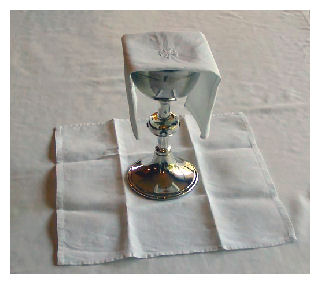 Picture courtesy of St. Bede
Today, Fr. Finegan posted on the care of altar linens.
Father wrote:
Washing altar linens
I had a request from DilexitPrior for information on washing altar linens. I thought it was worth a post because of the good links that people often give in the comment box. I don't consider myself an expert so if you have further advice or any useful links, please do chip in.
Washing
For purificators and corporals, the precaution is taken of washing them first in water and then pouring the water into the sacrarium or into the earth. The reason is that if there should be any particles of the sacred host or drops of the precious blood on either, they are not just poured into the sewer. It would be sufficient to put the items into a bowl of water for a while before squeezing them out and disposing of the water. Then they can be washed in the usual way either by hand or in a washing machine. (The finger towels can just be washed in the normal way.)
Well, today before Mass I was reading from 201 Inspirational Stories of the Eucharist by Sr. Patricia Proctor, OSC. Most of the stories in the book are very interesting as you can imagine. However, one story in particular caught my eye.
It was a story about an intern working on her certification as a lab tech. She tells that as she did her rotations in each department, distilled water was found on the countertops. Apparently, distilled water caused the red blood cells to burst so that the stain broke up quickly.
After her internship was over, she was called to enter the convent and she was soon assigned to the laundry. During the course of her duties, she was responsible for the laundry of the sisters, the sacristy, kitchen as well as other parts of the monastery.
Of course, the sacristy linens, which are the corporal, the purificators, the finger towel, the alb as well as the altar linen itself, were washed separately from the rest because they come in contact with the Consecrated Host and the Precious Blood. As Fr. Finegan explains, there are certain ways of cleaning them.
She explained how she carefully looked for what appeared to be wine stains on the linens, . However, she did not treat the stains like you would treat wine stains. Instead, she used distilled water on those stains.
Well, those stains responded quite well to the distilled water she used to treat those particular stains. After all, after the Consecration, that is exactly what the wine becomes...the Precious Blood of our Lord. The story is entitled: Faith and Science Do Mix and it was written by Sister Coleen Byrne, OSC.
 Picture of Our Lady of the Blessed Sacrament courtesy of Centre Immaculata
"It is I who am the bread of life" (Jn 6:34-35).
Before the Feast Day dedicated to our Guardian Angels is over, I'd like to share a story Fr. Dave shared with us during the Homily today.
He told us there was once a man who would always open the door and let his guardian angel go first. He would open the door and step aside. That is until the day of his ordination to the priesthood. He stepped aside to let his guardian angel go first. But he heard a voice tell him. "No, today, you go first".
 HT to Jim for sharing an article on angels by Peter Kreeft Click here for the complete article.
The Twelve Most Important Things to Know About Angels
1. They really exist. Not just in our minds, or our myths, or our symbols, or our culture. They are as real as your dog, or your sister, or electricity.
2. They’re present, right here, right now, right next to you, reading these words with you.
3. They’re not cute, cuddly, comfortable, chummy, or “cool”. They are fearsome and formidable. They are huge. They are warriors.
4. They are the real “extra-terrestrials”, the real “Super-men”, the ultimate aliens. Their powers are far beyond those of all fictional creatures.
5. They are more brilliant minds than Einstein.
6. They can literally move the heavens and the earth if God permits them.
7. There are also evil angels, fallen angels, demons, or devils. These too are not myths. Demon possessions, and exorcisms, are real.
8. Angels are aware of you, even though you can’t usually see or hear them. But you can communicate with them. You can talk to them without even speaking.
9. You really do have your very own “guardian angel”. Everybody does.
10. Angels often come disguised. “Do not neglect hospitality, for some have entertained angels unawares”—that’s a warning from life’s oldest and best instruction manual.
11. We are on a protected part of a great battlefield between angels and devils, extending to eternity.
12. Angels are sentinels standing at the crossroads where life meets death. They work especially at moments of crisis, at the brink of disaster—for bodies, for souls, and for nations.
From Angels (and Demons) — What Do We Really Know About Them? by Ignatius Press.
You are also welcome to listen to the fascinating audio lecture Aquinas and the Angels.
 Recently, a new friend asked about whether we as Catholics could partake in Halloween fun. Personally, I loved celebrating Halloween growing up. But I don't think I really understood how it related to our Catholic feast of All Saints Day back then.
In looking for help for my friend, I found an article at Catholic Exchange written by Catholic mom and writer Katherine Andes and I'd like to share it with you:
Taking Back Our "Holy" Halloween
10/10/05
"Kathy, why don’t you and the kids come to our church’s Harvest Festival?" asked my Evangelical friend. "There will be a bon fire, hay rides, and candy for the kids."
Are We Retreating?
It sounded great, and, since my husband had recently died, I didn’t relish trick-or-treating by myself with my little ones.
"Do the kids wear costumes?" I inquired.
"No, we definitely discourage that," she said.
I knew that wasn’t for my family. My children adore dressing up and roaming the streets extorting candy from the good neighbors. Besides, I knew that a number of people in my friend’s fellowship saw Catholics and Halloween and Satanism as being all of the same cloth. To the extent that Halloween has become a celebration of death and ghoulishness, I can see their point.
If some Protestants think that Halloween is satanic, then I understand their retreat to church parties. However, many Catholics are also beginning to retreat from Halloween. Like Protestants, some have church parties. Others simply close their blinds and watch videos in a back room come All Hallow’s Eve. Because of what’s going on in the streets, I don’t entirely blame them. Yet if Christmas Eve had somehow become a celebration of death, would Christians retreat to a back room and watch videos? I hope not.
So why should we, good Catholics, flee from this day? We should not. We should take back our "holy" Halloween.
What Kind of Costumes?
One of the first things I did was to encourage clean and, when possible, holy costumes. One year my then five-year-old son was determined to be a pirate. I suggested numerous alternatives to being a pirate but he wouldn’t hear of any. In exasperation he said, "But Mom, firemen don’t carry swords."
Now it was clear. What he really wanted to do was brandish a sword! I suggested he could be St. Michael the Archangel and still carry a sword, and he happily complied. (To those who ask what’s wrong with being a pirate, how would you feel if your child said he wanted to be a hijacker or terrorist?)
Although our family has high standards for costumes, I insist the children not make derogatory remarks about the choices of their friends. Last year, a child came over to trick-or-treat with us dressed as Count Dracula. It was strange taking a picture of a vampire and a nun, in full habit, together. At one point, the boy took off his vampire mask because it was hot.
My daughter suddenly squealed in admiration, "You look like Bach!"
My son chimed in, "You do. You look like a composer." Indeed the boy, sans mask and now dressed in a simple tuxedo, did look like a composer. That evening, by God’s grace, our group included a nun, an astronaut, a Lion King and... Johann Sebastian Bach.
Prayers and Treats
I was further inspired by the medieval All Soul’s Day custom of beggars knocking on doors for "soul cakes" in exchange for prayers for the household’s deceased. We created our own version. On my computer, I made up little strips that said: "Thank you for the treat. My family and I will be praying for you and the souls of your dearly departed loved ones during the month of November. Happy All Saints Day and happy All Souls Day!" The children had fun the day of Halloween cutting up their messages, rolling them into tiny scrolls, and tying them with pretty satin ribbons.
Although I wanted my children to say "Prayer for a treat," I didn’t push it, and they happily chanted "Trick or treat" like ordinary kids. People were surprised and delighted with the scrolls. One man said to my "nun" daughter, "Why, thank you, Sister."
She replied with a big grin, "Well, not yet."
On the giving-out-treats part of the evening, I hand out candy along with stickers, purchased from a Christian supply store, with messages such as "Jesus loves you." One year, as we were returning from trick-or-treating, we were behind a little boy whose mother was berating him with foul language. The boy ran ahead to our house where a friend was giving out treats. When the child returned, he was elated — literally jumping for joy as he showed his sticker to his now-docile mother. "Look, Jesus loves me!" he said. My children, who had been stunned by the earlier bad language, quietly observed everything, and I know it made an impression upon them.
This year we plan to design holy cards explaining the Christian custom of Halloween, which is the eve of two feast days: All Saints and All Souls. These can be passed out by youngsters and treat-givers alike. Packets of similar holy cards could be made available in parishes for parishioners to use with room on the back of the cards for the pastor’s name and number.
Our Halloweens have truly become joyful and holy events with the month of November dedicated to special prayer, not just for our own loved ones, but also for the souls of all our neighbors and their dearly departed. The Church has always evangelized, in part, through the celebration of feasts. By taking back Halloween we can introduce our children to evangelization and begin to respond to our Holy Father’s call to re-evangelize the West.
Katherine Andes is the co-author with Matt Pinto of Friendly Defenders Catholic Flash Cards. She is also a freelance commercial, proposal, and grant writer. You can write her at katherineandes@hotmail.com or visit her web site at KatherineAndes.com.
This article has appeared in This Rock and Immaculata magazines and is used by permission of the author. Mahalo Katherine!!