Showing posts with label Our Lady of Guadalupe. Show all posts

Friday, December 09, 2016

OUR LADY OF GUADALUPE AND SAINT JUAN DIEGO

Brother John M. Samaha, S.M.


          There exist two miraculous images of Our Lady of Guadalupe: one in Spain, the older, and one in Mexico, the more famous.  Both are known by the same name because of some linguistic confusion.

          The original image of Our Lady of Guadalupe in Spain is an unpainted wooden statue carved in an Oriental style.  It was presented to Bishop Leander of Seville in 580 by Pope Gregory the Great.  This statue was widely revered by the people of Spain until the invasion by the Moors in 771.  At that time it was hidden for safekeeping along with some historical documents explaining its special identity.

          Those who had preserved and documented the statue died in the conquest and knowledge of its whereabouts was lost for 600 years.   In 1326 Gil Cordero, a poor cowherd, was searching for a lost cow when he saw the radiant figure of a lady appear at the edge of the woods.  The lady told him about a buried treasure and showed him where to dig to find it.  She requested that a chapel be built at that location.  Gil reported the apparition to the local clergy and brought them to the place where the lady said the treasure lay. Both the statue and its historical documents were found in perfect condition in an underground cave.

          King Alfonso built the chapel, and the statue named for the nearby town of Guadalupe was enshrined.  Soon miracles were attributed to the veneration of the statue, and the shrine became one of the most popular places of pilgrimage in Spain.  Tradition holds that Christopher Columbus visited the shrine before making his first voyage to the New World, and carried a likeness of the statue on his voyages.  The conquistadors also carried a replica of the statue with them while on their conquests in America.

          In 1531 on December 9, only 39 years after Columbus discovered the western hemisphere, an Indian convert to Christianity, Juan Diego, was crossing Tepeyac Hill near Mexico City on his way to Mass.  As he paused he heard celestial music  which he said sounded like a "choir of birds."  When looking up he saw a golden cloud arched by a rainbow.  Affectionately a voice called to him: "Juanito, Juan Diegito,"  and out of the cloud a beautiful young girl, about 16 years old and of Mexican appearance, stood before him.  She spoke to him in Nahuatl, his native dialect, and asked where he was going.  He replied that he was going to Mass and religious instruction.

          The young woman told him that she was the "Mother of the  true God who gives life."  She explained that she wanted to help the poor native Indians  and that she would like to have a chapel built on the hill so that the Indians would have a place to come to her.  At one time that hill had been the site of a shrine to the Aztec goddess of the earth and harvest, Tonantzin.  The pagan shrine had been destroyed by the Christian conquerors. 

          The Lady asked Juan to take her message to Bishop Juan
Zumarraga in Tenochtitlan, which became Mexico City.  Although 57 years old, Juan had lived his entire life in or near his native village of Tolpetlac.  He had never been to Tenochtital which was only about five miles from his home.  However he agreed to undertake the Lady's mission, even though it meant venturing into unfamiliar territory to see a person he had never met.

          At the bishop's residence the servants were amazed that a lowly Indian  would request a meeting with the bishop.  They kept Juan waiting for hours before informing the bishop that Juan was waiting.  When Juan finally spoke with the bishop, matters did not go well.  The bishop was polite, but he was clearly skeptical of  what Juan told him.  As a conciliatory gesture, the bishop told Juan he was welcome to come again to visit, if he wished.

          A disappointed Juan Diego returned to the hill and reported his failure to the Lady.   He asked that she select another messenger because he was a "nobody."  However the Lady told Juan there were others she could have sent, but she chose him.  Then she asked him to try again the following day, a Sunday.  The next day Juan returned to the bishop's residence, and again he was made to wait for hours before he was admitted.  Again the bishop listened patiently but remained incredulous.  He asked Juan to bring him a sign and then he would seriously consider seriously the request to build a chapel.

          After Juan reported another failure and the bishop's insistence on a sign, the Lady asked him to meet her again on Monday and she would give him a sign for the bishop. However Juan did not keep the appointment.  His uncle, Juan Bernardino, who had raised him from early childhood, was seriously ill.  Juan remained at home on Monday to care for his uncle.  Juan Bernardino was near death and on Tuesday asked his nephew to bring him a priest.  Upset because he had not kept his appointment with the Lady the day before, Juan chose another path to avoid the hill en route to the village.  But the Lady was aware of this and blocked his path.  She assured him that his uncle would be fine and not to worry.  She then instructed him to ascend the hill and gather the flowers he would find there.  Very little vegetation grew on that desolate hill at any time of year let alone flowers in December.  But Juan did as he was told.  There Juan found Castilian roses, which had not yet been brought to Mexico, but would be familiar to the Spanish bishop.  Using his tilma, or cloak, as an apron he gathered as many of the blooms as he could carry and took them to the Lady.  She arranged them in Juan's tilma.  Holding the edges of the tilma close to his chest, Juan proceeded to visit Bishop Zumarraga again.

          Encountering Juan Diego again at the bishop's residence, the bishop's servants tried to persuade him to leave.  But Juan Diego held his ground and expressed his determination to stay as long as necessary.  Eventually some of the bishop's staff became curious about what was in his tilma.  Juan refused to show them, and they threatened force.  Reluctantly Juan opened one corner to allow them a glimpse of the flowers and sniff their fragrance.  Immediately one of the servants rushed to tell the bishop.  The bishop asked that Juan be brought to him at once.

          Juan Diego explained to Bishop Zumarraga that the Mother of God directed him to bring the flowers to the bishop as a sign.  Juan opened his tilma and roses cascaded to the floor.  The bishop fell to his knees in reverence of the image that appeared on the cloak.  Juan also was astonished at the picture.  The bishop invited Juan Diego to stay the night, and the bishop took the tilma to his quarters to be alone with it. 

          News of the miracle spread quickly .  By morning the entire city was clamoring  to see the miraculous image.  The tilma was taken to the cathedral so that all could venerate it. 

         
          Though Juan Diego believed the Lady when she told him his uncle was fine, he was still anxious to see for himself.   After showing Bishop Zumarrga where the apparitions occurred on Tepeyac Hill, the two were joined by a throng of followers as  they returned to  his village. 

          Indeed Juan Bernardino was fine and had an amazing story of his own to tell.  After Juan Diego had left on Tuesday morning to find a priest, and as Juan Bernardino felt his life ebbing, a beautiful young Mexican woman appeared to him.  Immediately he felt his strength return, and he knelt before her.  The Lady told him not to worry about his nephew because she had sent him to the bishop with her image imprinted in his tilma.  She also told Juan Bernardino the name by which she wished to be remembered.

          The Spanish image of Our Lady of Guadalupe and the Mexican image became entwined in the popular understanding.  Neither Juan Diego nor Juan Bernardino spoke Spanish.  Their conversations and dealings with Bishop Zumarraga were conducted through an interpreter.  When the name by which the Lady wished to be called was heard by the bishop, he thought Juan Diego was trying to say "the Ever Virgin Holy Mary of Guadalupe," a name familiar to him.  Consequently that is what he called her image on the tilma.  Since the Lady spoke to these two men in their native language, it is dubious that she used the word "Guadalupe," since Guadalupe can neither be spoken nor spelled in Nahuatl because this Aztec language contains neither the letter "d" nor "g."  No Indian writings about the miracle use the word Guadalupe; they prefer Tonantizen, the name of the former pagan shrine at that spot, or other pagan names.  While the bishop never offered a correction, he was most likely aware of his error because he referred to the image as the Immaculate Conception when writing to Cortez  to invite him to join the procession to the first chapel built to house it.  Some thought the bishop made a mistake and that Juan Bernardino used a word that sounded like Guadalupe.  Earlier scholars speculated the Lady said Tequantlaxopeuh, pronounced Tequetalope, which means "Who saves us from the Devourer."   Devourer is Satan and the dreaded pagan serpent-god Quetzalcoatl to whom 2,000 Aztecs  were sacrificed each year.  Some think the word the Virgin used was more likely Coatlaxopeuh, pronounced Coatallope which means "she who breaks, stamps, or crushes the serpent.  This is reminiscent of both the winged serpent Quetzalcoatl and Satan, and recalls Genesis 3:15.

          The Indians were treated cruelly by their Spanish conquerors under the leadership of Don Nune de Guzman, who believed the Indians were not truly human and therefore unworthy of evangelization.  To him the Indians were soulless and deserved to be exploited.  Neither did Bishop Zumarraga and his associates have a high appreciation of the Indians, but they did believe that because the Indians had the ability to reason they could attain salvation through baptism.  For this the Indians were accorded a degree of respect.  On the other hand, most Indians had no interest or desire to give up their own gods in favor of the God offered by the Spaniards.  Juan Diego and Juan Bernardino were clearly exceptions.  Fearing an Indian rebellion, the bishop sent a message to Charles V begging that Guzman be replaced.  Charles agreed with Zumarraga, but the distance between Spain and Mexico delayed the replacement.  The Lady, however, was prompt.  Her apparitions and the miracle of the tilma were the turning point in the Christianization of the Indians.  The Indians recognized signs and symbols in the picture on the tilma that were meaningless to the Europeans.  As a result eight million Indians were converted in the seven years following the apparitions.

          The first chapel where the tilma hung took only 13 days to build.  Juan Diego was appointed custodian and lived in an adjacent lean-to shelter.   

For 17 years until his death in 1548 he greeted pilgrims and explained his experience.


Friday, December 12, 2014

OUR LADY OF GUADALUPE A NATIONAL SYMBOL OF MEXICO


Brother John M. Samaha, S.M.

          One would be hard pressed to find a better example of a highly evocative national symbol than the Virgin of Guadalupe of Mexico. Like her famous Polish counterpart, the Black Madonna of Czestochowa, Our Lady of Guadalupe embodies abstract principles and precepts of the nation where she dwells.

          The complexity and heterogeneous nature of Mexico are reconciled in Our Lady of Guadalupe in a special way that no other symbol can rival. Political overtones are blended with individual and societal aspirations, especially for the Indian, because it was an Indian to whom she revealed herself in 1531.

          Several decades ago Eric Wolf (1923-1999), noted anthropologist, compiled a masterful analysis of the Guadalupe phenomenon. This is an attempt to summarize his findings. With the recent canonization of St. Juan Diego, this topic is timelier than ever.

          Now and then we encounter a symbol that seems to embody the major hopes and aspirations of an entire society. Such a master symbol is Our Lady of Guadalupe, Mexico’s patroness – and Empress of the Americas.

          During the Mexican War of Independence against Spain, her image preceded the insurgents into battle.  Emiliano Zapata and his agrarian rebels fought under her emblem in the Great Revolution of 1910. Today the Guadalupe image of Juan Diego’s tilma adorns house exteriors and interiors, churches and home altars, bull rings and gambling dens, taxis and buses, restaurants and houses of ill repute. Our Lady of Guadalupe is celebrated in song and poetry popular and sacred. Annually her shrine at Tepeyac, a little north of Mexico City, is visited by millions of pilgrims ranging from the Indian villages to the members of the socialist trade unions. As one scholarly observer reported, “Nothing to be seen in North America or Europe equals it in the volume and vitality of its moving quality or in the depth of its spirit of religious devotion.”

          Eric Wolf referred to the holy image and the ideology surrounding it as the Mexican master symbol. He identified it as a cultural form or idiom of behavior operating on the symbolic level, and not restricted to one set of social ties, but referring to a wide range of social relationships.

          The history of the image and shrine are well known. The Virgin Mary appeared to Juan Diego, a neophyte Indian of ordinary standing, and addressed him in Nahuatl, his native Indian language. The encounter occurred on the hill of Tepeyac in 1531, ten years after the Spanish Conquest of Tenochtitlan. Mary directed Juan Diego to visit the bishop of Mexico and to inform him of her desire to have a church built in her honor on Tepeyac. Twice unsuccessful in his mission, Mary miraculously provided her messenger colorful roses in a spot where normally only desert plants would grow. Juan Diego gathered the roses into his tilma, and was told by the Virgin Mother to present the roses and tilma to the Franciscan Bishop-elect Zumarraga. When St. Juan Diego unfolded his tilma before the bishop, the roses cascaded to the floor and the image of Our Lady of Guadalupe was miraculously impressed to the cloth. The bishop acknowledged the miracle and ordered a shrine to be built where Mary had appeared to her humble servant.

          Now the tilma bearing the sacred image of Mary is displayed above the main altar of the basilica, showing a young woman with her head lowered demurely in her shawl. She wears an open crown and flowing gown, and stands upon a half moon.

          This Marian shrine, however, had been preceded on Tepeyac hill by the pagan temple honoring the earth and fertility goddess, Tonantzi -- our lady mother, who like Our Lady of Guadalupe, was also associated with the moon. In pre-Hispanic times, that temple was the site of large-scale pilgrimages.

          The veneration accorded Our Lady of Guadalupe at first commingled with and was influenced by the earlier pagan worship of Tonantzin.  Several Spanish friars attest to this over those early years.

          Fray Bernardino de Sahagún writing fifty years after the Spanish Conquest bemoaned the fact that the Indian pilgrims to the shrine were calling Our Lady of Guadalupe Tonantzin, too. “The term refers to that ancient Tonantzin,” he wrote, “and this state of affairs should be remedied, because the proper name of the Mother of God is not Tonantzin but Dios and Nantzin. It seems to be a satanic device to mask idolatry.”

          Later, Fray Marin de León expressed a similar concern: “On the hill of Our Lady of Guadalupe they once adored an idol of the goddess called Tonantzin, which means our mother. This is the name they also give to Our Lady, and they always say they are going to Tonantzin, or they are celebrating Tonantzin; and many of them understand this in the old way, and not in the new way.

          In the 17th century the syncretism was still alive. Discussing the pilgrimages to the shrine at Tepeyac, Fray Jacinto de la Serna noted, “It is the purpose of the wicked to worship the goddess and not the Most Holy Virgin, or both together.”

          The cult of Our Lady of Guadalupe increased steadily in the 16th century and thereafter, and gathered emotional impetus during the 17th century. The 17th century saw the first pictorial and artistic representations of the miraculous original; poems were composed in honor of the Virgin and her chosen messenger; sermons presented the implications of her supernatural appearance in Mexico and among Mexicans. Wolf’s opinion is that historians tended to neglect the 17th century, which seemed “a kind of Dark Age in Mexico.” But in this period the institution of the hacienda begins to dominate Mexican life, and “New Spain” ceases to be “new” and is regarded as Spain. These new experiences required a new cultural idiom, and in the Guadalupe cult the various segments of colonial society found cultural forms in which they expressed their parallel interests and longings.

          The evolution of the Guadalupe symbol took on functional aspects in relation to the major social relationships of Mexican society. Primary among these relations are the ties of kinship, and the emotions arising in the interplay of relationships within families. Wolf suggests that some of the meanings of the Virgin symbol in general and the Guadalupe symbol in particular derive from these emotions. He says “derive” rather than “originate” because the form and formation of the family in any given society are themselves determined by other social factors: residence, economy, technology, and political power. The family is one relay in the circuit within which symbols are generated in complex societies.

          Mexican family life may be understood in terms of two major types of families. The first type of family is congruent with the closed and static life of the Indian village. This is the Indian family. The husband is ideally dominant, but in reality labor and authority are shared equally between both marriage partners. Exploitation of one sex by another is atypical; sexual feats do not add to a person’s status in the eyes of others. Physical punishment and authoritarian treatment of children are rare. The second type of family is congruent with the much more open, manipulative life of a nation, a life in which power relationships between individuals and groups are of great moment. This is the Mexican family. The father’s authority is unquestioned on both the real and ideal planes. Double standards regarding sex prevail, the male sexuality is charged with a desire to exercise domination. Children are ruled with a heavy hand. Physical punishment is common, even frequent.
          The Indian family pattern is consistent with the behavior toward Our Lady of Guadalupe noted by John Bushnell in the Matlazinca-speaking community of San Juan Atzingo in the Valley of Toluca. There the image of the Virgin Mother is addressed in passionate terms as a source of warmth and love; and the pulque  (century plant beer) drunk on ceremonial occasions is identified with her milk. Bushnell assumed that Our Lady is identified with the mother as a source of early satisfactions, never again experienced after separation from the mother and emergence into social adulthood. She embodies a longing to return to the pristine state in which hunger and unsatisfactory social relations are minimized. The Mexican family pattern is also consistent with a symbolic identification of Virgin and mother, within a context of male and adult dominance and sexual assertion, discharged against submissive females and children. In this context the Guadalupe symbol is charged with the energy of rebellion against the father. Her image is the embodiment of hope in a victorious outcome of the struggle between generations.

          The symbolism is further extended by that struggle. Successful rebellion against power figures is equated with the promise of life; defeat is equated with the promise of death. John A. McKay saw additional symbolic identification of the Virgin Mother with life, of defeat and death with the crucified Christ. Mexican artistic tradition and Hispanic artistic tradition in general seldom depict Christ as an adult man, but usually as a helpless child, or as a person beaten, tortured, defeated, and killed. This symbolic equation strikes at the roots both of the passionate affirmation of faith in the Virgin Mother, and of the fascination with death that characterized Baroque Christianity in general, and Mexican Catholicism in particular. Our Lady of Guadalupe stands for life, for health, for hope; Christ on the cross, for despair, for death, for salvation.

          Supernatural Mother and natural mother are equated symbolically, as are earthly and other-worldly hopes and desires.
          However, family relations are seen as only one element in the formation of the Guadalupe symbol. They illuminate the feminine and maternal attributes of the more widespread Virgin symbol. Our Lady of Guadalupe is important to Mexicans not only because she is a Supernatural Mother, but also because she embodies their major religious and political aspirations.

          To the Indians the symbol is more than an embodiment of life and hope. It restores to them the hopes of salvation. The Spanish Conquest signified not only military defeat, but the defeat also of the old gods and the decline of the old ritual. The apparition of Our Lady of Guadalupe to an Indian commoner represented in one way the return of Tonantzin.  Tannenbaum had observed, “The Church gave the Indian an opportunity not merely to save his own life, but also to save his faith in his own gods.” But on a deeper level the apparition served as a symbolic testimony that the Indians as much as the Spaniards were capable of being saved, capable of receiving Christianity. To be understood properly, this must be seen against the background of the bitter theological and political disputes that followed the Conquest and divided clerics, religious, officials, and conquerors into two camps: those who believed that the Indian was incapable of conversion, was inhuman, and therefore a subject of political and economic exploitation; and those who held the opposite and knew that this exploitation had to be tempered by the demands of the Catholic faith and of orderly civil processes of just government. Consequently the Guadalupe event validates the Indian’s right to legal defense, fair government, citizenship, and salvation from random oppression.

          If that sacred event guaranteed a rightful place to the Indians in the social system of New Spain, it held special appeal to the large group of illegitimate offspring of Spanish fathers and Indian mothers. These progeny were disinherited, impoverished, acculturated, and bereft of any status with the Spanish population or the Indian. For these people there was no proper place in the social order for a considerable length of time. Their very right to exist was questioned because of their inability to command the full rights of citizenship and legal protection. While the Spaniard and the Indian stood squarely within the law, the mestizo landed in the intersections and margins of constituted society. Although they acquired influence and wealth in the 17th and 18th centuries, they still found themselves outside the pale of social recognition and power by prevailing economic, social, and political order. For them the Guadalupe event symbolized not only the possibility of a place in heaven, but also an assurance of their place in society here and now. Politically the desire for a return to a paradise of food and warmth, a life without defeat and sickness, gave rise to a wish for an earthly Mexican paradise. There the illegitimate would possess the country and the irresponsible Spanish overlords who never acknowledged the social obligations of their paternity would be driven from the land.

          In the writings of 17th century clerics, the Guadalupe event looms as a harbinger of this new order. A book published by Miguel Sanchez in 1648 offered the view that the Spanish Conquest of New Spain is justified solely on the ground that it allowed the Virgin Mary to become manifest in her chosen country, and to found in Mexico a new paradise. As Israel was chosen to produce Christ, Mexico had been chosen to produce Guadalupe. Sanchez equated Our Lady of Guadalupe with the apocalyptic woman of Revelation 12:1, “arrayed with the sun, and the moon under her feet, and upon her head a crown of twelve stars,” who is to realize the prophecy of Deuteronomy 8:7-10 and lead the Mexicans into the Promised Land. Hence, colonial Mexico became the desert of Sinai; independent Mexico the land of milk and honey.

          Writing in 1688 Fray Francisco de Florencia coined the slogan that made Mexico not merely another chosen nation, but the Chosen Nation: non fecit taliter omni nationi (he did not act in such a way for every nation) – words which still adorn the portal of the basilica and shine in lights at night.

          An additional elaboration had been expressed on the eve of Mexican independence when Servando Teresa de Mier claimed that Mexico had been converted to Christianity long before the Spanish Conquest. St. Thomas the Apostle had brought the image of Guadalupe Tonantzin to the New World as a symbol of his mission, just as St. James the Elder had converted Spain with the image of Our Lady of the Pillar. This made the Spanish Conquest unnecessary and erasable from the annals of history. In that perspective the Mexican War of Independence marked the final realization of the apocalyptic promise. The banner of the Virgin of Guadalupe led the insurgents. Their cause was labeled “her law.”

          In this ultimate extension of the symbol, the promise of life proffered by the Supernatural Mother has become the promise of an independent Mexico, liberated from the Spanish father oppressors and restored to the Chosen Nation whose election had been manifest in the apparition of the Virgin Mary on Tepeyac. The land is finally possessed by the rightful heirs. The symbolic circuit is closed. Mother; food, hope, health, life; supernatural salvation, rescue from oppression; Chosen People, national independence. All find expression in a single master symbol.
         
          The symbol of Our Lady of Guadalupe links together family, politics, and religion; colonial past and independent present; Indian and Mexican. This reflects the salient social relationships of Mexican life, and embodies the emotions generated. It provides a cultural idiom through which the import and emotions of these relationships can be expressed. Ultimately the Guadalupe symbol is a way of talking about Mexico: a “collective representation” of Mexican society.


Litany of Our Lady of Guadalupe


Litany of Our Lady of Guadalupe
Lord, have mercy on us.
Christ, have mercy on us.
Lord, have mercy on us.
Christ, hear us.
Christ, graciously hear us.God our Heavenly Father, Creator through whom we live,
have mercy on us.God the Son, the One who owns what is near and beyond,
have mercy on us.God the Holy Spirit,
have mercy on us.Holy Trinity, one God,
have mercy of us.Holy Mary of Guadalupe,
pray for us.*Holy Mary, Mother of America,
Holy Mary, Star of the New Evangelization,
Holy Mary, Perfect and Ever Virgin,
Holy Mary, Mother of the True God,
Holy Mary, Mother worthy of honor and veneration,
Holy Mary, Mother most merciful,
Holy Mary, Mother of those who love you and have confidence in you,
Holy Mary, Mother of those who cry to you and search for you,
Holy Mary, Mother who cures all our pains, miseries, and sorrows,
Holy Mary, Mother who remedies and alleviates our sufferings,
Holy Mary, Mother who keeps us within her compassionate and merciful gaze,
Holy Mary, Mother who shows us her help, love and compassion,
Holy Mary, Mother who chooses those who are humble and simple,
Holy Mary, Mother who graciously repays all who serve her,
Holy Mary, Mother who has us under her shadow and protection,
Holy Mary, Mother who carries us in her embrace,
Holy Mary, Fountain of our joy,
Lamb of God, who take away the sins of the world,
spare us, O Lord.Lamb of God, who take away the sins of the world,
graciously hear us, O Lord.Lamb of God, who take away the sins of the world,
have mercy on us.Pray for us, O Holy Mother of God, that we may be made worthy of the promises of Christ.
Let Us Pray
Almighty and Eternal God, your message of mercy, entrusted to Our Lady of Guadalupe, invites all your children to place all their trust in you. Through the intercession of the mother of your Son, may your message of Merciful Love inflame our hearts that we may be faithful heralds and instruments of this Divine Mercy to the world.
(Mention your intentions)
We ask this through our Lord Jesus Christ, your Son, who lives and reigns with you and the Holy Spirit, one God, forever and ever.
Amen.

Shared by Mary Jane.

Tuesday, December 09, 2014

NOT PAINTED BY A HUMAN HAND


Brother John M. Samaha, S.M.

Picture source

          In the past five centuries since 1531 each generation of scientific researchers have found the miraculous image of Our Lady of Guadalupe on the tilma of St. Juan Diego an unsolvable puzzle.  Our Blessed Mother left a portrait painted by a heavenly hand on material produced by human hands.  Keep in mind this happened only a handful of years after Columbus discovered the western hemisphere and the Spaniards colonized what is now Mexico.   Juan Diego was among the first converts of the Franciscan missionaries.

          A tilma was the broad cloak worn by the early  Aztecs of Mexico.  It was woven from the thick and coarse fibers of the agava plant (cactus ayate), and had the color of raw linen.  Anything made with these fibers generally disintegrates completely within two decades.  Because of its coarse and uneven surface and its loose weave, the fabric is unsuitable as a canvas for a painting. 

          Scientific studies verify that the Guadalupe tilma is formed from the fibers of the agava plant.  After almost 500 years no sign of any decay has been detected and it endures in its pristine condition.  This baffles modern science. Amazing also is the freshness of colors in this incredible image.  Equally impressive is the absence of any indication of spoilage even though the image hung unprotected over a hundred years and was exposed to a variety of pollutants like incense smoke, soot, perfumes, and  the burning wax of innumerable votive candles. 

          The noted Mexican painter, Miguel Cabrera,  reported that in 1753 he observed in a period of two hours the pilgrims touching the image about 500 times with a variety of objects.  Under similar conditions any other image would be damaged beyond recognition.  Yet this image of Our Lady of Guadalupe remains intact and vibrant.  For unexplainable reasons its material is resistant to dust, insects, bacteria, and mold.

          Dr. Phillip Callahan, University of Florida, studied the Guadalupe image in 1979, and reported that one lighted votive candle emits over 600 microwatts of light. In such enclosed premises and in the presence of hundreds of burning candles and thousands of pilgrims  one would expect the colors to fade and the image to suffer irreparable damage.  But the image has been resistant to nay harmful agent.

          The perfect preservation of the fabric and its colors has elicited genuine wonder among scientific experts and art specialists.  Some skeptics and rationalists confronted with the facts resulting from their studies of the holy image abandoned their unbelief and bowed before the mystery of God.  In 1975 Ramirez Vasquez, the renowned Mexican architect entrusted with the design of the new Guadalupe basilica, was permitted to scrutinize the holy image.  The results of his study persuaded him both intellectually and spiritually to renounce agnosticism and he became an ardent Catholic. 

          Throughout its centuries-old history the image experienced numerous incidences of preservation from unfortunate circumstances.  In 1791 a worker accidentally spilled an entire bottle of nitric acid on the image when cleaning its silver frame.   During the 1920s the Church in Mexico suffered bloody persecution under Plutarco Calles, and many met death because of their Catholic faith.  The atheistic Masonic regime closed all the churches in the country except the Guadalupe basilica and planned to destroy Our Lady's image as well as to kill the members of the hierarchy. 

          November 14, 1921, government agents planted a powerful time bomb in a flower vase under the tilma.  At 10:30 a.m. the bomb exploded as a Pontifical Mass was being celebrated.  The blast rocked entire basilica and destroyed the floor, altar, and stained glass windows.  Some people suffered minor wounds, but miraculously no one was killed.  The miraculous image survived untouched. 

          Over the years the Guadalupe image underwent careful examination by many scientific researchers and art experts to determine if its preservation was the result of natural causes.  Studies were conducted with the help of electron microscopes, infrared irradiation, and other state-of-the-art methods.  The conclusions were always the same: no human hand could have painted the image.  
     
          In 1936 Dr. Richard Kuhn, chemist and Nobel Prize laureate at the University of Heidelberg, ran meticulous tests on fibers of the tilma.   His results  concluded that the dyes used to produce the image are unknown to natural science, and are not of animal, plant, mineral, or synthetic origin, 

          Microscopic studies in 1946 showed that the image bears no trace of brushstrokes or a preliminary sketch or an artist's signature.    Additional studies in 1954 and 1966 by Dr. F. Camps Ribera and his associates reinforced these previous findings.  Authorities have agreed that the greatest artist could not have painted the image of Our Lady of Guadalupe. 

          Professional photographer Alfonso Gonzales in 1929 enlarged Our Lady's face many times and discovered that her eyes showed the clear reflection of a bearded man's face.  This prompted a series of detailed studies of her eyes from 1950 to 1990.  The results of all researchers indicated that Mary's eyes are like those of a living person.  They exhibit extraordinary depth, the phenomenon of reflection that occurs only in living persons, and the best of painting techniques cannot replicate this.  Scientists enlarged Mary's eyes up to 2500 times, and this showed that 12 persons are reflected in her eyes -- the scene of Juan Diego's meeting with Bishop Zumarraga and his associates.  The scene is so lucid that it shows details such as tears of emotion, earrings, Aztec sandal laces, a bald man with a white beard, another man with an aquiline nose and whiskers on his cheeks, and other details. 

          These scientific studies rule out any possibility that a human hand may have painted the image of Our Lady of Guadalupe on the tilma of St. Juan Diego.  Among the experts conducting these studies were some of the world's leading scientists in the fields of optics and ophthalmology: Dr. Charles Wahling, Dr. Francis Avignone of Columbia University, Dr. H. G. Noyes, Edward Gebhardt of NBC, Dr. Italo Mannelli of the University of Pisa, and others of this caliber.

          Only faith can tell us that the author of this image is God Himself.  The image of Our Lady of Guadalupe is a sign calling all people to conversion.  Gazing on the miraculous image we can experience the maternal love of the Mother of the Redeemer and our own spiritual mother, who is concerned about the salvation of all her children.  This extraordinary sign reminds us that true happiness is found in God alone.


Thursday, December 12, 2013

Our Lady of Guadalupe - Movie


Happy feast day!

Here is a movie I found online that you can watch in its entirety.  However, it is in Spanish.  I haven't seen it but it looks promising.


Tuesday, December 11, 2012

OUR LADY OF GUADALUPE A NATIONAL SYMBOL OF MEXICO


Brother John M. Samaha, S.M.

          One would be hard pressed to find a better example of a highly evocative national symbol than the Virgin of Guadalupe of Mexico. Like her famous Polish counterpart, the Black Madonna of Czestochowa, Our Lady of Guadalupe embodies abstract principles and precepts of the nation where she dwells.

          The complexity and heterogeneous nature of Mexico are reconciled in Our Lady of Guadalupe in a special way that no other symbol can rival. Political overtones are blended with individual and societal aspirations, especially for the Indian, because it was an Indian to whom she revealed herself in 1531.

          Several decades ago Eric Wolf (1923-1999), noted anthropologist, compiled a masterful analysis of the Guadalupe phenomenon. This is an attempt to summarize his findings. With the recent canonization of St. Juan Diego, this topic is timelier than ever.

          Now and then we encounter a symbol that seems to embody the major hopes and aspirations of an entire society. Such a master symbol is Our Lady of Guadalupe, Mexico’s patroness – and Empress of the Americas.

          During the Mexican War of Independence against Spain, her image preceded the insurgents into battle.  Emiliano Zapata and his agrarian rebels fought under her emblem in the Great Revolution of 1910. Today the Guadalupe image of Juan Diego’s tilma adorns house exteriors and interiors, churches and home altars, bull rings and gambling dens, taxis and buses, restaurants and houses of ill repute. Our Lady of Guadalupe is celebrated in song and poetry popular and sacred. Annually her shrine at Tepeyac, a little north of Mexico City, is visited by millions of pilgrims ranging from the Indian villages to the members of the socialist trade unions. As one scholarly observer reported, “Nothing to be seen in North America or Europe equals it in the volume and vitality of its moving quality or in the depth of its spirit of religious devotion.”

          Eric Wolf referred to the holy image and the ideology surrounding it as the Mexican master symbol. He identified it as a cultural form or idiom of behavior operating on the symbolic level, and not restricted to one set of social ties, but referring to a wide range of social relationships.

          The history of the image and shrine are well known. The Virgin Mary appeared to Juan Diego, a neophyte Indian of ordinary standing, and addressed him in Nahuatl, his native Indian language. The encounter occurred on the hill of Tepeyac in 1531, ten years after the Spanish Conquest of Tenochtitlan. Mary directed Juan Diego to visit the bishop of Mexico and to inform him of her desire to have a church built in her honor on Tepeyac. Twice unsuccessful in his mission, Mary miraculously provided her messenger colorful roses in a spot where normally only desert plants would grow. Juan Diego gathered the roses into his tilma, and was told by the Virgin Mother to present the roses and tilma to the Franciscan Bishop-elect Zumarraga. When St. Juan Diego unfolded his tilma before the bishop, the roses cascaded to the floor and the image of Our Lady of Guadalupe was miraculously impressed to the cloth. The bishop acknowledged the miracle and ordered a shrine to be built where Mary had appeared to her humble servant.

          Now the tilma bearing the sacred image of Mary is displayed above the main altar of the basilica, showing a young woman with her head lowered demurely in her shawl. She wears an open crown and flowing gown, and stands upon a half moon.

          This Marian shrine, however, had been preceded on Tepeyac hill by the pagan temple honoring the earth and fertility goddess, Tonantzi -- our lady mother, who like Our Lady of Guadalupe, was also associated with the moon. In pre-Hispanic times, that temple was the site of large-scale pilgrimages.

          The veneration accorded Our Lady of Guadalupe at first commingled with and was influenced by the earlier pagan worship of Tonantzin.  Several Spanish friars attest to this over those early years.

          Fray Bernardino de Sahagún writing fifty years after the Spanish Conquest bemoaned the fact that the Indian pilgrims to the shrine were calling Our Lady of Guadalupe Tonantzin, too. “The term refers to that ancient Tonantzin,” he wrote, “and this state of affairs should be remedied, because the proper name of the Mother of God is not Tonantzin but Dios and Nantzin. It seems to be a satanic device to mask idolatry.”

          Later, Fray Marin de León expressed a similar concern: “On the hill of Our Lady of Guadalupe they once adored an idol of the goddess called Tonantzin, which means our mother. This is the name they also give to Our Lady, and they always say they are going to Tonantzin, or they are celebrating Tonantzin; and many of them understand this in the old way, and not in the new way.

          In the 17th century the syncretism was still alive. Discussing the pilgrimages to the shrine at Tepeyac, Fray Jacinto de la Serna noted, “It is the purpose of the wicked to worship the goddess and not the Most Holy Virgin, or both together.”

          The cult of Our Lady of Guadalupe increased steadily in the 16th century and thereafter, and gathered emotional impetus during the 17th century. The 17th century saw the first pictorial and artistic representations of the miraculous original; poems were composed in honor of the Virgin and her chosen messenger; sermons presented the implications of her supernatural appearance in Mexico and among Mexicans. Wolf’s opinion is that historians tended to neglect the 17th century, which seemed “a kind of Dark Age in Mexico.” But in this period the institution of the hacienda begins to dominate Mexican life, and “New Spain” ceases to be “new” and is regarded as Spain. These new experiences required a new cultural idiom, and in the Guadalupe cult the various segments of colonial society found cultural forms in which they expressed their parallel interests and longings.

          The evolution of the Guadalupe symbol took on functional aspects in relation to the major social relationships of Mexican society. Primary among these relations are the ties of kinship, and the emotions arising in the interplay of relationships within families. Wolf suggests that some of the meanings of the Virgin symbol in general and the Guadalupe symbol in particular derive from these emotions. He says “derive” rather than “originate” because the form and formation of the family in any given society are themselves determined by other social factors: residence, economy, technology, and political power. The family is one relay in the circuit within which symbols are generated in complex societies.

          Mexican family life may be understood in terms of two major types of families. The first type of family is congruent with the closed and static life of the Indian village. This is the Indian family. The husband is ideally dominant, but in reality labor and authority are shared equally between both marriage partners. Exploitation of one sex by another is atypical; sexual feats do not add to a person’s status in the eyes of others. Physical punishment and authoritarian treatment of children are rare. The second type of family is congruent with the much more open, manipulative life of a nation, a life in which power relationships between individuals and groups are of great moment. This is the Mexican family. The father’s authority is unquestioned on both the real and ideal planes. Double standards regarding sex prevail, the male sexuality is charged with a desire to exercise domination. Children are ruled with a heavy hand. Physical punishment is common, even frequent.
          The Indian family pattern is consistent with the behavior toward Our Lady of Guadalupe noted by John Bushnell in the Matlazinca-speaking community of San Juan Atzingo in the Valley of Toluca. There the image of the Virgin Mother is addressed in passionate terms as a source of warmth and love; and the pulque  (century plant beer) drunk on ceremonial occasions is identified with her milk. Bushnell assumed that Our Lady is identified with the mother as a source of early satisfactions, never again experienced after separation from the mother and emergence into social adulthood. She embodies a longing to return to the pristine state in which hunger and unsatisfactory social relations are minimized. The Mexican family pattern is also consistent with a symbolic identification of Virgin and mother, within a context of male and adult dominance and sexual assertion, discharged against submissive females and children. In this context the Guadalupe symbol is charged with the energy of rebellion against the father. Her image is the embodiment of hope in a victorious outcome of the struggle between generations.

          The symbolism is further extended by that struggle. Successful rebellion against power figures is equated with the promise of life; defeat is equated with the promise of death. John A. McKay saw additional symbolic identification of the Virgin Mother with life, of defeat and death with the crucified Christ. Mexican artistic tradition and Hispanic artistic tradition in general seldom depict Christ as an adult man, but usually as a helpless child, or as a person beaten, tortured, defeated, and killed. This symbolic equation strikes at the roots both of the passionate affirmation of faith in the Virgin Mother, and of the fascination with death that characterized Baroque Christianity in general, and Mexican Catholicism in particular. Our Lady of Guadalupe stands for life, for health, for hope; Christ on the cross, for despair, for death, for salvation.

          Supernatural Mother and natural mother are equated symbolically, as are earthly and other-worldly hopes and desires.
          However, family relations are seen as only one element in the formation of the Guadalupe symbol. They illuminate the feminine and maternal attributes of the more widespread Virgin symbol. Our Lady of Guadalupe is important to Mexicans not only because she is a Supernatural Mother, but also because she embodies their major religious and political aspirations.

          To the Indians the symbol is more than an embodiment of life and hope. It restores to them the hopes of salvation. The Spanish Conquest signified not only military defeat, but the defeat also of the old gods and the decline of the old ritual. The apparition of Our Lady of Guadalupe to an Indian commoner represented in one way the return of Tonantzin.  Tannenbaum had observed, “The Church gave the Indian an opportunity not merely to save his own life, but also to save his faith in his own gods.” But on a deeper level the apparition served as a symbolic testimony that the Indians as much as the Spaniards were capable of being saved, capable of receiving Christianity. To be understood properly, this must be seen against the background of the bitter theological and political disputes that followed the Conquest and divided clerics, religious, officials, and conquerors into two camps: those who believed that the Indian was incapable of conversion, was inhuman, and therefore a subject of political and economic exploitation; and those who held the opposite and knew that this exploitation had to be tempered by the demands of the Catholic faith and of orderly civil processes of just government. Consequently the Guadalupe event validates the Indian’s right to legal defense, fair government, citizenship, and salvation from random oppression.

          If that sacred event guaranteed a rightful place to the Indians in the social system of New Spain, it held special appeal to the large group of illegitimate offspring of Spanish fathers and Indian mothers. These progeny were disinherited, impoverished, acculturated, and bereft of any status with the Spanish population or the Indian. For these people there was no proper place in the social order for a considerable length of time. Their very right to exist was questioned because of their inability to command the full rights of citizenship and legal protection. While the Spaniard and the Indian stood squarely within the law, the mestizo landed in the intersections and margins of constituted society. Although they acquired influence and wealth in the 17th and 18th centuries, they still found themselves outside the pale of social recognition and power by prevailing economic, social, and political order. For them the Guadalupe event symbolized not only the possibility of a place in heaven, but also an assurance of their place in society here and now. Politically the desire for a return to a paradise of food and warmth, a life without defeat and sickness, gave rise to a wish for an earthly Mexican paradise. There the illegitimate would possess the country and the irresponsible Spanish overlords who never acknowledged the social obligations of their paternity would be driven from the land.

          In the writings of 17th century clerics, the Guadalupe event looms as a harbinger of this new order. A book published by Miguel Sanchez in 1648 offered the view that the Spanish Conquest of New Spain is justified solely on the ground that it allowed the Virgin Mary to become manifest in her chosen country, and to found in Mexico a new paradise. As Israel was chosen to produce Christ, Mexico had been chosen to produce Guadalupe. Sanchez equated Our Lady of Guadalupe with the apocalyptic woman of Revelation 12:1, “arrayed with the sun, and the moon under her feet, and upon her head a crown of twelve stars,” who is to realize the prophecy of Deuteronomy 8:7-10 and lead the Mexicans into the Promised Land. Hence, colonial Mexico became the desert of Sinai; independent Mexico the land of milk and honey.

          Writing in 1688 Fray Francisco de Florencia coined the slogan that made Mexico not merely another chosen nation, but the Chosen Nation: non fecit taliter omni nationi (he did not act in such a way for every nation) – words which still adorn the portal of the basilica and shine in lights at night.

          An additional elaboration had been expressed on the eve of Mexican independence when Servando Teresa de Mier claimed that Mexico had been converted to Christianity long before the Spanish Conquest. St. Thomas the Apostle had brought the image of Guadalupe Tonantzin to the New World as a symbol of his mission, just as St. James the Elder had converted Spain with the image of Our Lady of the Pillar. This made the Spanish Conquest unnecessary and erasable from the annals of history. In that perspective the Mexican War of Independence marked the final realization of the apocalyptic promise. The banner of the Virgin of Guadalupe led the insurgents. Their cause was labeled “her law.”

          In this ultimate extension of the symbol, the promise of life proffered by the Supernatural Mother has become the promise of an independent Mexico, liberated from the Spanish father oppressors and restored to the Chosen Nation whose election had been manifest in the apparition of the Virgin Mary on Tepeyac. The land is finally possessed by the rightful heirs. The symbolic circuit is closed. Mother; food, hope, health, life; supernatural salvation, rescue from oppression; Chosen People, national independence. All find expression in a single master symbol.
         
          The symbol of Our Lady of Guadalupe links together family, politics, and religion; colonial past and independent present; Indian and Mexican. This reflects the salient social relationships of Mexican life, and embodies the emotions generated. It provides a cultural idiom through which the import and emotions of these relationships can be expressed. Ultimately the Guadalupe symbol is a way of talking about Mexico: a “collective representation” of Mexican society.


THE IMAGE OF OUR LADY OF GUADALUPE Icon of the Church in the Americas


by Brother John M. Samaha, S.M.


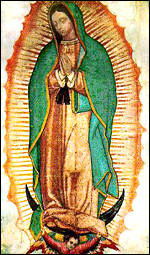
          With her head tilted to the right, her hazel eyes are cast downward in an expression of gentleness and concern.  The mantle covering her head and shoulders is turquoise, studded with gold stars and bordered in gold.  Her hair is jet black and her complexion is olive.  She stands alone, her hands clasped in prayer, an angel at her feet.

          We have all seen her image.  She is Our Lady of Guadalupe, a life-sized portrayal of the Virgin Mary as she appeared in 1531 on the cactus-cloth tilma, or cape, of St. Juan Diego, an Aztec peasant and devout convert.  This happened merely a dozen years after Hernan Cortes had conquered the land that is now Mexico for the monarchy of Spain.  Almost five centuries later the colors of that portrait have remained as vibrant as if painted this year.  The coarse, woven, cactus cloth shows no signs of fading or deterioration, although that type of material seldom lasts 20 years.

          Today the image is preserved behind an impenetrable glass screen in the basilica at Mexico City.  Pilgrims can view it from a distance of 25 feet.  Each year more than 10 million persons venerate the mysterious image of the Virgin of Guadalupe, making this shrine the most popular in the Catholic world after St. Peter’s Basilica at Vatican City.  The Mexican faithful refer to her lovingly as La Morenita.

          In 1979 when Pope John Paul II visited the Basilica of Our Lady of Guadalupe, he acknowledged the enduring appeal of this unique portrait, addressing the Virgin directly: “When the first missionaries who reached America . . . taught the rudiments of the Christian faith, they also taught love for you, the Mother of Jesus and of all people.  And ever since the time that the Indian Juan Diego spoke of the sweet Lady of Tepeyac, you, Mother of Guadalupe, have entered decisively into the Christian life of the people of Mexico.”

          Accounts abound of the miraculous events attributed to the Virgin of Guadalupe.  In the early 17th century when floods almost destroyed Mexico City, her image escaped unharmed.  In 1921 during the Mexican Revolution, a bomb was planted in flowers placed before the altar behind which the image hung.  When the bomb exploded, no one was hurt, but the altar was badly damaged.  Yet not even the glass covering the picture was broken.

          This venerable icon has come to be regarded widely as the national symbol of Mexico.  Her image is found everywhere, even in unlikely places.

          Forty years after La Morenita appeared to St. Juan Diego, she may have been responsible for a significant turning point in the history of Western civilization.  Throughout Europe copies of the holy image had been circulated.  One of the first copies was given to Admiral Giovanni Andrea Doria, grandnephew of the renowned Admiral Andrea Doria.  The young admiral took the picture aboard his flagship when he assumed command of a flotilla of ships sailing from Genoa to the Gulf of Lepanto.
Some 300 Turkish Muslim ships stood in battle array blocking entrance to the Gulf.  A Christian massed navy of almost the same number of ships attempted to meet the Turks head on, but were outmaneuvered by the Turkish force. 

          Doria’s squadron was cut off from the rest of the Christian fleet.  At this crucial hour Doria went to his cabin and knelt in prayer before the image of Our Lady of Guadalupe.  He implored her to save his men and his ships.  Miraculously by nightfall the tide of battle turned.  One Turkish squadron was captured, and others were thrown into panic and disarray.  Much of the Turkish fleet was destroyed.  That day 15,000 Christians enslaved in the Turks’ galleys were freed.  The Christian victory in the Battle of Lepanto was the last great naval battle fought under oars.

          To this day Our Lady of Guadalupe continues to work wonders large and small, noticed and unnoticed. 

          Why hasn’t the holy image deteriorated after almost five centuries?  Why do the colors remain bright?  Why hasn’t the crude fabric shown signs of disintegration?  The search for answers to these questions, regularly pursued by experts, persists from generation to generation.  What they have learned is fascinating.  However, the scientific investigations defy natural explanations.

          Although the picture has been touched up from time to time, there is proof that the original image is made in a manner no artist has been able to imitate or to explain.  Of particular interest is the fact that the eyes of the Virgin are done in a way never seen before in any painting. 

          Yet the greater, ongoing miracle is how the lives of millions are touched by Our Mother of Guadalupe.


Tuesday, December 04, 2012

Our Lady of Guadalupe short Novena & Prayer for Life - start today

Shared by Mary Jane:


Novena in Honor of Our Lady of Guadalupe

Feast is December 12. Our Lady of Guadalupe is the Patroness of the Americas. Novena is usually prayed from December 4 to December 12.

First Day Dearest Lady of Guadalupe, fruitful Mother of holiness, teach me your ways of gentleness and strength. Hear my humble prayer offered with heartfelt confidence to beg this favor...... Our Father, Hail Mary, Glory be...
Second Day O Mary, conceived without sin, I come to your throne of grace to share the fervent devotion of your faithful Mexican children who call to you under the glorious Aztec title of Guadalupe. Obtain for me a lively faith to do your Son’s holy will always: May His will be done on earth as it is in heaven. Our Father, Hail Mary, Glory be...
Third Day O Mary, whose Immaculate Heart was pierced by seven swords of grief, help me to walk valiantly amid the sharp thorns strewn across my pathway. Obtain for me the strength to be a true imitator of you. This I ask you, my dear Mother. Our Father, Hail Mary, Glory be...
Fourth Day Dearest Mother of Guadalupe, I beg you for a fortified will to imitate your divine Son’s charity, to always seek the good of others in need. Grant me this, I humbly ask of you. Our Father, Hail Mary, Glory be...
Fifth Day O most holy Mother, I beg you to obtain for me pardon of all my sins, abundant graces to serve your Son more faithfully from now on, and lastly, the grace to praise Him with you forever in heaven. Our Father, Hail Mary, Glory be...
Sixth Day Mary, Mother of vocations, multiply priestly vocations and fill the earth with religious houses which will be light and warmth for the world, safety in stormy nights. Beg your Son to send us many priests and religious. This we ask of you, O Mother. Our Father, Hail Mary, Glory be...
Seventh Day O Lady of Guadalupe, we beg you that parents live a holy life and educate their children in a Christian manner; that children obey and follow the directions of their parents; that all members of the family pray and worship together. This we ask of you, O Mother. Our Father, Hail Mary, Glory be...
Eighth Day With my heart full of the most sincere veneration, I prostrate myself before you, O Mother, to ask you to obtain for me the grace to fulfill the duties of my state in life with faithfulness and constancy. Our Father, Hail Mary, Glory be...
Ninth Day O God, You have been pleased to bestow upon us unceasing favors by having placed us under the special protection of the Most Blessed Virgin Mary. Grant us, your humble servants, who rejoice in honoring her today upon earth, the happiness of seeing her face to face in heaven. Our Father, Hail Mary, Glory be...


    Novena Prayer for Life to Our Lady of GuadalupeOh Mary, Mother of Jesus and Mother of Life,
    We honor you as Our Lady of Guadalupe.

    Thank you for pointing us to Jesus your Son,
    The only Savior and hope of the world.

    Renew our hope in him,
    That we all may have the courage to say Yes to life,
    And to defend those children in danger of abortion.

    Give us your compassion
    To reach out to those tempted to abort,
    And to those suffering from a past abortion.

    Lead us to the day when abortion
    Will be a sad, past chapter in our history.

    Keep us close to Jesus, the Life of the World,
    Who is Lord forever and ever. Amen.

    Monday, December 12, 2011

    Our Lady of Guadalupe - Video

    Thanks Father Vince!

    THE IMAGE OF OUR LADY OF GUADALUPE

    Picture source
    Reprinted with permission.

    Icon of the Church in the Americas


    by Brother John M. Samaha, S.M.


    With her head tilted to the right, her hazel eyes are cast downward in an expression of gentleness and concern. The mantle covering her head and shoulders is turquoise, studded with gold stars and bordered in gold. Her hair is jet black and her complexion is olive. She stands alone, her hands clasped in prayer, an angel at her feet.

    We have all seen her image. She is Our Lady of Guadalupe, a life-sized portrayal of the Virgin Mary as she appeared in 1531 on the cactus-cloth tilma, or cape, of St. Juan Diego, an Aztec peasant and devout convert. This happened merely a dozen years after Hernan Cortes had conquered the land that is now Mexico for the monarchy of Spain. Almost five centuries later the colors of that portrait have remained as vibrant as if painted this year. The coarse, woven, cactus cloth shows no signs of fading or deterioration, although that type of material seldom lasts 20 years.

    Today the image is preserved behind an impenetrable glass screen in the basilica at Mexico City. Pilgrims can view it from a distance of 25 feet. Each year more than 10 million persons venerate the mysterious image of the Virgin of Guadalupe, making this shrine the most popular in the Catholic world after St. Peter’s Basilica at Vatican City. The Mexican faithful refer to her lovingly as La Morenita.

    In 1979 when Pope John Paul II visited the Basilica of Our Lady of Guadalupe, he acknowledged the enduring appeal of this unique portrait, addressing the Virgin directly: “When the first missionaries who reached America . . . taught the rudiments of the Christian faith, they also taught love for you, the Mother of Jesus and of all people. And ever since the time that the Indian Juan Diego spoke of the sweet Lady of Tepeyac, you, Mother of Guadalupe, have entered decisively into the Christian life of the people of Mexico.”

    Accounts abound of the miraculous events attributed to the Virgin of Guadalupe. In the early 17th century when floods almost destroyed Mexico City, her image escaped unharmed. In 1921 during the Mexican Revolution, a bomb was planted in flowers placed before the altar behind which the image hung. When the bomb exploded, no one was hurt, but the altar was badly damaged. Yet not even the glass covering the picture was broken.

    This venerable icon has come to be regarded widely as the national symbol of Mexico. Her image is found everywhere, even in unlikely places.

    Forty years after La Morenita appeared to St. Juan Diego, she may have been responsible for a significant turning point in the history of Western civilization. Throughout Europe copies of the holy image had been circulated. One of the first copies was given to Admiral Giovanni Andrea Doria, grandnephew of the renowned Admiral Andrea Doria. The young admiral took the picture aboard his flagship when he assumed command of a flotilla of ships sailing from Genoa to the Gulf of Lepanto.

    Some 300 Turkish Muslim ships stood in battle array blocking entrance to the Gulf. A Christian massed navy of almost the same number of ships attempted to meet the Turks head on, but were outmaneuvered by the Turkish force.

    Doria’s squadron was cut off from the rest of the Christian fleet. At this crucial hour Doria went to his cabin and knelt in prayer before the image of Our Lady of Guadalupe. He implored her to save his men and his ships. Miraculously by nightfall the tide of battle turned. One Turkish squadron was captured, and others were thrown into panic and disarray. Much of the Turkish fleet was destroyed. That day 15,000 Christians enslaved in the Turks’ galleys were freed. The Christian victory in the Battle of Lepanto was the last great naval battle fought under oars.

    To this day Our Lady of Guadalupe continues to work wonders large and small, noticed and unnoticed.

    Why hasn’t the holy image deteriorated after almost five centuries? Why do the colors remain bright? Why hasn’t the crude fabric shown signs of disintegration? The search for answers to these questions, regularly pursued by experts, persists from generation to generation. What they have learned is fascinating. However, the scientific investigations defy natural explanations.

    Although the picture has been touched up from time to time, there is proof that the original image is made in a manner no artist has been able to imitate or to explain. Of particular interest is the fact that the eyes of the Virgin are done in a way never seen before in any painting.

    Yet the greater, ongoing miracle is how the lives of millions are touched by Our Mother of Guadalupe.

    Friday, December 03, 2010

    Our Lady of Guadalupe novena Starts Today


    This reminder comes from Evann.  I am happy to see Father Lovasik wrote the novena.  I highly recommend reading everything he has written:

    The December 12 Feast of Our Lady of Guadalupe is fast approaching. Begin your novena on Friday, December 3 to end on the eve of her Feast Day. Here is the novena in its entirety, written by Rev. Lawrence G. Lovasik, S.V.D., and approved by Bishop Burke, now Cardinal Burke, for use preceding Consecration/Renewal. I will also repost the prayers for each day as we move through the novena.

    The novena can be found on Evann's blog here.

    Monday, December 14, 2009

    Our Lady of Guadalupe Prayer Mural

    Our Lady of Guadalupe Prayer Mural


    My friend Mary Ann S. shared this email with you and I am in turn am sharing it with all of you here:
    This is a photo and a link from the Franciscan Friars of the Renewal. This picture is mural on the side of there Franciscan monastery in the South Bronx in NYC. This photo is bringing healing to city in dire need of healing. You can make donations to the site listed below to create more murals around the city which are helping create revenue for women considering abortions.
    -----

    Hi Everyone,


    I am excited to tell you about a prayerful project currently in the works!
    Imagine murals of Our Lady of Guadalupe all over NYC ! First the Friars of the Renewal did it on the side of one of their friaries, and now we are looking to have her watch over one of our Good Counsel Homes. By adopting a space to honor or memorialize someone you love (only $12) , you also be bringing her presence to the city while helping homeless expectant mothers choose life for their unborn children. Your prayers and intentions will be placed in our chapel and with the Franciscan Friars for the Renewal for perpetual remembrance.

    Please check it out here Our Lady of Guadalupe Prayer Mural

    You can view the image in the attachment above…there is no doubt her presence has changed neighborhoods and brought many graces !
    Please spread the word!


    Adopt your space in Our Lady of Guadalupe Prayer Mural

    Enroll your prayer intentions, or in honor or memory of a loved one, as a Perpetual Remembrance in Our Lady of Guadalupe Prayer Mural

    Unite your prayers with Our Lady of Guadalupe for the protection of abandoned pregnant women choosing life for their unborn children. With an offering of $12 your prayer intentions will be united with the prayerful remembrance of each child of the 1.2 million children lost each year to abortion.

    Our Lady of Guadalupe, pray for us.

    Saturday, December 12, 2009

    Our Lady of Guadalupe - Queen of the Americans

    OLOG
    Know for certain, least of my sons, that I am the perfect and perpetual Virgin Mary, Mother of the True God through whom everything lives, the Lord of all things near and far, the Master of heaven and earth.

    It is my earnest wish that a temple be built here to my honor. Here I will demonstrate, I will exhibit, I will give all my love, my compassion, my help and my protection to people.

    I am your merciful mother, the merciful mother of all of you who live united in this land, and of all mankind, of all those who love me, of those who cry to me, of those who seek me, of those who have confidence in me.

    Here I will hear their weeping, their sorrow, and will remedy, and alleviate all their multiple sufferings, necessities and misfortunes.

    Words of Our Lady of Guadalupe to Juan Diego on December 9, 1531.
    From a prayer card.

    Tuesday, December 12, 2006

    The Image of Our Lady of Guadalupe

    OLOG

    THE IMAGE OF OUR LADY OF GUADALUPE

    Icon of the Church in the Americas

    Brother John M. Samaha, S.M.

    With her head tilted to the right, her hazel eyes are cast downward in an expression of gentleness and concern. The mantle covering her head and shoulders is turquoise, studded with gold stars and bordered in gold. Her hair is jet black and her complexion is olive. She stands alone, her hands clasped in prayer, an angel at her feet.

    We have all seen her image. She is Our Lady of Guadalupe, a life-sized portrayal of the Virgin Mary as she appeared in 1531 on the cactus-cloth tilma, or cape, of St. Juan Diego, an Aztec peasant and devout convert. This happened merely a dozen years after Hernan Cortes had conquered the land that is now Mexico for the monarchy of Spain. Almost five centuries later the colors of that portrait have remained as vibrant as if painted this year. The coarse, woven, cactus cloth shows no signs of fading or deterioration, although that type of material seldom lasts 20 years.

    Today the image is preserved behind an impenetrable glass screen in the basilica at Mexico City. Pilgrims can view it from a distance of 25 feet. Each year more than 10 million persons venerate the mysterious image of the Virgin of Guadalupe, making this shrine the most popular in the Catholic world after St. Peter’s Basilica at Vatican City. The Mexican faithful refer to her lovingly as La Morenita.

    In 1979 when Pope John Paul II visited the Basilica of Our Lady of Guadalupe, he acknowledged the enduring appeal of this unique portrait, addressing the Virgin directly: “When the first missionaries who reached America . . . taught the rudiments of the Christian faith, they also taught love for you, the Mother of Jesus and of all people. And ever since the time that the Indian Juan Diego spoke of the sweet Lady of Tepeyac, you, Mother of Guadalupe, have entered decisively into the Christian life of the people of Mexico.”

    Accounts abound of the miraculous events attributed to the Virgin of Guadalupe. In the early 17th century when floods almost destroyed Mexico City, her image escaped unharmed. In 1921 during the Mexican Revolution, a bomb was planted in flowers placed before the altar behind which the image hung. When the bomb exploded, no one was hurt, but the altar was badly damaged. Yet not even the glass covering the picture was broken.

    This venerable icon has come to be regarded widely as the national symbol of Mexico. Her image is found everywhere, even in unlikely places.

    Forty years after La Morenita appeared to St. Juan Diego, she may have been responsible for a significant turning point in the history of Western civilization. Throughout Europe copies of the holy image had been circulated. One of the first copies was given to Admiral Giovanni Andrea Doria, grandnephew of the renowned Admiral Andrea Doria. The young admiral took the picture aboard his flagship when he assumed command of a flotilla of ships sailing from Genoa to the Gulf of Lepanto.


    Some 300 Turkish Muslim ships stood in battle array blocking entrance to the Gulf. A Christian massed navy of almost the same number of ships attempted to meet the Turks head on, but were outmaneuvered by the Turkish force.

    Doria’s squadron was cut off from the rest of the Christian fleet. At this crucial hour Doria went to his cabin and knelt in prayer before the image of Our Lady of Guadalupe. He implored her to save his men and his ships. Miraculously by nightfall the tide of battle turned. One Turkish squadron was captured, and others were thrown into panic and disarray. Much of the Turkish fleet was destroyed. That day 15,000 Christians enslaved in the Turks’ galleys were freed. The Christian victory in the Battle of Lepanto was the last great naval battle fought under oars.

    To this day Our Lady of Guadalupe continues to work wonders large and small, noticed and unnoticed.

    Why hasn’t the holy image deteriorated after almost five centuries? Why do the colors remain bright? Why hasn’t the crude fabric shown signs of disintegration? The search for answers to these questions, regularly pursued by experts, persist from generation to generation. What they have learned is fascinating. However, the scientific investigations defy natural explanations.

    Although the picture has been touched up from time to time, there is proof that the original image is made in a manner no artist has been able to imitate or to explain. Of particular interest is the fact that the eyes of the Virgin are done in a way never seen before in any painting.

    Yet the greater, ongoing miracle is how the lives of millions are touched by Our Mother of Guadalupe.

    Used with Permission.