Showing posts with label Marian: Mary's Garden. Show all posts

Monday, June 18, 2007

Photos - Mary's Garden

I thought I would share some photos of my mom's Mary's Garden.

The first photo is the herb garden. There is a statue of a pelican overlooking the small garden. I think I bought this statue at a flea market over 20 years ago. At first I didn't think it went well with the surroundings. My mom told me the pelican was a Catholic symbol. Well in searching I found the following at Fisheaters


Pelican: The Pelican is a symbol of the atonement and the Redeemer and is often found in Christian murals, frescos, paintings and stained glass. The pelican was believed to wound itself in order to feed its young with its own blood. In the hymn "Adoro Te," St. Thomas Aquinas addresses the Savior with, "Pelican of Mercy, cleanse me in Thy Precious Blood." Allusion is even made to this belief in "Hamlet" (act iv): "To his good friend thus wide I'll ope my arms And, like the kind, life-rendering pelican, Repast them with my blood."


So I guess the pelican stays right where it is.


MG2
MG1

These photos show the Blessed Mother statue given to my parents by my brother in Washington State. I believe my mom restored it as it broke in transit. There is a hydrangea bush, little blue flowers in front of this statue. The rest of the garden has hostas, petunias. There is even a little vegetable garden on the other end. After all, what would a home be without Jersey tomatoes in the garden state?

veggies

Monday, May 29, 2006

How to Make Your Own Mary Garden

BVM
From BeliefNet

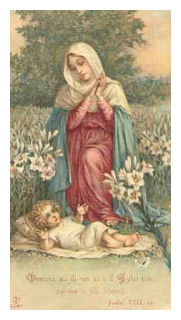
A Mary Garden is a garden dedicated to Mary, the Mother of God. In a Mary Garden, which can be as small as a clay pot or as large as a city block, a statue of Mary is surrounded by herbs and flowers related to her through legends or naming.

Your personal Mary Garden can grow in a secluded corner of your garden or backyard, or be open to the neighborhood in front of your house. It can be in a pot on your windowsill, on a patio, or on an indoor table.

A Mary Garden can be formal or wild, sunny or shady, and contain annuals and perennials, herbs, ground covers, and shrubs. It can be planted with bulbs to bloom in the early spring, flowering plants that continue into the fall, and evergreens that give color in winter.

Mary's image may be a statue, plaque, holy card, or icon. Ann Duffy of Annapolis, Md., painted the likeness of Mary's face from a holy card onto a piece of wood and waterproofed it for her outdoor garden. A large concrete statue of Mary, found in a garden-ornaments shop, graces my own Mary Garden.

The location, size, and soil of the site will determine what can be planted in an outdoor garden. After that, personal preference, and sometimes Divine Providence, is the guide. Since the Mary names of hundreds of flowers and herbs have survived--Our Lady's Shoes for columbines, Mary's Tears for lilies of the valley, and so forth (see the main story for more)--your garden may contain many of your favorite flowers, planted with the intention of honoring Mary and representing her many attributes. An indoor garden may be planted in a dish, planter, glass, or fishbowl.

----------------------
Although I do not know the original source, the following which goes into a little more detail, was shared by Kaylan of Catholic Community.


Mary Garden

The joy over the appearance of new plants and flowers in spring prompted man to attribute to them a special power of protection and healing. People planted special spring flower gardens; they brought branches of early-blossoming plants, like pussy willows, into their homes; they decorated themselves and their living rooms with wreaths of flowers and clusters of blossoms. A striking Christian variation of these nature rites was the medieval custom of planting "Mary gardens," which were made up of all the flowers and herbs that are ascribed by love and legend as a special tribute to the Blessed Virgin. This charming and inspiring tradition has been revived in many places in Europe and more recently in this country.


DIRECTIONS
In a typical Mary garden the statue of the Madonna occupies a place of honor, either in the center or in a grotto against the wall, with, usually, a birdbath or bubbling fountain built in front of it. Some of the more familiar plants of the many that belong in a typical Mary garden are:

Columbine and Trefoil are said to have sprung forth at the touch of Mary's foot, and consequently bear the popular names Our Lady's shoes or Our Lady's slippers.
Marigold (Mary's bud) has bell-shaped blossoms of vivid yellow. An old legend says, "Her dresses were adorned with Marigold." This flower was used to decorate her shrines for the Feast of the Annunciation (March 25) and during the month of May.

Lily-of-the-valley (Our Lady's tears). This delicate flower is still widely used in Germany, there it is called Maiglockchen (May bells), to decorate the Mary shrines in churches and homes during the Virgin's month (May).

Foxgloves thrive in moist and shaded places; they blossom in many colors and present a most attractive sight with their clusters of little bells, which were called Our Lady's thimbles in medieval times.

Snowdrop. This charming flower is the first herald of spring in Europe. It often blossoms as early as Candlemas (February 2) between batches of melting snow; hence the name. In Germany it is called "Snow bell" (Schneeglocklein). Little bouquets of snowdrops are the first floral tribute of the year at the shrines of the Madonna on Candlemas. It is a popular emblem of Mary's radiant purity and of her freedom from any stain of sin.

Lily. This stately and dignified flower has been associated from ancient times with Jesus and Mary, and is called Madonna lily in many parts of Europe. At Easter its brilliant and fragrant blossoms symbolize the radiance of the Lord's risen life. Later in the year it is used to decorate the shrines of Mary, especially on July 2, the Feast of the Visitation. It also is an old and traditional symbol of innocence, purity, and virginity.

Rosemary produces delicate and fragrant blossoms of pale blue color in early spring. according to legend, the plant originally bloomed in white; however, it turned blue (Mary's color) in reward for the service it offered when Our Lady looked for some bush on which to spread her Child's tiny garments after having washed them on the way to Egypt. The bushes do not grow very tall but as they grow older they spread out and thicken, forming a dense bush. There is an old superstition that "the rosemary passeth not commonly the height of Christ when he was on earth."

Violets are dedicated to Mary as symbols of her humility. They are said to have blossomed forth outside her window when she spoke the words, "Behold, I am a handmaid of the Lord." Leaving her, the angel of God blessed the little flowers in passing, thus endowing them with the tenderest and most beautiful fragrance of all plants.

Roses were associated with Mary from early times. Saint Dominic (1221) is credited with the spreading of the familiar devotion called the "Rosary (rosarium) of the Blessed Virgin Mary." The word "rosary" originally meant a rose garden but was later used in the sense of "rose garland." Three colors are especially consecrated to Mary: white roses as symbols of her joys, red roses as emblems of her sufferings, and yellow (golden) roses as heralds of her glories.