
Saturday, December 31, 2011
Solemnity - Mary, Mother of God


December 31st Plenary Indulgence - Praying the Te Deum
 |
| "God the Father" by Cima de Conegliano |
Picture source
From the Saint Louis Catholic's blog:
"...there is an opportunity for a plenary indulgence for those who partake in the traditional end-of-year public recitation of the Te Deum on December 31. The Canons at St. Francis de Sales will pray the Te Deum at 5 pm. It is a very convenient opportunity to gain the indulgence, which may come in quite handy the way people drive on New Year's Eve. The usual conditions apply-- confession, communion, prayers for the intentions of the Holy Father, complete detachment from sin..."O God, we praise Thee, and acknowledge Thee to be the supreme Lord.
Everlasting Father, all the earth worships Thee.
All the Angels, the heavens and all angelic powers,
All the Cherubim and Seraphim, continuously cry to Thee:
Holy, Holy, Holy, Lord God of Hosts!
Heaven and earth are full of the Majesty of Thy glory.
The glorious choir of the Apostles,
The wonderful company of Prophets,
The white-robed army of Martyrs, praise Thee.
Holy Church throughout the world acknowledges Thee:
The Father of infinite Majesty;
Thy adorable, true and only Son;
Also the Holy Spirit, the Comforter.
O Christ, Thou art the King of glory!
Thou art the everlasting Son of the Father.
When Thou tookest it upon Thyself to deliver man,
Thou didst not disdain the Virgin's womb.
Having overcome the sting of death, Thou opened the Kingdom of Heaven to all
believers.
Thou sitest at the right hand of God in the glory of the Father.
We believe that Thou willst come to be our Judge.
We, therefore, beg Thee to help Thy servants whom Thou hast redeemed with Thy
Precious Blood.
Let them be numbered with Thy Saints in everlasting glory.
V. Save Thy people, O Lord, and bless Thy inheritance!
R. Govern them, and raise them up forever.
V. Every day we thank Thee.
R. And we praise Thy Name forever, yes, forever and ever.
V. O Lord, deign to keep us from sin this day.
R. Have mercy on us, O Lord, have mercy on us.
V. Let Thy mercy, O Lord, be upon us, for we have hoped in Thee.
R. O Lord, in Thee I have put my trust; let me never be put to shame.
Te Deum laudamus: te Dominum confitemur.
Te aeternum Patrem omnis terra veneratur.
Tibi omnes Angeli; tibi caeli et universae Potestates;
Tibi Cherubim et Seraphim incessabili voce proclamant:
Sanctus, Sanctus, Sanctus, Dominus Deus Sabaoth.
Pleni sunt caeli et terra maiestatis gloriae tuae.
Te gloriosus Apostolorum chorus,
Te Prophetarum laudabilis numerus,
Te Martyrum candidatus laudat exercitus.
Te per orbem terrarum sancta confitetur Ecclesia,
Patrem immensae maiestatis:
Venerandum tuum verum et unicum Filium;
Sanctum quoque Paraclitum Spiritum.
Tu Rex gloriae, Christe.
Tu Patris sempiternus es Filius.
Tu ad liberandum suscepturus hominem, non horruisti Virginis uterum.
Tu, devicto mortis aculeo, aperuisti credentibus regna caelorum.
Tu ad dexteram Dei sedes, in gloria Patris.
Iudex crederis esse venturus.
Te ergo quaesumus, tuis famulis subveni: quos pretioso sanguine redemisti.
Aeterna fac cum sanctis tuis in gloria numerari.
V. Salvum fac populum tuum, Domine, et benedic hereditati tuae.
R. Et rege eos, et extolle illos usque in aeternum.
V. Per singulos dies benedicimus te.
R. Et laudamus nomen tuum in saeculum, et in saeculum saeculi.
V. Dignare, Domine, die isto sine peccato nos custodire.
R. Miserere nostri, Domine, miserere nostri.
V. Fiat misericordia tua, Domine, super nos, quemadmodum speravimus in te.
R. In te, Domine, speravi: non confundar in aeternum.
">EWTRN
Friday, December 30, 2011
Feast of the Holy Family
 |
| Sts. Peter and Paul Church, Honolulu |
"At the very outset of Christ's work on earth, God showed the world a family in which, as Pope Leo XIII teaches, 'all men might behold a perfect model of domestic life, and of all virtue and holiness.' The harmony, unity, and holiness which characterized this holy Family make it the model for all Christian families."
Jesus, Mary, and Joseph most kind,
Bless us now and in death's agony.
Prayer for the Protection of the Holy Family
Grant unto us, Lord Jesus, ever to follow the example of Thy holy Family, that in the hour of our death Thy glorious Virgin Mother together with blessed Joseph may come to meet us and we may be worthily received by Thee into everlasting dwellings: who livest and reignest world without end. - Roman Missal
Consecration to the Holy Family
O Jesus, our most loving Redeemer, who having come to enlighten the world with Thy teaching and example, didst will to pass the greater part of Thy life in humility and subjection to Mary and Joseph in the poor home of Nazareth, thus sanctifying the Family that was to be an example for all Christian families, graciously receive our family as it dedicates and consecrates itself to Thee this day. Do Thou defend us, guard us, and establish amongst us Thy holy fear, true peace, and concord in Christian love; in order that, by conforming ourselves to the divine pattern of Thy family, we may be able, all of us, without exception, to attain to eternal happiness.
Mary,d ear Mother of Jesus and Mother of us, by thy kindly intercession make this our humble offering acceptable in the sight of Jesus, and obtain for us His graces and blessings.
O Saint Joseph, most holy guardian of Jesus and Mary, assist us by they prayers in all our spiritual and temporal necessities; that so we may be enable to praise our divine Savior Jesus, together with Mary and thee, for all eternity.
In Honor of the Holy Family
O God, heavenly Father, it was part of Thine eternal decree that Thine only-begotten Son, Jesus Christ, the Savior of the human race, should form a holy family with Mary, His blessed mother, and His foster father, Saint Joesph. In Nazareth home life was sanctified, and a perfect example was given to ever Christian family. Grant, we beseech Thee, that we may fully comprehend and faithfully imitate the virtues of the Holy Family so that we may be united with them one day in their heavenly glory. Through the same Christ our Lord. Amen.
The Prayer Book
Thursday, December 29, 2011
Tomorrow Dec. 30 - Memorial Mass - Servant of God, Fr. Hardon S.J.
Shared by Mary Jane for those of you in the Dallas- Fort Worth area
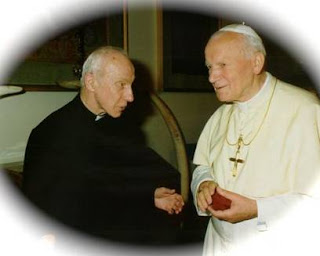
Discalced Carmelite Nuns of Dallas, Texas
Invite you to a Special Memorial Mass
Eleventh Anniversary of His Death
Friday, December 30, 2011
7:00 PM / Rosary at 6:30 PM

Servant of God, Father John Hardon, SJ
Father Hardon was a Spiritual Director
to Bl. Mother Teresa of Calcutta
Monastery of The Infant Jesus of Prague and St. Joseph
600 Flowers Avenue Dallas, TX 75211
Convenient from I-30 & Loop 12
From downtown: I-30 going WEST, exit LOOP 12 SOUTH.
Take the 2nd exit, which is JEFFERSON EAST.
Go through the stop light & about 7-8 blocks.
Make a right on Flowers and enter through Monastery gate
For more information: 214-702-8051
To learn more about his life,
print the prayer for his beatification:
Wednesday, December 28, 2011
News Regarding Bl. Mother Marianne Cope - Saints and Siblings
Someone one Twitter tweeted this fascinating story. Enjoy!
Saints and Siblings
Saints and Siblings
Monsignor Paul J.E. Burkard, the man behind the cause for Father Nelson Baker's canonization, knows exactly where to search for good advice on navigating the Vatican's oftentimes perplexing saint-making process.
He simply picks up the telephone and calls his sister in Syracuse, who already has helped guide the candidacy of Blessed Marianne Cope, a nun who ministered to lepers for more than 30 years, to the brink of canonization.
"We talk about it frequently," Burkard said .
Saturday, December 24, 2011
Merry Christmas!

Picture source
I just wanted to wish you all a very blessed Christmas. May we welcome the Baby Jesus with much joy in our hearts.
With much aloha,
Esther
Friday, December 23, 2011
O! Emmanuel

our King and our Lawgiver,
You are the Desired of the antions
and the Savior of all people.
- Come to save us, O Lord our God!
*New Saint Joseph People's Prayer Book
Thursday, December 22, 2011
Pope's Christmas address to the Roman Curia
The following is from Dr. Robert Moynihan, editor of Inside the Vatican Magazine
"The Holy Feast of Christmas is almost upon us"—Pope Benedict XVI this morning in Rome
December 22, 2011 Message to the Roman Curia
This morning in Rome, Pope Benedict XVI delivered his annual Christmas address to the members of Roman Curia, his closest collaborators. Each year, he takes this occasion to reflect on the chief events of the past year.
The most important line in the address (reprinted below) is this: "The essence of the crisis of the Church in Europe – as I argued in Freiburg – is the crisis of faith." (The Pope spoke in Freiburg during his visit to Germany in September.)
The Pope says this crisis is evident: "Not only faithful believers but also outside observers are noticing with concern that regular churchgoers are growing older all the time and that their number is constantly diminishing; that recruitment of priests is stagnating; that scepticism and unbelief are growing. What, then, are we to do?"
The Pope's central message, his prescription, for Europe and the world, is to return to the faith.
Benedict uses the term "faith fatigue" to refer to the present crisis of the faith. He says: "If faith does not take on new life, deep conviction and real strength from the encounter with Jesus Christ, then all other reforms will remain ineffective."
He then notes that on his trip to Africa in November, and also at World Youth Day in Madrid in August, there was considerable evidence of vibrant faith, of "joyful passion for faith."
Concerning Africa: "None of the faith fatigue that is so prevalent here, none of the oft-encountered sense of having had enough of Christianity, was detectable there. Amid all the problems, sufferings and trials that Africa clearly experiences, one could still sense the people’s joy in being Christian, buoyed up by inner happiness at knowing Christ and belonging to his Church."
Concerning World Youth Day: the young people attending were filled with a genuine love of doing good, a genuine love of Christ, and this gave him great hope, he said.
"They were not looking round for themselves"
"And here something fundamental became clear to me," Benedict continued. "These young people (thousands of youth volunteers in Madrid) had given a part of their lives in faith, not because it was asked of them, not in order to attain Heaven, nor in order to escape the danger of Hell. They did not do it in order to find fulfilment. They were not looking round for themselves.
"There came into my mind the image of Lot’s wife, who by looking round was turned into a pillar of salt. How often the life of Christians is determined by the fact that first and foremost they look out for themselves, they do good, so to speak, for themselves. And how great is the temptation of all people to be concerned primarily for themselves; to look round for themselves and in the process to become inwardly empty, to become 'pillars of salt.'
"Simply becaue it is a wonderful thing to do"
"But here it was not a matter of seeking fulfilment or wanting to live one’s life for oneself," Benedict continued. "These young people did good, even at a cost, even if it demanded sacrifice, simply because it is a wonderful thing to do good, to be there for others. All it needs is the courage to make the leap."
The "leap" is sparked by an encounter with Christ, Benedict said. In essence, he is saying that meeting Christ, learning about Christ, spending time alone in prayer with Christ, sets hearts on fire.
"Prior to all of this (the work the young people committed themselves to carry out) is the encounter with Jesus Christ, inflaming us with love for God and for others, and freeing us from seeking our own ego. In the words of a prayer attributed to Saint Francis Xavier: 'I do good, not that I may come to Heaven thereby and not because otherwise you could cast me into Hell. I do it because of you, my King and my Lord.'"
"Adoration of primarily an act of faith"
The Pope then reflected on two particular moments from the summer: the time of eucharistic adoration and the reception by thousands of the sacrament of confession during the week-long World Youth Day gathering in Spain.
His remarks included a strikingly concise summary of the entire meaning of "theology," that is, the science of God, or the knowledge of God.
God, he said, is in his essential nature a being to be adored, to be worshiped.
"Adoration is primarily an act of faith – the act of faith as such," the Pope said. "God is not just some possible or impossible hypothesis concerning the origin of all things. He is present. And if he is present, then I bow down before him. Then my intellect and will and heart open up towards him and from him."
And Benedict went on, referring to confession, in a reflection on sin, repentance, and forgiveness. Notably, the Pope uses the word "my" when he says "my soul is tarnished" by the pull toward sin present in all men, known as original sin. Benedict is emphasizing his own participation in the human contion, in fallen human nature.
"Openness to love is present in man, implanted in him by the Creator, together with the capacity to respond to God in faith," Benedict said. "But also present, in consequence of man’s sinful history (Church teaching speaks of original sin) is the tendency that is opposed to love – the tendency towards selfishness, towards becoming closed in on oneself, in fact towards evil. Again and again my soul is tarnished by this downward gravitational pull that is present within me. Therefore we need the humility that constantly asks God for forgiveness, that seeks purification and awakens in us the counterforce, the positive force of the Creator, to draw us upwards."
Toward the end of his address, the Pope spoke about the widespread joyfulness that he observed at World Youth Day, and reflected on the deep source of this joy. That source, he told the Curia, was faith: faith in God's existence, faith in God's love for us. And he cites the great German theologian, Joseph Pieper, whose works Benedict has recommended on numerous occasions.
"Certainly, there are many factors at work here," the Pope said. "But in my view, the crucial one is this certainty, based on faith: I am wanted; I have a task; I am accepted, I am loved. Joseph Pieper, in his book on love, has shown that man can only accept himself if he is accepted by another. He needs the other’s presence, saying to him, with more than words: 'It is good that you exist.' Only from the You can the I come into itself. Only if it is accepted, can it accept itself.
"Those who are unloved cannot even love themselves," Benedict continued. "This sense of being accepted comes in the first instance from other human beings."
And then Benedict added a passage which shows his particular depth, something characteristic of his thought: he compared the partial and changeable love of human beings with the total and unchangeable love of God.
"But all human acceptance is fragile," he said. "Ultimately we need a sense of being accepted unconditionally. Only if God accepts me, and I become convinced of this, do I know definitively: it is good that I exist. It is good to be a human being.
"If ever man’s sense of being accepted and loved by God is lost, then there is no longer any answer to the question whether to be a human being is good at all," the Pope said. "Doubt concerning human existence becomes more and more insurmountable. Where doubt over God becomes prevalent, then doubt over humanity follows inevitably.
"We see how widely this doubt is spreading"
"We see today how widely this doubt is spreading," the Pope continued. "We see it in the joylessness, in the inner sadness, that can be read on so many human faces today. Only faith gives me the conviction: it is good that I exist. It is good to be a human being, even in hard times. Faith makes one happy from deep within."
The last line bears repeating: "Faith makes one happy from deep within."
And so, in essence, the Pope's address to the Curia is a call for the renewal of faith, particularly in the West, where it has seemingly grown cold, or "fatigued," so that, through this renewal, human life can be more authentic, more joyful, more filled with love, more filled with meaning, not meaningless, not empty, not sad.
The Pope then quickly ended his talk. His last words were: "I wish all of you the joy that God wanted to bestow upon us through the incarnation of his Son. A blessed Christmas to you all!"
===========================
Full text of the Popes' address today
The Pope’s Address to the Roman Curia
By POPE BENEDICT XVI
Thursday, 22 December 2011
Dear Cardinals, Brother Bishops and Priests, dear Brothers and Sisters,
The occasion that brings us together today is always particularly moving. The holy feast of Christmas is almost upon us and it prompts the great family of the Roman Curia to come together for a gracious exchange of greetings, as we wish one another a joyful and spiritually fruitful celebration of this feast of the God who became flesh and established his dwelling in our midst (cf. Jn 1:14).
For me, this is an occasion not only to offer you my personal good wishes, but also to express my gratitude and that of the Church to each one of you for your generous service; I ask you to convey this to all the co-workers of our extended family.
I offer particular thanks to the Dean of the College, Cardinal Angelo Sodano, who has given voice to the sentiments of all present and of all who work in the various offices of the Curia and the Governorate, including those whose apostolate is carried out in the Pontifical Representations throughout the world. All of us are committed to spreading throughout the world the resounding message that the angels proclaimed that night in Bethlehem, “Glory to God in the highest and on earth peace to people of good will” (Lk 2:14), so as to bring joy and hope to our world.
As this year draws to a close, Europe is undergoing an economic and financial crisis, which is ultimately based on the ethical crisis looming over the Old Continent. Even if such values as solidarity, commitment to one’s neighbour and responsibility towards the poor and suffering are largely uncontroversial, still the motivation is often lacking for individuals and large sectors of society to practise renunciation and make sacrifices. Perception and will do not necessarily go hand in hand. In defending personal interests, the will obscures perception, and perception thus weakened is unable to stiffen the will. In this sense, some quite fundamental questions emerge from this crisis: where is the light that is capable of illuminating our perception not merely with general ideas, but with concrete imperatives? Where is the force that draws the will upwards? These are questions that must be answered by our proclamation of the Gospel, by the new evangelization, so that message may become event, so that proclamation may lead to life.
The key theme of this year, and of the years ahead, is this: how do we proclaim the Gospel today? How can faith as a living force become a reality today? The ecclesial events of the outgoing year were all ultimately related to this theme. There were the journeys to Croatia, to the World Youth Day in Spain, to my home country of Germany, and finally to Africa – Benin – for the consignment of the Post-Synodal document on justice, peace and reconciliation, which should now lead to concrete results in the various local churches. Equally memorable were the journeys to Venice, to San Marino, to the Eucharistic Congress in Ancona, and to Calabria. And finally there was the important day of encounter in Assisi for religions and for people who in whatever way are searching for truth and peace, representing a new step forward in the pilgrimage towards truth and peace. The establishment of the Pontifical Council for the New Evangelization is at the same time a pointer towards next year’s Synod on the same theme. The Year of Faith, commemorating the beginning of the Council fifty years ago, also belongs in this context. Each of these events had its own particular characteristics. In Germany, where the Reformation began, the ecumenical question, with all its trials and hopes, naturally assumed particular importance. Intimately linked to this, at the focal point of the debate, the question that arises repeatedly is this: what is reform of the Church? How does it take place? What are its paths and its goals? Not only faithful believers but also outside observers are noticing with concern that regular churchgoers are growing older all the time and that their number is constantly diminishing; that recruitment of priests is stagnating; that scepticism and unbelief are growing. What, then, are we to do? There are endless debates over what must be done in order to reverse the trend. There is no doubt that a variety of things need to be done. But action alone fails to resolve the matter. The essence of the crisis of the Church in Europe – as I argued in Freiburg – is the crisis of faith. If we find no answer to this, if faith does not take on new life, deep conviction and real strength from the encounter with Jesus Christ, then all other reforms will remain ineffective.
On this point, the encounter with Africa’s joyful passion for faith brought great encouragement. None of the faith fatigue that is so prevalent here, none of the oft-encountered sense of having had enough of Christianity was detectable there. Amid all the problems, sufferings and trials that Africa clearly experiences, one could still sense the people’s joy in being Christian, buoyed up by inner happiness at knowing Christ and belonging to his Church. From this joy comes also the strength to serve Christ in hard-pressed situations of human suffering, the strength to put oneself at his disposal, without looking round for one’s own advantage. Encountering this faith that is so ready to sacrifice and so full of happiness is a powerful remedy against fatigue with Christianity such as we are experiencing in Europe today.
A further remedy against faith fatigue was the wonderful experience of World Youth Day in Madrid. This was new evangelization put into practice. Again and again at World Youth Days, a new, more youthful form of Christianity can be seen, something I would describe under five headings.
Firstly, there is a new experience of catholicity, of the Church’s universality. This is what struck the young people and all the participants quite directly: we come from every continent, but although we have never met one another, we know one another. We speak different languages, we have different ways of life and different cultural backgrounds, yet we are immediately united as one great family. Outward separation and difference is relativized. We are all moved by the one Lord Jesus Christ, in whom true humanity and at the same time the face of God himself is revealed to us. We pray in the same way. The same inner encounter with Jesus Christ has stamped us deep within with the same structure of intellect, will and heart. And finally, our common liturgy speaks to our hearts and unites us in a vast family. In this setting, to say that all humanity are brothers and sisters is not merely an idea: it becomes a real shared experience, generating joy. And so we have also understood quite concretely: despite all trials and times of darkness, it is a wonderful thing to belong to the worldwide Church that the Lord has given to us.
From this derives a new way of living our humanity, our Christianity. For me, one of the most important experiences of those days was the meeting with the World Youth Day volunteers: about 20,000 young people, all of whom devoted weeks or months of their lives to working on the technical, organizational and material preparations for World Youth Day, and who thus made it possible for the whole event to run smoothly. Those who give their time always give a part of their lives. At the end of the day, these young people were visibly and tangibly filled with a great sense of happiness: their time had meaning; in giving of their time and labour, they had found time, they had found life. And here something fundamental became clear to me: these young people had given a part of their lives in faith, not because it was asked of them, not in order to attain Heaven, nor in order to escape the danger of Hell. They did not do it in order to find fulfilment. They were not looking round for themselves. There came into my mind the image of Lot’s wife, who by looking round was turned into a pillar of salt. How often the life of Christians is determined by the fact that first and foremost they look out for themselves, they do good, so to speak, for themselves. And how great is the temptation of all people to be concerned primarily for themselves; to look round for themselves and in the process to become inwardly empty, to become “pillars of salt”. But here it was not a matter of seeking fulfilment or wanting to live one’s life for oneself. These young people did good, even at a cost, even if it demanded sacrifice, simply because it is a wonderful thing to do good, to be there for others. All it needs is the courage to make the leap. Prior to all of this is the encounter with Jesus Christ, inflaming us with love for God and for others, and freeing us from seeking our own ego. In the words of a prayer attributed to Saint Francis Xavier: I do good, not that I may come to Heaven thereby and not because otherwise you could cast me into Hell. I do it because of you, my King and my Lord. I came across this same attitude in Africa too, for example among the Sisters of Mother Teresa, who devote themselves to abandoned, sick, poor and suffering children, without asking anything for themselves, thus becoming inwardly rich and free. This is the genuinely Christian attitude. Equally unforgettable for me was the encounter with handicapped young people in the Saint Joseph Centre in Madrid, where I encountered the same readiness to put oneself at the disposal of others – a readiness that is ultimately derived from encounter with Christ, who gave himself for us.
A third element, that has an increasingly natural and central place in World Youth Days and in the spirituality that arises from them, is adoration. I still look back to that unforgettable moment during my visit to the United Kingdom, when tens of thousands of predominantly young people in Hyde Park responded in eloquent silence to the Lord’s sacramental presence, in adoration. The same thing happened again on a smaller scale in Zagreb and then again in Madrid, after the thunderstorm which almost ruined the whole night vigil through the failure of the microphones. God is indeed ever-present. But again, the physical presence of the risen Christ is something different, something new. The risen Lord enters into our midst. And then we can do no other than say, with Saint Thomas: my Lord and my God! Adoration is primarily an act of faith – the act of faith as such. God is not just some possible or impossible hypothesis concerning the origin of all things. He is present. And if he is present, then I bow down before him. Then my intellect and will and heart open up towards him and from him. In the risen Christ, the incarnate God is present, who suffered for us because he loves us. We enter this certainty of God’s tangible love for us with love in our own hearts. This is adoration, and this then determines my life. Only thus can I celebrate the Eucharist correctly and receive the body of the Lord rightly.
A further important element of the World Youth Days is the sacrament of Confession, which is increasingly coming to be seen as an integral part of the experience. Here we recognize that we need forgiveness over and over again, and that forgiveness brings responsibility. Openness to love is present in man, implanted in him by the Creator, together with the capacity to respond to God in faith. But also present, in consequence of man’s sinful history (Church teaching speaks of original sin) is the tendency that is opposed to love – the tendency towards selfishness, towards becoming closed in on oneself, in fact towards evil. Again and again my soul is tarnished by this downward gravitational pull that is present within me. Therefore we need the humility that constantly asks God for forgiveness, that seeks purification and awakens in us the counterforce, the positive force of the Creator, to draw us upwards.
Finally, I would like to speak of one last feature, not to be overlooked, of the spirituality of World Youth Days, namely joy. Where does it come from? How is it to be explained? Certainly, there are many factors at work here. But in my view, the crucial one is this certainty, based on faith: I am wanted; I have a task; I am accepted, I am loved. Joseph Pieper, in his book on love, has shown that man can only accept himself if he is accepted by another. He needs the other’s presence, saying to him, with more than words: it is good that you exist. Only from the You can the I come into itself. Only if it is accepted, can it accept itself. Those who are unloved cannot even love themselves. This sense of being accepted comes in the first instance from other human beings. But all human acceptance is fragile. Ultimately we need a sense of being accepted unconditionally. Only if God accepts me, and I become convinced of this, do I know definitively: it is good that I exist. It is good to be a human being. If ever man’s sense of being accepted and loved by God is lost, then there is no longer any answer to the question whether to be a human being is good at all. Doubt concerning human existence becomes more and more insurmountable. Where doubt over God becomes prevalent, then doubt over humanity follows inevitably. We see today how widely this doubt is spreading. We see it in the joylessness, in the inner sadness, that can be read on so many human faces today. Only faith gives me the conviction: it is good that I exist. It is good to be a human being, even in hard times. Faith makes one happy from deep within. That is one of the wonderful experiences of World Youth Days.
It would take too long now to go into detail concerning the encounter in Assisi, as the significance of the event would warrant. Let us simply thank God, that as representatives of the world’s religions and as representatives of thinking in search of truth, we were able to meet that day in a climate of friendship and mutual respect, in love for the truth and in shared responsibility for peace. So let us hope that, from this encounter, a new willingness to serve peace, reconciliation and justice has emerged.
As I conclude, I would like to thank all of you from my heart for shouldering the common mission that the Lord has given us as witnesses to his truth, and I wish all of you the joy that God wanted to bestow upon us through the incarnation of his Son. A blessed Christmas to you all!
O! King of the Gentiles

and the longed-for Ruler of the nations, You are the cornerstone who make all one.
-Come and save those whom You have created.
*New Saint Joseph's People's Prayer Book
Subscribe to:
Posts (Atom)