H/T to Sue
The life of a Christian is nothing but a perpetual struggle against self; there is no flowering of the soul to the beauty of its perfection except at the price of pain.
St. Padre Pio (1887-1968)
 Thank you Sue!
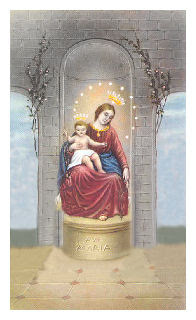
In order to pray well, it is not enough to give expression to our petitions by means of that most excellent of all prayers, the Rosary, but we must also pray with great attention, for God listens more to the voice of the heart than that of the mouth. To be guilty of willful distractions during prayer would show a great lack of respect and reverence; it would make our Rosaries unfruitful and make us guilty of sin.How can we expect God to listen to us if we ourselves
do not pay attention to what we are saying? How can we expect him to be pleased if, while in the presence of his tremendous majesty, we give in to distractions, like a child running after a butterfly?
People who do that forfeit God's blessing, which is changed into a curse for having treated the things of God disrespectfully: "Cursed be the one who does God's work negligently." Jer. 48:10.
Of course, you cannot say your Rosary without having a few involuntary distractions; it is even difficult to say a Hail Mary without your imagination troubling you a little, for it is never still; but you can say it without voluntary distractions, and you must take all sorts of precautions to lessen involuntary distractions and to control your imagination. To do this, put yourself in the
presence of God and imagine that God and his Blessed Mother are watching you, and that your guardian angel is at your right hand, taking your Hail Mary's, if they are well said, and using them like roses to make crowns for Jesus and Mary.
But remember that at your left hand is the devil, ready to pounce on every Hail Mary that comes his way and to write it down in his book of death, if they are not said with attention, devotion, and reverence.
Above all, do not fail to offer up each decade in honour of one of the mysteries, and try to form a picture in your mind of Jesus and Mary in connection with that mystery.
~ St. Louis De Montfort
 Picture courtesy of Natural Moment
To watch the Silent Night Movie, please click HERE
 Masterpieces Synthesize Gospel and Culture
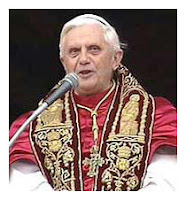
VATICAN CITY, DEC. 19, 2006 (Zenit.org).- The Vatican Museums provide an "extraordinary opportunity for evangelization," Benedict XVI said on the occasion of the institution's 500th anniversary.
The Pope said this Saturday during an audience with the participants of an international congress which closed a year of events commemorating the long history of the Vatican Museums.
The Holy Father described them as "the greatest museum institutions in the entire world."
Benedict XVI congratulated those participating in the symposium to reflect on the identity and role of the museums today, and their prospects for the future.
The congress identified "elements that make it possible to better delineate the function, which we could describe as 'educational,' of museums in the context of the present globalized society," said the Pontiff.
The Pope said that "the Church has always supported and promoted the world of art, considering its language as a privileged vehicle of human and spiritual progress."
The Vatican Museums have the following inscription placed on the main door: "Ad augendum Urbis splendorem et asserendam religionis veritatem" (To promote the splendor of the city of Rome and affirm the truth of the Christian religion).
Benedict XVI continued: "The development in time of the Vatican Museums shows that these ends have always been clearly present in the Popes' intentions."
Connections
The Vatican Museums "can represent an extraordinary opportunity of evangelization because, through the different works exhibited, they offer visitors an eloquent testimony of the continuous intertwining that exists between the divine and human in life and in the history of nations," added the Pope.
The Holy Father said: "The enormous number of people that visit them every day shows the growing interest in these masterpieces of art and these historical testimonies, which are a marvelous synthesis of the Gospel and culture."
The Pontiff said that the museums are no longer "reserved for artists, specialists and men of culture alone, in our days it is increasingly everyone's home, thus responding to a widespread formative need of society."
Benedict XVI added that the institutions belong as well to the youth, "which can recognize in the museums the roots of their history and culture."
The Pope said that "every opportunity to foster integration and encounter between individuals and nations is, undoubtedly, something that should be stimulated."
"In such perspective, also museums -- though keeping in mind the changed social conditions -- can become places of artistic mediation, links of relationship between the past, the present and the future, crossroads of men and women of several continents, in addition to sources of research and forges of cultural and spiritual enrichment," the Holy Father said.
The Pontiff said: "The museums will be able to spread the culture of peace if, while retaining their nature of temples of the historical memory, they are also places of dialogue and friendship among all."
ZE06121903
If you are interested in visiting the Vatican Museum virtually, please CLICK HERE
 Mahalo Sue
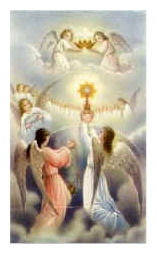
"I reminded the entire Church of the central and irreplaceable nature of the Eucharist in Christian life, in order be faithful to the vocation to sanctity.
Make the Blessed Sacrament the pinnacle of spiritual life and an inspiration for every missionary and apostolic project. In effect, in the Blessed Sacrament we encounter Christ, and therefore, it is a privileged point of encounter for souls in love with Him."
"Live the just-begun Year of the Eucharist as an intense time of encounters with Christ," "discover in this incomparable treasure that Jesus left us the joy and goodness of the loving presence of the Savior"
Pope John Paul II, November 9, 2004
Mahalo Sue
Fight all error, but do it with good humor, patience, kindness, and love.
Harshness will damage your own soul and spoil the best cause.
St. John of Kanty (1390-1474)

Be nice. Do not be mean. Be respectful. Be sweeter than honey, but do not water down the truth. Sound doctrine, with sweet honey.
Custos Fidei has the list so make sure to check it out their blog.
 Santa in Hawaii picture courtesy of Color Matters
An old Christmas favorite has been posted on Domestic Vocations' Blog
Yes, Virginia, There is a Santa Claus
By Francis P. Church, first published in The New York Sun in 1897. [See The People’s Almanac, pp. 1358–9.]
We take pleasure in answering thus prominently the communication below, expressing at the same time our great gratification that its faithful author is numbered among the friends of The Sun:
Dear Editor—
I am 8 years old. Some of my little friends say there is no
Santa Claus. Papa says, “If you see it in The Sun, it’s so.” Please tell me the
truth, is there a Santa Claus?
Virginia O’Hanlon
CLICK HERE for the Editor's response.
 H/T to Di
Even thought the following story may not be true, it is still a beautiful way of viewing the candy cane. And, in the spirit of Christmas I would like to share it:Many years ago, a candy maker in Indiana had an idea to show through the candy he made, that Jesus Christ was born among us, lived and died to save us all.
So he created the candy cane. He began with a stick of pure white, hard candy. White to symbolize the Virgin Birth and the sinless nature of Jesus; hard to symbolize the Solid Rock, the foundation of the Church, and the firmness of the promises of God. The candy maker made the candy in the form of a "J" to represent the precious name of Jesus, who came to earth as our Savior. It could also represent the shepherd's staff, reminding us that Jesus is the Good Shepherd.
Thinking that the candy was somewhat plain, the candy maker stained it with red stripes of the scourging Jesus received by which we are healed. The large red stripe was for the blood shed by Christ on the cross so that we could have the promise of eternal life.