 Thanks Sue!
Each martyr has offered the same simple—and profound—lessons:
Be not afraid. You are not alone.
Your faith is your greatest treasure.
Embrace it, celebrate it, live it openly.
Trust in God.
St. Andrew Dung-Lac (1785-1839)
Martyr
 Thanks Sue!
O Jesus, living in Mary,
Come and live in Thy servants,
In the spirit of Thy holiness,
In the fullness of Thy might,
In the truth of Thy virtues,
In the perfection of Thy ways,
In the communion of Thy mysteries.
Subdue every hostile power
In Thy spirit, for the glory of the Father. Amen.
St. Louis de Montfort
 Thanks Sue!
We are all but God’s instruments who do our little bit and pass by.
I believe that the way in which an act of kindness is done is as important as the action itself.
Blessed Mother Teresa of Calcutta (1910-1997)
Church Fears a Legal Trend Is Undermining Marriage
By Father John Flynn
ROME, DEC. 18, 2006 (Zenit.org).- A fierce debate is under way in Italy over whether to give legal recognition and rights to cohabiting couples. Shortly after last April's general election some members of the new center-left government briefly broached the issue. The matter sprung back to life recently when the government announced that early in 2007 there would be a new law for de facto couples.
The exact form of the law is still unclear, but according to speculation in the media it would give legal status to both heterosexual and homosexual de facto couples. Debate over what rights should be given the couples is dividing the multi-party coalitions of both government and opposition.
Church criticism of the proposals came swiftly, albeit indirectly, in the form of articles in the Vatican newspaper, L'Osservatore Romano. The opening shot came after the municipal council of Padua passed a motion approving recognition of rights for cohabiting couples.
The Dec. 7 edition of L'Osservatore Romano condemned the move, arguing that it set a dangerous precedent of recognizing family forms not based on marriage between a man and a woman. The national government's project for de facto couples came to light immediately afterward. The Dec. 8-9 edition of the Vatican newspaper described as a "lie" the argument that giving rights to cohabiting couples does not damage the institution of the family.
Varying forms of laws giving rights for de facto couples have come into force in Europe in the recent past. A review of the situation was set out in a book published in Italy, "I PACS Della Discordia: Spunti per un dibattito" (The PACS of Discord: Ideas for a Debate), by journalist Umberto Folena. PACS is the French acronym for "civil solidarity pacts."
Denmark was the first off the rank, in 1989, when it gave formal recognition to homosexual unions. Norway followed suit, in 1993; Sweden, the following year. In 1996, Iceland also gave same-sex couples the possibility of forming a partnership.
In 1999, France approved a law allowing two people, regardless of their sex, to enter into a legal union that gives them a series of rights related to fiscal and welfare entitlements. In Germany a 2000 law gave homosexuals many of the same legal rights as married couples. A further law, passed in 2004, opened up the possibility for adoption by non-married couples.
Other European countries that give recognition to non-married couples include Portugal, Finland, the United Kingdom and Luxembourg. The step of giving full marriage rights to homosexuals, including the right to adoption, was taken by the Netherlands in 2001. Spain followed, in June 2005. Outside of Europe, Canada opened up marriage for homosexual couples, in July 2005.
Meanwhile, in the United States, Thursday's vote by the New Jersey Legislature means that it will become the third state, after Vermont and Connecticut, to recognize civil unions for same-sex couples. The law, expected to be signed shortly by Governor Jon Corzine, was imposed on the Legislature by a recent decision of the New Jersey Supreme Court.
"Un-Christian"
Arguments over the issue of rights for cohabiting couples are raging in the Italian media. Some opinion articles in newspapers have even maintained it would be "un-Christian" to deny legal protection to de facto couples.
A useful guide to the debate is the book "PACS, matrimonio e coppie omosessuali" (PACS, Marriage and Homosexual Couples), by Michele Aramini. The author, who teaches theology at Milan's Catholic University, concentrated on the issue of rights for same-sex couples. He started by explaining the need to separate the issue of the family from that of protecting homosexuals from unfair discrimination.
Homosexuals should be protected from unfair treatment, Aramini declared, but this does not mean that their relationships should be put on the same level as the traditional form of marriage and the family.
When it comes to defining the family, he continued, an essential element is that of procreation. As this is only possible when the couple is formed by members of the opposite sex, it is impossible to talk of homosexual "families."
At an even more fundamental level, what is at stake is the concept of the human person and whether there exists a single, objective way to live in the area of sexuality and the family. Those who argue in favor of rights for homosexual couples, or other variations of cohabitation, maintain that this is just simply recognizing a legitimate difference in lifestyles.
The reply to this argument, Aramini explains, is to recognize that the family based on marriage is not something that depends on a set of cultural or historical circumstances that are capable of change. It is, rather, based on needs inherent in our very human nature. Demanding rights for cohabiting couples is, therefore, nothing more than an expression of the current tendency toward extreme individualism. This individualism demands that the law accommodate itself to whatever may be requested by the individual, regardless of the consequences for others or for society.
The traditional family, based on marriage between a man and a woman, brings with it many benefits for society and the common good, Aramini points out. The family is, in fact, a basic foundation stone for society. As such, it is perfectly legitimate that it be given a privileged legal status.
The Pontifical Council for the Family made a similar argument in its statement: "Family, Marriage and ‘De Facto' Unions," published in 2000. "The family based on marriage," it said, "is a fundamental and precious good for the whole society whose most solid fabric is built on the values that are developed in family relations and guaranteed by stable marriage" (No. 2).
Substantial difference
The document goes on to explain why marriage and the different forms of cohabitation cannot be put on the same level. The family is based on the marriage covenant between the spouses and is the nucleus for the procreation and education of the next generation. As an institution it is prior, in fact, to the state.
It is not reasonable to expect, the Pontifical Council for the Family argues, that the vital functions carried out by the family, based on a stable marriage, can be carried out in a large-scale, stable and permanent way by cohabitation.
Pressure for legal recognition of de facto unions is often made on the grounds of the need to avoid discrimination. Ceding to this petition would, however, result in "a real discrimination against the family based on marriage because it would be considered on a level similar to any other form of cohabitation, regardless of whether there is a commitment to reciprocal fidelity and the begetting and upbringing of children or not" (No. 10).
In this sense the document asks that a distinction be made between public interest and private interest. The state should protect what is in the public interest, in this case the family based on marriage. When it comes to the private interest, all the state is called upon to do is to guarantee freedom.
"Marriage and the family are of public interest," the Vatican document states; "they are the fundamental nucleus of society and the state and should be recognized and protected as such" (No. 11). A decision by two persons to live together, by contrast, is a private choice. "De facto unions are the result of private behavior and should remain on the private level," the Vatican body argued.
Such thinking is not an imposition of Christian belief on a pluralistic society, the document explains. Of course, Christians have a vision of marriage and the family that is illuminated by their faith and Church teaching, but marriage is also a natural reality. "It is not a question primarily of Christian faith but of rationality" (No. 13). A rationality that is, nevertheless, becoming increasingly obscured in many countries.
ZE06121820
Just to be clear on what the church teaches, I direct your attention to the CCC 846-848. The following is from the Compendium of the CCC:171. What is the meaning of the affirmation “Outside the Church there is no salvation”?
846-848
This means that all salvation comes from Christ, the Head, through the Church which is his body. Hence they cannot be saved who, knowing the Church as founded by Christ and necessary for salvation, would refuse to enter her or remain in her. At the same time, thanks to Christ and to his Church, those who through no fault of their own do not know the Gospel of Christ and his Church but sincerely seek God and, moved by grace, try to do his will as it is known through the dictates of conscience can attain eternal salvation.
Note: I have removed what I orginally wrote so as to not inadvertently mislead others regarding salvation. The above quote from the CCC speaks for itself.
Recently, someone in one of my Catholic groups, posted an article he wrote regarding points of view that are circulated and attributed to St. Padre Pio, one being salvation outside the Church. And, I'd like to share it with you:
Padre Pio on Salvation Outside the Church
by Frank M. Rega, S.F.O.
As published in Christian Order, December 2006 issue.
This article may be reproduced in print or electronic form, as long as its original publication in Christian Order is cited.
--------------------------------------------------------------------------------
It is quite unfortunate that alleged quotations or viewpoints attributed to Padre Pio have frequently been used to justify the stances, rumors, or agendas of various individuals or groups. Often it is difficult to find reliable documentation to verify his involvement in such scenarios as the "three days of darkness,"1 his alleged opposition to Archbishop Marcel Lefebvre, 2 or his purported support of Garabandal.3 Another area of speculation focuses on what he would think of the current state of the Church – where would this Tridentine rite Catholic, known for his lifelong obedience and loyalty to the hierarchy, place his support along the Novus Ordo – Traditionalist – reactionary spectrum?
It is not surprising, then, to find some who contend that St. Padre Pio held their own strict interpretation of extra ecclesiam nulla salus – outside of the Roman Catholic Church no one can be saved. The most notable proponents of this presumed stance of Padre Pio are to be found among the Sedevacantists (the See of Peter is vacant, since it has been occupied by invalidly elected and/or heretical popes since Vatican II). In particular, "Brother" Michael Dimond, a Sedevacantist from the non-canonical Most Holy Family Monastery in Fillmore, New York, has recently written and published an 86-page illustrated booklet on the life of Padre Pio. Regrettably, he promotes this booklet as containing evidence that Padre Pio would support the central tenet of the Most Holy Family Monastery, that absolutely no one can be saved outside of the Catholic Church. Along with adherence to the true Faith, and being in a state of grace at the moment of death, Dimond and his followers insist that a strict requirement for entering the kingdom of heaven is water baptism, and water baptism alone. "Baptism of Desire" and "Baptism of Blood" are rejected as not being true Catholic dogmas. Neither can those invincibly ignorant of the Faith be saved.4
Please click title above to read the complete article.
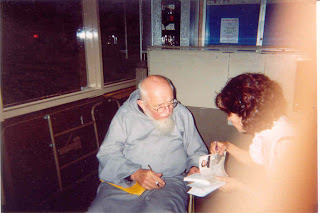 My friend Leticia over at Cause of Our Joy posted about marching with Fr. Benedict Groeschel. That reminded me that I had a photo taken of Fr. G and yours truly a few of years ago. Thought I would share it. Try to ignore my mom's finger.This is taken a few months prior to his serious accident when Father was struck by a car.
 For unto us a child is bornLuke 2
In those days a decree went out from Caesar Augustus 2 that the whole world should be enrolled. This was the first enrollment, when Quirinius was governor of Syria. So all went to be enrolled, each to his own town.
And Joseph too went up from Galilee from the town of Nazareth to Judea, to the city of David that is called Bethlehem, because he was of the house and family of David, to be enrolled with Mary, his betrothed, who was with child.
While they were there, the time came for her to have her child, and she gave birth to her firstborn son. She wrapped him in swaddling clothes and laid him in a manger, because there was no room for them in the inn.
Now there were shepherds in that region living in the fields and keeping the night watch over their flock.
The angel of the Lord appeared to them and the glory of the Lord shone around them, and they were struck with great fear.
The angel said to them, "Do not be afraid; for behold, I proclaim to you good news of great joy that will be for all the people.
For today in the city of David a savior has been born for you who is Messiah and Lord. And this will be a sign for you: you will find an infant wrapped in swaddling clothes and lying in a manger."
And suddenly there was a multitude of the heavenly host with the angel, praising God and saying: "Glory to God in the highest and on earth peace to those on whom his favor rests."
When the angels went away from them to heaven, the shepherds said to one another, "Let us go, then, to Bethlehem to see this thing that has taken place, which the Lord has made known to us."
So they went in haste and found Mary and Joseph, and the infant lying in the manger. When they saw this, they made known the message that had been told them about this child. All who heard it were amazed by what had been told them by the shepherds.
And Mary kept all these things, reflecting on them in her heart.
Then the shepherds returned, glorifying and praising God for all they had heard and seen, just as it had been told to them.
 Thanks Sue!
Celebrate the feast of Christmas every day, even every moment in the interior temple of your spirit, remaining like a baby in the bosom of the heavenly Father, where you will be reborn each moment in the Divine Word, Jesus Christ.
St. Paul of the Cross
 Mahalo Sue
Bethlehem became the link between heaven and earth;
God and man met there and looked each other in the face.
Archbishop Fulton J. Sheen
 His name will be called “Wonderful, Counselor, Mighty God, Everlasting Father, Prince of Peace” ...
Isaiah 9:6-7




 My friend Leticia over at Cause of Our Joy posted about marching with Fr. Benedict Groeschel. That reminded me that I had a photo taken of Fr. G and yours truly a few of years ago. Thought I would share it. Try to ignore my mom's finger.


 His name will be called “Wonderful, Counselor, Mighty God, Everlasting Father, Prince of Peace” ...
