Thursday, November 16, 2006

Biblical Curses to Order

H/T to Dean who finds the most interesting things to post. Mahalo Dean!

Has someone made you so frustrated or upset and you want to come up with a great come back or curse, well try the
Ship of Fools Bible Curse Generator

May you go on a diet of crunchy, unsweetened locusts, thou lazy Babylonian!
Monday, November 13, 2006

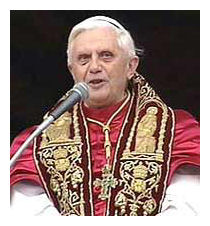
Holy Father Quote

B16 Mahalo Sue!

The Church must steadily and firmly heed that although the language of the people may change, the language of liturgy should not be altered. Thus, the Mass must be said in the language in which it was said from the beginning, even if such a language be already, antiquated and strange to the people, for it is wholly enough, if the learned men understand it. ~ Pope Benedict X IV

Saintly Quote

Mahalo Sue!

Make a little cell in your heart for Jesus of the Agony;
take refuge there,
when you hear Him outraged by men,
try to make reparation;
you, at least, love Him and keep your heart quite pure for Him.
Oh! If you only knew how the good God loves pure hearts!
It is there that He loves to reign.

Saint Elizabeth of the Trinity (1880-1906)

Sunday, November 12, 2006

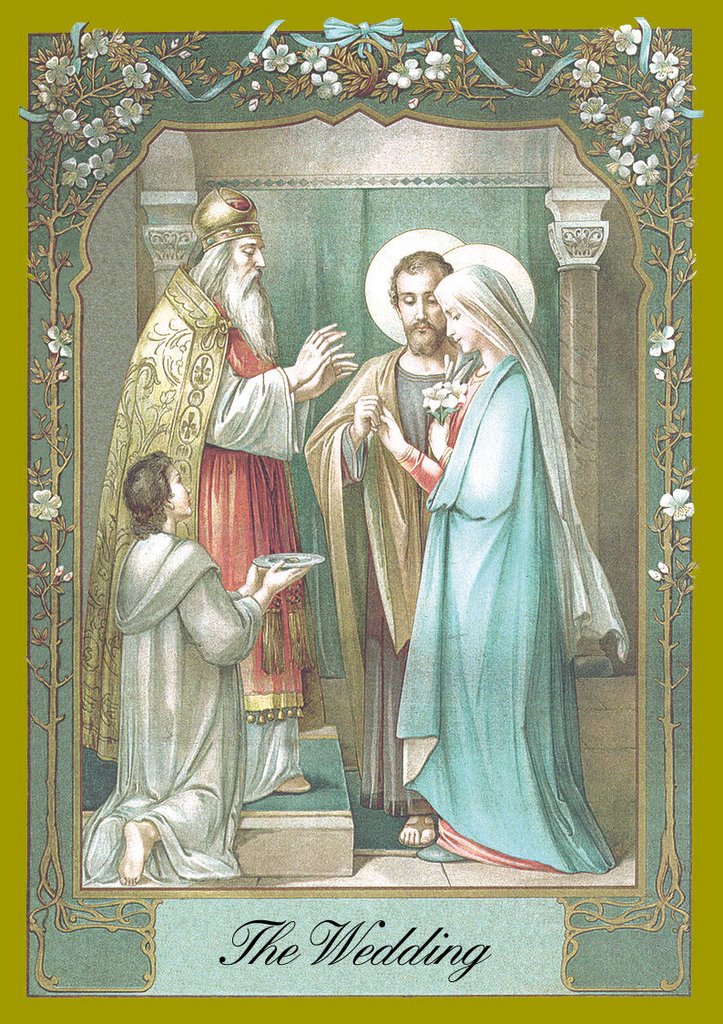
Father Cantalamessa on Marriage in Heaven

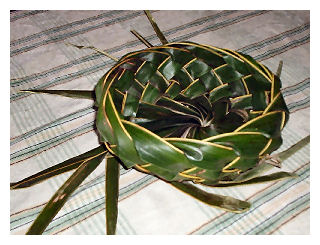
Picture used with permission by Chant Art
Pontifical Household Preacher on Sunday's Gospel

ROME, NOV. 10, 2006 (Zenit.org).- Here is a translation of a commentary by the Pontifical Household preacher, Capuchin Father Raniero Cantalamessa, on the readings from this Sunday's liturgy.

There came a poor widow
32nd Sunday in Ordinary Time (b)
1 Kings 7:10-16; Hebrews 9:24-28; Mark 12:38-44

One day, Jesus was standing before the temple treasury, watching people deposit their offerings. He saw a poor widow come and put in all she had, two copper coins, which make a penny. He turned to his disciples and said, "Truly I say to you, this poor widow has put in more than the others. All have given from their excess, but she, in her poverty, put in all she had, all she had to live on."

We might call this Sunday the "Sunday of the widows." The story of a widow was also told in the first reading, the widow of Zarephath who gave up all she had left to eat (a handful of flour and a drop of oil) to prepare a meal for the prophet Elijah.

This is a good occasion in which to turn our attention toward both the widows and the widowers of today. If the Bible speaks so often of widows and never of widowers it is because in ancient society the woman who was left alone was at a greater disadvantage than the man who was left alone. Today there is no longer this difference. Actually, in general it now seems that women who are alone manage much better than men.

On this occasion I would like to treat a theme that is of definite interest not only to widows and widowers but also to all those who are married, especially during this month in which we remember the dead. Does the death of a husband or wife, which brings about the legal end of a marriage, also bring with it the total end of communion between the two persons? Does something of that bond which so strongly united two persons on earth remain in heaven, or will all be forgotten once we have crossed the threshold into eternal life?

One day, some Sadducees presented Jesus with the unlikely case of a woman who was successively the wife of seven brothers, asking him whose wife she would be after the resurrection. Jesus answered: "When they rise from the dead they will neither marry nor be given in marriage but will be like angels in heaven" (Mark 12:25).

Interpreting this saying of Jesus wrongly, some have claimed that marriage will have no follow-up in heaven. But with his reply Jesus is rejecting the caricature the Sadducees presented of heaven, as if it were going to be a simple continuation of the earthly relationship of the spouses. Jesus does not exclude the possibility that they might rediscover in God the bond that united them on earth.

According to this vision, marriage does not come to a complete end at death but is transfigured, spiritualized, freed from the limits that mark life on earth, as also the ties between parents and children or between friends will not be forgotten. In a preface for the dead the liturgy proclaims: "Life is transformed, not taken away." Even marriage, which is part of life, will be transfigured, not nullified.

But what about those who have had a negative experience of earthly marriage, an experience of misunderstanding and suffering? Should not this idea that the marital bond will not break at death be for them, rather than a consolation, a reason for fear? No, for in the passage from time to eternity the good remains and evil falls away. The love that united them, perhaps for only a brief time, remains; defects, misunderstandings, suffering that they inflicted on each other, will fall away.

Indeed, this very suffering, accepted with faith, will be transformed into glory. Many spouses will experience true love for each other only when they will be reunited "in God," and with this love there will be the joy and fullness of the union that they did not know on earth. In God all will be understood, all will be excused, all will be forgiven.

Some will ask of course about those who have been legitimately married to different people, widowers and widows who have remarried. (This was the case presented to Jesus of the seven brothers who successively had the same woman as their wife.) Even for them we must repeat the same thing: That which was truly love and self-surrender between each of the husbands or wives, being objectively a good coming from God, will not be dissolved. In heaven there will not be rivalry in love or jealousy. These things do not belong to true love but to the intrinsic limits of the creature.

ZE06111001

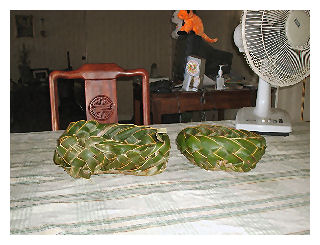
Tradition and the Art of Native Hawaiian Basket Weaving

hb3
hb2
hb1 If you look in the Catholic Dictionary, you will find a very long definition for the word tradition.
"It means properly the act of handing down, and thus the doctrine so handed
down. In its widest sense it includes all truths or supposed truths handed
down from one generation to another; and in all societies which have no
literature tradition is, with all its manifold imperfections, the great bond
between the present and the past, and one of the great distinguishing marks
between man and the brutes, which latter have no tradition, and therefore no
history...

What does the above definition have to do with Hawaiian basket weaving?

We have a neighbor who graciously offered to teach a couple of us moms and our sons how to weave baskets out of palm fronds.

So a total of six of us met yesterday afternoon, equipped with knives, cutting shears, palm fronds and Charlie our kapuna.

We were first taught which palm fronds to collect or pick. Charlie told us which were the ones that were good for basket weaving without hurting the tree.

In the Hawaiian culture, you respect nature.

I should tell you that Charlie is not a native Hawaiian. However, he grew up on the big island with native Hawaiians. There he and the other keiki learned this skill.

Then we prepared the palm fronds. The palm fronds we used yesterday came from ones that were trimmed from local palm trees by professional tree trimmers. These fronds had to cure a few days in order to be pliable enough to work on. We trimmed the fronds for use and then Charlie told us that he would teach us with the understanding, that once we learned this skill, we in turn would teach others.

So first he taught my friend while the rest of us prepared our fronds for weaving. He then taught me. It was interesting to note that the way we weave these palm fronds is go towards the natural flow of the palm itself.

Charlie then told us he would not be teaching the boys....actually, three young men...instead, we as their mothers, would teach our sons this skill. In that way, the tradition is passed on from one family member to another. He also expects our sons, in turn to teach their children.

So you see, the connection between tradition and basket weaving.

This got me to thinking about the Catholic Church. The church is based on Jesus' teachings in Scripture but tradition also plays an important part in what the Church is. So when the Church is criticized for what some say is relying too much on tradition, that isn't necessarily a bad thing. If you think about it, tradition is a very important concept in all cultures, and the Church's tradition, came from Jesus and the men who knew Jesus very intimately.
Tuesday, November 07, 2006

An Election Prayer to Mary


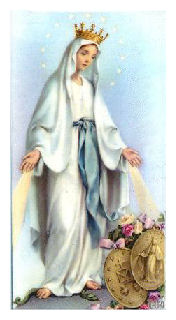
Picture courtesy of Art Gallery

Mahalo to my friend Easter for sharing this.

O Most Blessed Virgin Mary, Mother of Mercy, at this most critical time, we entrust the United States of America to your loving care.
Most Holy Mother, we beg you to reclaim this land for the glory of your Son.

Overwhelmed with the burden of the sins of our nation, we cry to you from the depths of our hearts and seek refuge in your motherly protection.


Look down with mercy upon us and touch the hearts of our people.

Open our minds to the great worth of human life and to the responsibilities that accompany human freedom.


Free us from the falsehoods that lead to the evil of abortion and threaten the sanctity of family life.

Grant our country the wisdom to proclaim that God’s law is the foundation on which this nation was founded, and that He alone is the True Source of our cherished rights to life, liberty and the pursuit of happiness.


O Merciful Mother, give us the courage to reject the culture of death and the strength to build a new Culture of Life.

-EWTN, An Election Prayer to Mary

Monday, November 06, 2006

Eucharistic Quote


Picture courtesy of Mystical Rose

Mahalo to Sue

Without the spiritual nourishment that comes from the Body and Blood of Christ, human love always remains contaminated by egoism. However, communion with the Bread of heaven converts hearts and infuses in them the capacity to love as Jesus has loved us.

Pope John Paul the Great
Solemnity of Corpus Domini - the most Holy Body and Blood of Christ, June 17, 2001)

Sunday, November 05, 2006

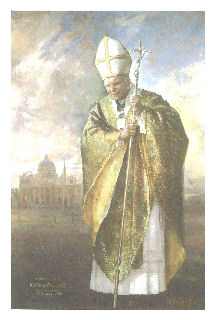
Pope John Paul the Great Quote


H/T to Sue

Picture courtesy of New York Catholic War Vets

The Saints and Blesseds of heaven remind us,
pilgrims on earth,
that the support we have every day
in order to never lose sight of our eternal destination
is above all prayer.

Pope John Paul II the Great (November 1, 2003)

Prayer For the Most Forgotten Soul

H/T to Sue

O Lord God Almighty,
I beseech Thee by the Precious
Body and Blood of Thy Divine Son Jesus,
which He Himself on the night before His Passion
gave as meat and drink to His beloved Apostles
and bequeathed to His Holy Church
to be the perpetual Sacrifice
and life-giving nourishment of His faithful people,
deliver the souls in purgatory,
but most of all,
that soul which was most devoted
to this Mystery of infinite love,
in order that it may praise Thee therefor,
together with Thy Divine Son
and the Holy Spirit in Thy glory for ever.

Amen.

Can We Avoid Purgatory?

H/T to Sue

By Susan Tassone

The answer is YES! We are given the grace to avoid purgatory. We must strive to attain Heaven because God desires it.

To avoid purgatory is to honor and magnify the redemption of Christ. Where sin abounds, grace super-abounds. Let us show God our gratitude. We have great opportunities for paying our debt.

The month of November is upon us. We are entering the marvelous season devoted to the dead. The Feast of All Souls is celebrated on November 2. There is not one saint who has more than one given Feast Day. However, the whole month of November is given over to the remembrance of the deceased. Make this November the best one in your life!

So how do we avoid purgatory? Avoid sin at all costs: mortal sin and deliberate venial sins. A little girl was asked about sin. She said, "Mortal sin makes God angry, venial sin makes him nervous!" Break off all bad habits. Monthly confession. Daily Mass and Holy Communion. Daily Rosary. Pray, pray, pray. We must return to the Upper Room and rediscover the power of prayer that Our Lady begs of us in all her apparitions. We are all invited to say "Yes, thy will be done," and become her burning bushes of prayer.

Visits to the Blessed Sacrament: Love and adore our precious Jesus who is waiting for you to give you many special graces. His heart breaks from the sins of our poor world. Go and comfort, adore and kneel before the Lord our God in reparation for the sins of the world, the dying, the souls in purgatory. Read Scripture. As the Little Flower says, "Do many little things." Perform random acts of kindness. Be always in a state of acceptance of trials and death. Forgive. Avoid judging others.

Parents and grandparents: form kind and merciful hearts in your children. You will have planted the seed of reverence and in due time this will manifest itself and will assure you of their suffrages.

Value indulgences. An indulgence is granted the Christian faithful who devoutly visit a cemetery and pray, if only mentally, for the dead. This indulgence is applicable to the souls in purgatory, a plenary one from November 1 through November 8, one that can be gained on each of these days. (On the other days of the year this indulgence is a partial one.)

The surest means of avoiding purgatory is to aid the suffering souls in purgatory! Let us ask three graces of Jesus: To avoid purgatory, to learn from purgatory, and to empty Purgatory.

Listen here especially well, for there are among these silent voices those that you know. They are the voices of family and friends, of those who helped you in your life. And what they say is, "Have you forgotten us? You promised never to forget us! Give us your feet by going to hear Mass for us. Give us your eyes by watching to perform a good deed for us. Give us your hands by giving alms or an offering for a holy Mass. Give us your tongue by encouraging others to be charitable to us. Give us your body by offering up for us to God all its labors, fatigues and penances."

"Become our deliverers and we will become your powerful intercessors forever."